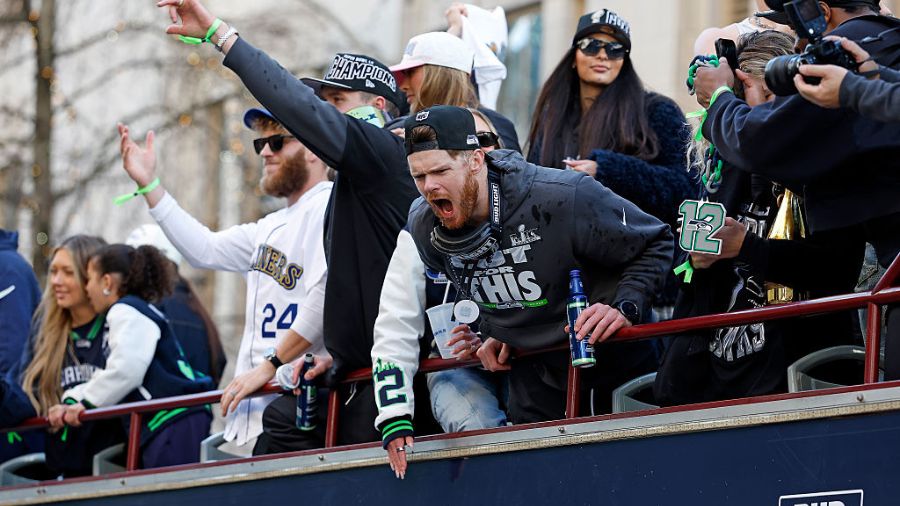
The City of Seattle generated more than $16 million during the Seahawks’ Super Bowl parade held last February.
According to the Downtown Seattle Association’s (DSA) March Revitalization Dashboard, between 700,000 and 1 million people attended the parade on February 11, generating $16.6 million.
“The power of people coming together in the heart of the city is impressive, and it should be a taste of what’s to come when we welcome people from all over the world in a couple of months,” Chris Copacino, DSA’s vice president of communications and marketing, told The Puget Sound Business Journal.
Players, coaches take stage for trophy ceremony
The trophy ceremony began at 10 a.m. Feb. 11 at Lumen Field, where players and coaches took the stage to cheers from the crowd, still buzzing from Seattle’s 29-13 win over the New England Patriots. Quarterback Sam Darnold and linebacker Ernest Jones IV were among those addressing fans, thanking the city for its support and calling the championship a shared accomplishment.
Former players took on active roles in the ceremony and later jumped on one of the more than a dozen vehicles for the ride.
“It’s pretty cool,” former quarterback Matt Hasselbeck said, who led the Seahawks to a Super Bowl in 2005. “I wish we could have done it three times, but it’s still pretty cool.”
Former defensive end Cliff Avril was part of the last Super Bowl-winning team against the Denver Broncos.
“I’m excited for the guys,” Avril said. “I love to see great players do great things, and if you’re doing it for the city of Seattle, I’m happy and I’m excited and we’re world champs.”
Finally, clutching the trophy, Coach Mike MacDonald said to a cluster of reporters outside the military Humvee he would ride in, “It’s in the right city … to understand what it takes to get to this point, the whole city, all of our community, all of our fans, our whole organization, Jody, all of our players, faith, the hard work, the courage, the toughness … I mean, all of it coming together for one purpose is the power of what you can do when you do it together.”
Parade transforms downtown into sea of blue and green
By 11 a.m., the celebration spilled into the streets. The parade traveled north along Fourth Avenue from Lumen Field toward Cedar Street near the Space Needle, transforming downtown into a two-mile corridor of cheering fans.
12’s stood 10, 20, and sometimes 30 people deep while others climbed lampposts, trashcans, street signs, or a pair of shoulders to get a glimpse of the shiny, silver championship hardware and, of course, their favorite players.
For many fans, the parade was more than a victory lap. Families dressed toddlers in miniature jerseys. Longtime season ticket holders wiped away tears. Students debated skipping school to witness what some called a once-in-a-lifetime moment, especially after the Seahawks evened their Super Bowl score with the Patriots.
As the line of military troop carriers, SUVs, and double-decker buses cleared the route and streets gradually reopened, fans lingered downtown, continuing the celebration in nearby bars, restaurants, and public plazas. The Lombardi Trophy may have been the centerpiece, but Tuesday’s parade underscored something broader: a city united.
Long after the confetti settled, the chant, “SEA… HAWKS!” still carried through downtown Seattle. It was a reminder that, for at least one morning, the Seahawks and their fans shared the same stage.
Seahawks Super Bowl Parade leaves behind 10,000 pounds of trash in downtown Seattle
As roughly one million Seahawks fans gathered along 4th Avenue to celebrate a Super Bowl win, the party left downtown Seattle quite messy, with thousands of pounds of garbage being left behind.
Seattle Public Utilities (SPU) nd the Washington State Department of Transportation (WSDOT) estimated that more than 10,000 pounds of trash and five large pieces of furniture were collected after the parade, according to KIRO 7.
But even with hundreds of thousands of fans celebrating downtown, the parade remained crime-free aside from the littering, with no arrests being made during the event.
The cleanup efforts along 4th Avenue were much more hands-on than the standard garbage cleanup, though the trash collected after the parade paled in comparison to the daily amount of garbage thrown out across Seattle.
Each Seattle resident generates approximately 2.68 pounds of garbage per day, according to the city’s trash collection metrics. While Seattle’s population currently exceeds 800,000, the city could process more than two million pounds of trash per day.
Contributing: Luke Duecy, KIRO Newsradio; Jason Sutich, MyNorthwest
Follow @http://twitter.com/Mynorthwest