
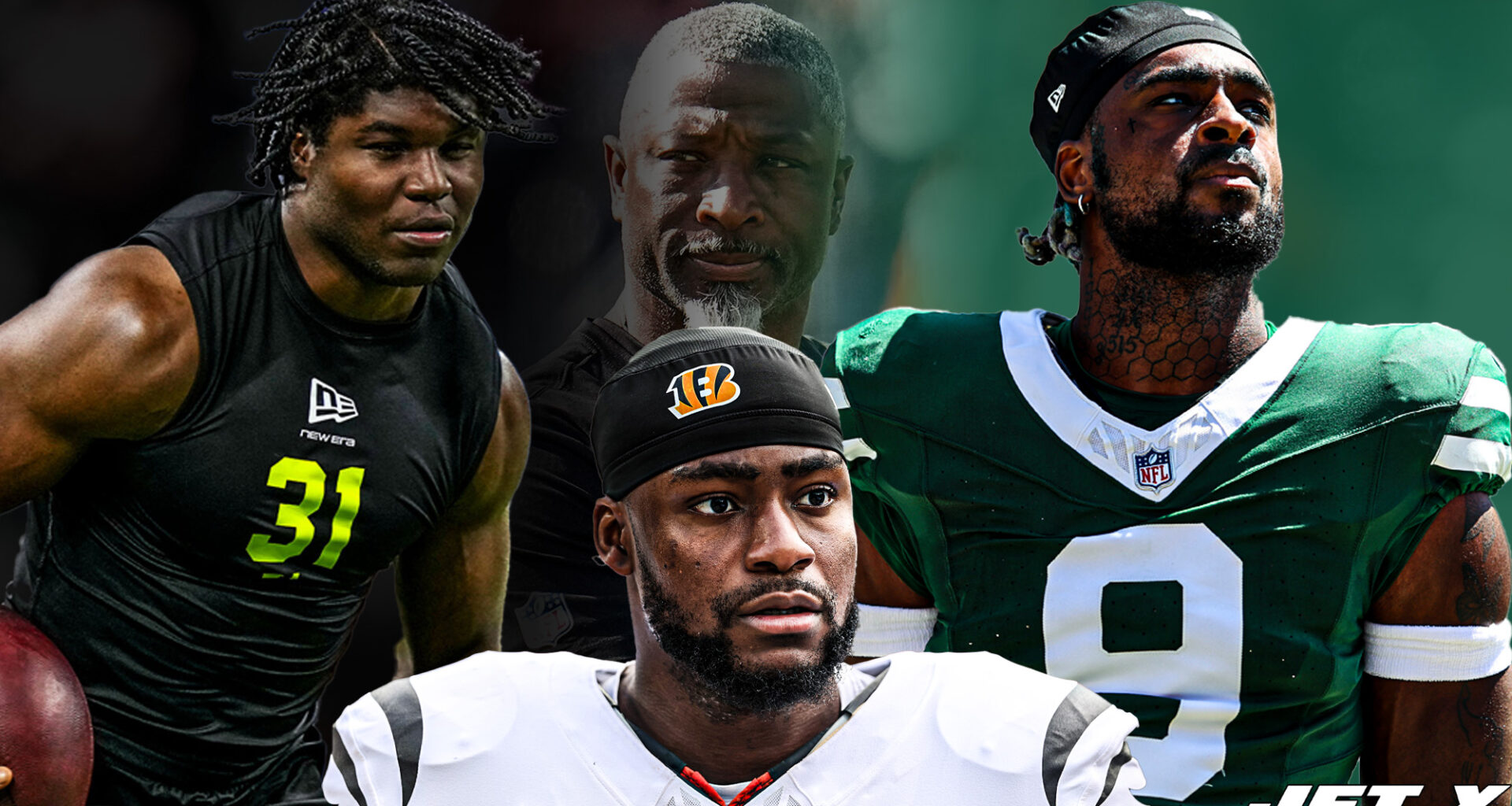
The 2026 NFL draft is less than one week away, and the New York Jets’ pick at No. 2 remains unknown.
While the debate has centered on David Bailey and Arvell Reese, recent reports have painted Bailey as the perceived favorite around the league.
If the Jets ultimately go that route, the question becomes, “How would the Jets deploy Bailey across their defensive looks?”
4-3 base
DE (Strong): Joseph Ossai
DT: T’Vondre Sweat
DT: Harrison Phillips
DE (Weak): Will McDonald
As Aaron Glenn shared at the NFL’s annual owners meetings, the Jets will use multiple defensive fronts this season. In today’s NFL, the difference between a 3-4 and 4-3 base is largely negligible when 11 personnel is thrown into the equation.
In a 4-3 base, Bailey may not have an immediate starting role. Despite a 4-3 being an even front, defensive ends are required to play with discipline, which is questionable with Bailey. Also, DEs need to set the edge and hold their own against the run, which Bailey also struggles to do.
Beyond that, he is often displaced at the point of attack and struggles to play within structure, which is another issue.
He can’t be trusted to start right away in a 4-3 base.
3-4 base
DT: Jowon Briggs
NT: T’Vondre Sweat
DT: Harrison Phillips
OLB (SAM): Joseph Ossai
OLB (JACK): Kingsley Enagbare
In a 3-4 base, it is even more difficult to project where Bailey would fit. Outside linebackers in this set, especially the Jack, must be complete edge defenders. They are responsible for setting a strong edge and maintaining outside leverage while playing with strong gap integrity.
As noted in the prior section, Bailey’s tape raises concerns in each of those areas. Not only does he struggle to hold up at the point of attack, but he also often abandons his assignment to pursue a splash play.
Those habits are exactly why he can’t be trusted to be a three-down player in his rookie season.
Nickel
Now this is a clean fit.
DE: David Bailey
DT: David Onyemata
DT: Harrison Phillips
DE: Will McDonald
On the surface, this is where Bailey fits best.
In a 4-2-5 look, Bailey can line up wide and focus on what he does best: pin his ears back and rush the passer.
By not having to take on such a substantial responsibility as a run defender, it is a much simpler role for the Texas Tech product, allowing him to lean into his quick burst/get-off.
Overall
Jet X’s Robby Sabo explained it best: Bailey’s deficiencies should disqualify him as an option for the Jets at No. 2.
There is no doubt he is a talented pass-rusher, but the position is edge defender — not edge rusher. Edge rusher folds into edge defender as just one action of potentially hundreds of responsibilities.
As evidenced by this exercise, his impact is significantly limited from the outset. Furthermore, the question becomes: how much more room for growth does he have, given that he will turn 23 before his rookie season begins?
It’s far from a guarantee that he will develop into a viable run-defender in the pros.
Arvell Reese is the clear pick for the Jets, and it’s not even close. Not only does he modernize the team’s defense, but he also optimizes the depth chart in a way that Bailey doesn’t even come close to doing.