
Finally, it is NFL Draft week.
Soon, there will be no more speculation or guesswork. The world will know who the Jets actually wanted at No. 2 the whole time, whether they actually ever considered Ty Simpson and which wide receiver(s) they had in mind when they passed on signing any in free agency.
The Jets are flush with draft capital — in terms of value of their picks, more than any other team in this draft — and will have a chance to infuse their roster with high-end, young talent.
So what will Aaron Glenn and Darren Mougey do? Here is my final mock draft.
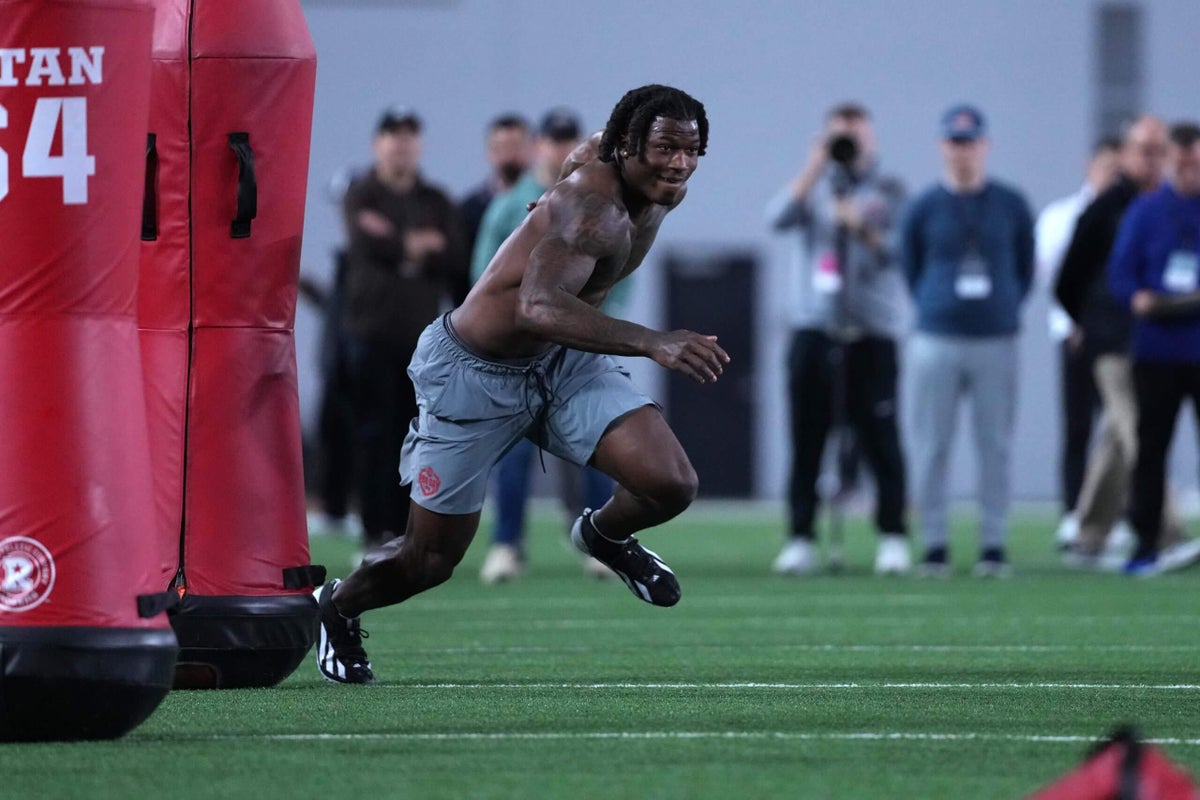
Round 1, Pick 2: Arvell Reese, LB/edge, Ohio State
There has been an overwhelming amount of noise nationally that the Jets are going to pick Texas Tech edge rusher David Bailey. As such, the Reese versus Bailey debate has intensified — certainly on a local level. Despite all the smoke, I’m staying with Reese, who has been my projection throughout this process.
I understand the logic with Bailey. Glenn is now calling plays; he’s putting it on his own shoulders to turn one of the NFL’s worst defenses around in a significant way. Bailey is going to walk into the NFL capable of getting 10 sacks right away, while Reese might require more development as a pass rusher. So it’s become a debate of floor versus ceiling — Bailey has the higher floor, but Reese has the higher ceiling.
The Jets, especially at this pick — and especially because of how many other picks they have to add ready-made prospects — need to swing for a home run. This is not a roster full of blue-chip players, especially on defense. An argument could be made that the only no-doubt building blocks on the roster are wide receiver Garrett Wilson and tackle Armand Membou. The defense improved in free agency by adding some quality veteran players, but those moves only served to raise the floor of a terrible defense. Reese has the talent and ability to raise the ceiling for this year and beyond.
I also know the Jets believe in defensive line coach Karl Dunbar’s ability to develop pass-rushing talent. It’s what he was known for with the Steelers all those years — just ask T.J. Watt and Alex Highsmith.
And, for what it’s worth, I think Reese is more ready to make an impact right away than people are giving him credit for.
Round 1, Pick 16: TRADE!
The Jets trade the 16th pick to the Los Angeles Chargers in exchange for No. 22, No. 86 (third round) and a 2027 fourth-round pick.
I’m not confident in Jordyn Tyson, Carnell Tate and/or Makai Lemon making it to No. 16 — though of the three, Lemon feels the most likely right now. Perhaps Mougey will look to trade up, but I also like the idea of trading back here, picking up a third (they don’t currently have one) and picking up a pass-catcher a little later in the round. The Chargers desperately need interior offensive line help and Vega Ioane from Penn State was on the board for this projection.
Round 1, Pick 22 (via projected trade with Chargers): Omar Cooper, WR, Indiana
If the Jets do trade back, this feels like a better range to target one of the next two best wide receivers on most boards: Cooper and Washington’s Denzel Boston. Both bring a different flavor — Boston is a big-bodied, 50/50-ball outside receiver who fits the mold of what offensive coordinator Frank Reich usually prefers. Cooper feels like a more dynamic, versatile option, even if he’s on the smaller side (6-foot, 199). His ability to play the slot and outside would give the Jets more wiggle room to move him and Wilson around the formation.
Cooper forced 27 missed tackles after the catch in 2025 and accounted for 30 plays of 20-plus yards last season.
Round 2, Pick 33: Colton Hood, CB, Tennessee
There’s been some buzz regarding the Jets’ interest in Hood. It makes some sense — though I’m skeptical they’d consider him in the first round, as some have suggested. If Hood is there for one of the Jets’ two second-round picks, that makes more sense.
The Athletic’s Dane Brugler has him at No. 30 and the fifth-best cornerback in this class. Hood comes from a man-heavy scheme — the Jets will run a lot of man in Glenn’s defense — and NFL.com compared him to Carlton Davis, who played corner for Glenn in Detroit. Brugler wrote that Hood “embraces press-man challenges and is the type of balanced, scrappy athlete who can attach himself to receivers and make things difficult for the offense. He has the talent and wiring to be an early NFL starter.”
That sounds like a Glenn-type of player to me — though the most Glenn-type of cornerback is Indiana’s D’Angelo Ponds. If the Jets are picking a corner in this range, the ones that make the most sense to me are Hood, Ponds and San Diego State’s Chris Johnson.
As for why they’d pick a cornerback here: The Jets have a bunch of solid cornerbacks who profile as No. 2 or 3 on a depth chart rather than the no-doubt, No. 1 guy they used to have with Sauce Gardner. If they feel Hood, or someone else, has the potential to become that guy, it makes complete sense to pursue it. Sure, it’s a crowded cornerback room (Brandon Stephens, Azareye’h Thomas, Jarvis Brownlee, Nahshon Wright), but none of them are the level of player that screams no-doubt, long-term starter.
Would I pick a cornerback this early if I were the Jets? Maybe not, but I can see Glenn wanting to go in that direction.
Round 2, Pick 44: Germie Bernard, WR, Alabama
The Jets should, and will, absolutely consider double-dipping at wide receiver. More teams should get into the habit of drafting wide receivers on Day 2 or early on Day 3 every year because there is value to doing that — and Mougey already doesn’t believe in overspending at the position in free agency, hence why the Jets haven’t added a single new receiver this offseason.
The Jets could go for someone who is stylistically more divergent from Wilson and Cooper than Bernard, who is only 6-foot-1, but I think the goal should simply be getting the best possible pass-catchers into the offense rather than putting much thought into body types. The Jets’ goal for this season is simply competence, and there is probably not a receiver in this draft class that fits that theme better than Bernard.
It would be surprising if he is not, at minimum, a solid NFL wide receiver for a long time. A common comparison for Bernard is Robert Woods, who carved out a long, productive career. Bernard is pro-ready, capable of lining up at every receiver position, and he’s an underrated athlete too — he ran the fastest three-cone drill (6.71 seconds) at the combine. He only had one drop for Alabama last season, and is a quality blocking receiver too. The Jets could take a bigger swing on someone like Louisville’s Chris Bell here, but I like the idea of loading up the depth chart with quality receivers who have less risk attached.
A wide receiver room featuring Wilson, Cooper, Bernard and Adonai Mitchell is highly promising, and protects the Jets if Wilson were to get hurt again.
Round 3, Pick 86 (via projected trade with Chargers): Keyron Crawford, edge, Auburn
The Jets added two edge rushers in free agency (Joseph Ossai, Kingsley Enagbare) and brought back Will McDonald. The Jets’ base defense is expected to be a 3-4, so these players will spend most of their time standing up as outside linebackers.
Yes, the Jets did add Reese in this projection, but that doesn’t mean they should stop loading up on pass rushers. McDonald is expected to have his fifth-year option picked up for 2027, but isn’t signed beyond that, and Enagbare — primarily a run-stopper — is on a one-year deal. The Jets had barely any effective pass rushers last season, so the phrase “you can never have enough good pass rushers” doesn’t need additional emphasis. The pass rush has been mostly a disaster since the Haason Reddick experiment.
Brugler described Crawford as “shredded,” and Crawford described his play style as “Rottweiler or bulldog — something that’s going to bite you.”
He was only a starter for one year at Auburn, but still ranked fourth in the SEC and 12th in FBS in pressure rate, getting five sacks and 9.5 tackles for loss in 12 games. Brugler wrote that Crawford “is still learning what it means to be a technician, but he is a twitched-up defender with the compete skills and intriguing skill set to contribute right away. He offers role versatility and will fit 3-4 or 4-3 looks.”
Round 4, Pick 103: TE Sam Roush, Stanford
Yes, a third pass-catcher — though Roush is more than that. He’s big (6-6, 267) and athletic for his size. And he’s the sort of tight end who will contribute at the NFL level as both a pass-catcher and blocker. The Jets are still high on Mason Taylor, but that doesn’t mean they shouldn’t continue adding at this position, even after extending Jeremy Ruckert.
Roush had 545 yards and seven touchdowns last season for Stanford. And who was Stanford’s head coach in 2025? That would be new Jets offensive coordinator Frank Reich.
This was the first real spot I considered drafting a quarterback for the Jets. Penn State’s Drew Allar feels like a Reich-type of QB but I don’t think the Jets can pass on adding players who could make an immediate contribution in 2026, when Allar would likely not see the field.
Round 4, Pick 140: Febechi Nwaiwu, G, Oklahoma
The Jets are running it back with the same reserve offensive line unit as last year, re-signing tackle/guard Max Mitchell, tackle Chukwuma Okorafor and guard Xavier Newman. None of them are potential long-term starters, and the Jets should be trying to develop offensive linemen, especially on the interior. Nwaiwu isn’t the best athlete, but he’s “strong as a bull,” per Brugler, has high-level awareness and consistency — he had one penalty in 2025 — and projects to carry guard and center flexibility in the NFL.
Round 5, Pick 179: Red Murdock, LB, Buffalo
The Jets need playmakers on defense in a bad way, and there are very few players in this draft class who are better at forcing turnovers than Murdock. He forced an FBS-record 17 fumbles in three seasons, returned an interception 31 yards for a touchdown in 2024, compiled nine sacks and 39.5 tackles for loss over the last three seasons and averaged 149 tackles over the last two years.
He didn’t test great at his Pro Day (a 4.75 40), but his intangibles are undeniable and Brugler called him a “magnet” for the football. The Jets have Demario Davis and Jamien Sherwood in the starting lineup (I did consider Jacob Rodriguez in the second round, which would make Sherwood expendable) but lack depth behind them. Brugler wrote that Murdock “plays with a physicality that will get the job done in the NFL. There is a place in the league for his competitive toughness and playmaking ability.”
Round 7, Pick 228: Cole Wisniewski, S, Texas Tech
This is a talented safety class, so there’s a chance the Jets target someone much earlier than this — I have my eye on TCU’s Bud Clark and LSU’s AJ Haulcy on Day 2, among others — but I don’t think it’s as big of a priority for the Jets as other positions. They traded for Minkah Fitzpatrick, signed Dane Belton, re-signed Andre Cisco and Glenn remains high on 2025 fourth-round pick Malachi Moore.
Wisniewski would be a fine target in the seventh round. The Jets hosted him for a Top-30 visit, which is at least notable. He, remarkably, had eight interceptions in 2023 at North Dakota State but broke his foot in 2024 and didn’t intercept any passes at Texas Tech last season — though he did finish with 78 tackles, six tackles for loss, one sack, two forced fumbles and six pass deflections. PFF had him graded as the 12th-best run-stopping safety and he allowed zero touchdowns in coverage. He had good size (6-3, 219) too.
Round 7, Pick 242: Behren Morton, QB, Texas Tech
Finally, a quarterback. Maybe the Jets will wind up drafting one earlier than this; I just couldn’t bring myself to do it based on who was available at earlier picks. I considered Allar in the fourth round and North Dakota State’s Cole Payton in the fifth.
The Jets got dinner with Morton before his Pro Day, according to a report, and also hosted him on a Top-30 visit. Brugler projects Morton as an undrafted free agent, while NFL.com has him as a seventh-round pick. He’s 6-2, 218, and passed for 6,115 yards, 49 touchdowns and 14 interceptions over the last two seasons. He’s not a particularly good athlete (4.89 40, 12 scrambles in 2025), but Brugler wrote that he thrives throwing over the middle, completing 76.2 percent of his passes with a 13-to-1 touchdown-to-interception ratio.
He can compete with Bailey Zappe and Brady Cook during training camp for the third spot behind Geno Smith and whoever else they sign to back him up.