

SPRINGFIELD — House Democrats met for hours behind closed doors Tuesday, working to advance a proposal that would bring the Chicago Bears to Arlington Heights.
The plan would allow the charter NFL franchise to make special payments to taxing bodies in the northwest suburbs — known as Payment in Lieu of Taxes, or PILOT — rather than paying regular property taxes. A bill requiring businesses with large-scale development plans to enter into such agreements for at least 20 years passed through the Illinois House Revenue and Finance Committee in February, but has stalled since then for lack of sufficient support within the House’s Democratic supermajority.
Among the concerns are that some local governments on the outskirts of the proposed megaproject zone in Arlington Heights could lose hundreds of millions of dollars in revenue. The influential Illinois Federation of Teachers — whose leader, Stacy Davis Gates, also heads the Chicago Teachers Union — has raised concerns that the property tax burden is being shifted onto regular taxpayers, according to a lawmaker familiar with the discussions.
State Rep. Kam Buckner, a Chicago Democrat leading the stadium negotiations in the House, said Tuesday he hopes the bill clears committee and is up for a full House vote by the end of the week.
As part of the provisions in the latest megaproject bill, he said, data centers — which have contributed to residents’ skyrocketing electric bills — would be ineligible for incentives, and both developers and municipalities would have to check in with the Illinois General Assembly every five years about what’s working and not working about the megaprojects, Buckner said. He also said local review boards would not only approve megaprojects but also participate in negotiations. Buckner said this was a change he discussed with the IFT after the union raised its concerns that the bill would hurt average taxpayers.
“There has to be something in this for people,” Buckner said. “The focus is on the Bears and Arlington Heights but when you look at the companies and the developers around the state who are … willing to use this, having a very stable flow of resources back to the people I think will be important to the local review boards, to mayors, to managers, to school districts, to mosquito abatement boards, to police and fire districts, all of those things that are part of our public services.”
Buckner said colleagues wanted assurances that taxpayers would not be left exposed and that the legislation would offer something to ordinary residents, not just tax certainty for eligible businesses.
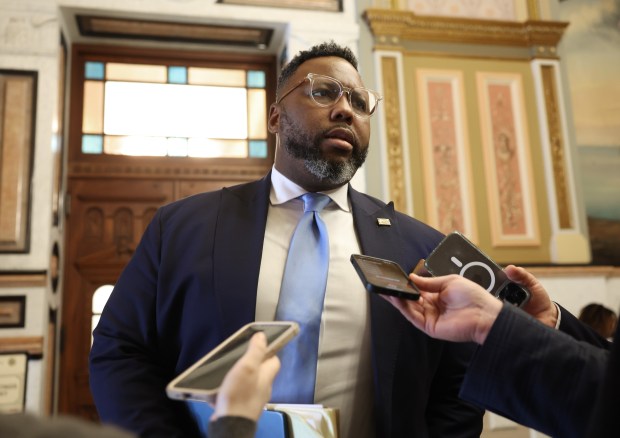 State Rep. Kam Buckner answers reporters’ questions at the Illinois State Capitol on May 29, 2025, in Springfield. Buckner is leading the Bears stadium negotiations in the House and speaks with the Bears organization nearly every day. (John J. Kim/Chicago Tribune)
In addition, the bill would give Chicago the opportunity to pay off development project debt with Sales Tax and Revenue, or STAR bonds, which support economic development related to tourism, entertainment or retail projects, Buckner said.
The Illinois moves come as Indiana lawmakers earlier this year authorized the building of a new stadium in Hammond to try to attract the Bears to play their home games across the border. Under that deal, the Bears would play and get revenue from operating the facility.
Illinois House Speaker Emanuel “Chris” Welch, a Democrat from Hillside, typically requires 60 members of his caucus to back a bill in private before bringing it to the House floor — a threshold that has proven difficult to clear given how many Democrats represent Chicago districts with little appetite for incentivizing the Bears to leave the city.
Asked what Chicago-based legislators would want in exchange for their support, state Rep. Marcus Evans, a South Side Democrat, pushed back on the framing.
“I don’t want anything from the Bears. We want the Bears to want to stay in Chicago. I would like the Bears to sit down with the governor … sit down with the mayor, work a deal out that’s going to benefit our working class, that’s going to benefit our unions, benefit our businesses. The answer’s right there. Everybody sit down and get this thing over,” Evans said. “This should have been done months ago. But I don’t want anything from the Bears but a Super Bowl and a resolution on this easy-to-solve problem.”
Even without reaching that 60-vote threshold among Democrats, Republicans have signaled openness to a PILOT bill, albeit on their terms. Earlier this month, state Rep. Dan Ugaste of Geneva authored a letter co-signed by 29 House Republicans to the Democratic majority and Gov. JB Pritzker, making their support contingent on “meaningful” statewide property tax relief.
“We understand the upside of a world-class stadium and Illinois should be competing for those opportunities. But the other taxpayers are not an afterthought. Any (megaprojects) or Bears deal that shifts the burden onto homeowners and small businesses, who already face some of the highest property taxes in America, is dead on arrival,” said Ugaste. “As property tax reform is going to be part of this package, it must apply to everyone, not just handpicked projects.
“At a minimum, that means: Requiring all property tax referendums to appear only on November ballots, when voters are most engaged in the process (and ending) “back-door” referendums, or bond rollovers that allow governments to raise taxes without ever asking voters,” he said.
Buckner also said he wants the latest legislative language to include a form of property tax relief, which would entail taxpayers in the immediate area of a megaproject benefiting from the special payment made by the Bears or any other recipient of a megaproject, while other funds from that payment would go to a statewide property tax relief fund.
State Rep. Brad Stephens of Rosemont, the only Republican in the General Assembly whose district includes part of Chicago, and also Rosemont’s mayor, did not sign Ugaste’s letter but has met with key decision-makers on the PILOT bill. He said additional GOP support is possible if the legislation is “fair and equitable,” and noted that other projects around the state could also benefit from PILOT provisions that haven’t yet entered the public conversation.