
Sorry I wasn’t here last week. I was too busy traversing Bloomington and Indianapolis. Shout out to Shapiro’s and Buffa Louie’s.
Let’s get back at it.
Note: Submitted questions have been edited for clarity and length.
Hi Stewart! How much should we care about spring games? I saw Bryce Underwood’s numbers, and I can’t help but be a bit nervous. — Mike M.
I might be in the minority, but I’m someone who takes stock in spring game performances. Mind you, context is everything. Was it first team offense vs. first team defense, or starters vs. backups? What key players were missing? How many series did the star quarterback actually play?
In my experience, the guys who play well in the fall don’t generally bomb in the spring game. And for that reason, I’m nervous about Bryce Underwood, too.
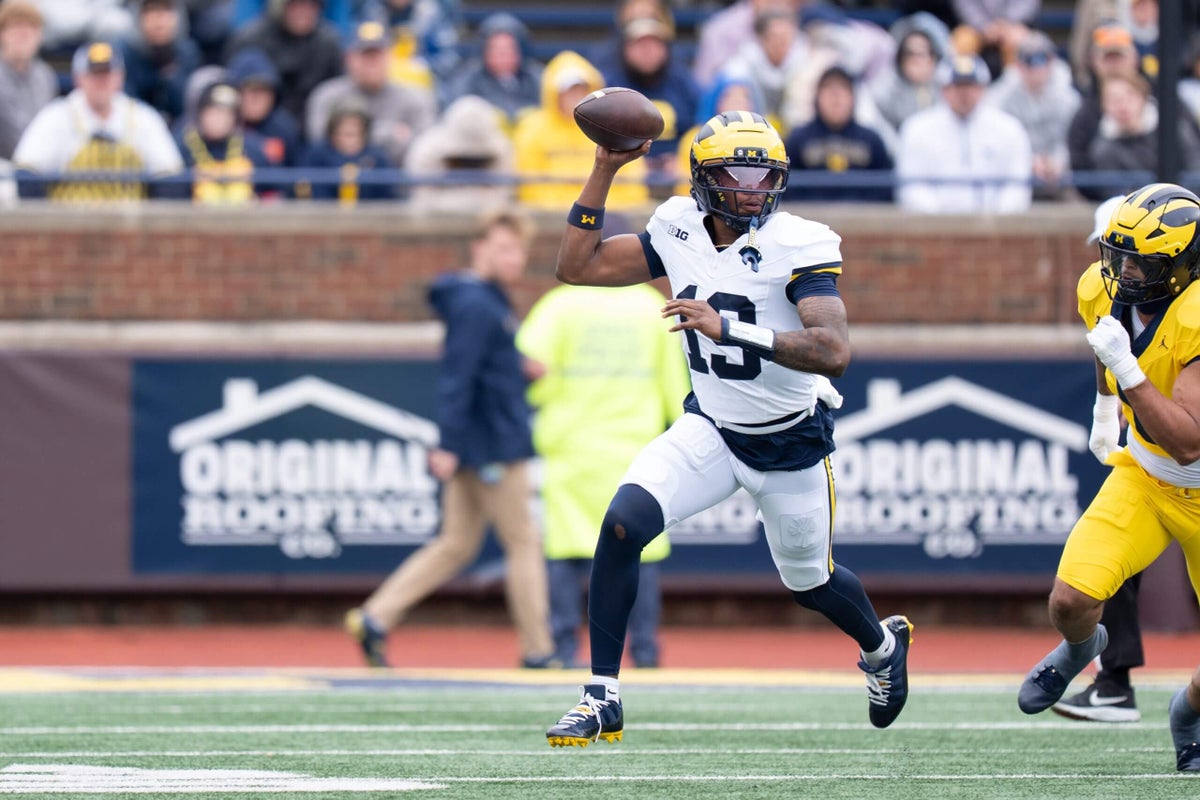
Michigan’s $12 million quarterback was underwhelming as a true freshman starter, finishing 94th in the country in passer rating. But most true freshman starters have a rocky first year: Bo Nix at Auburn (81st nationally in passer rating), Dylan Raiola at Nebraska (82nd) or Dante Moore at UCLA (didn’t qualify, but he would have been around 80th). So, Underwood deservedly got a pass.
If you were a Michigan fan tuning into Saturday’s spring game, you just wanted to see some sign he’s been progressing under new coach Kyle Whittingham and offensive coordinator Jason Beck. Instead, you saw him go 3-of-9 for 22 yards while playing just a quarter, overthrowing open receivers on his two longest passes and throwing into traffic on another. In his defense, his pocket was constantly collapsing, forcing him to tuck and run.
Still, freshman Tommy Carr (Lloyd Carr’s grandson and CJ Carr’s brother) had a better day.
The good news: It was just one scrimmage. Underwood has the whole summer and preseason camp to get into the flow of Beck’s offense and build rapport with his receivers. Unfortunately, though, it’s the one scrimmage everyone saw, so that will be our lasting image of Underwood for the next four months.
As an aside: Watch out for the Wolverines’ five-star freshman RB Savion Hiter. He looked like a potential tackle-breaking machine.
In an era where players can play at multiple schools in their college career, which school (and conference, for that matter) gets to claim they put a player into the NFL? For example, Fernando Mendoza spent the majority of his career at Cal, but his brief time at Indiana is what made him the likely No. 1 pick in this week’s draft. — Nicholas R.
This is a valid question. As it is, the NFL and pretty much every media outlet defaults to the player’s last school. But should they? Should it be where the guy spent the majority of his career? Where he got his undergraduate degree? Where he had his best production? Is this going to become like the Baseball Hall of Fame when there’s debate over which cap a player should be wearing on his plaque?
But more often than not, a player’s performance at his most recent school is what got him drafted. It’s probably the tape teams are watching the most. Mendoza might have been a mid-round pick without his year at Indiana. David Bailey had flashes at Stanford, but nothing like his monstrous season at Texas Tech. Same goes for Dillon Thieneman moving from Purdue to Oregon.
One player I always felt bad about his old school not getting credited was Jalen Hurts. He was at Alabama for three years, started two national championship games and, even after he got benched, came in for Tua Tagovailoa to win the SEC championship game. But now he’s forever associated with one season at Oklahoma. However, without that one season under Lincoln Riley to resurrect his career, he’s probably not a Super Bowl champion starter.
All of which is a long way of my saying: It’s probably fine to keep doing it the way we’ve been doing it.
Stew: With the NCAA considering a move to start the season in Week 0 come 2027, wouldn’t this be a great opportunity to have a standalone game each night, Thursday-Monday night, for two straight weeks? What unique scheduling approaches can conferences/teams make to maximize viewership at the start of the season? — Paul G.
Why stop there, right? Why couldn’t we have a game every night for 12 straight nights from the Thursday of Week 0 (which will be Aug. 26) through Labor Day night (Sept. 6)? There’s not much else going on then, and a whole lot of schools would get to play in high-exposure windows. Granted, you might have a hard time convincing the major schools to play on a random Tuesday or Wednesday game, but that’s fine. I’m sure most G6 schools would jump at it.
It could also help alleviate the most obvious drawback of starting the season earlier: It’s really freaking hot in most places. You could shift a lot of Texas/Florida/Arizona games into nighttime windows.
But most importantly, it’s an extra week of not competing with the NFL, which, in the last couple of years, has been hogging even more oxygen. Last year, it added a Friday night game from Brazil in Week 1 (though that’s not happening this year) and a Black Friday game that could reportedly become a doubleheader this season. Also, it got so ticked when the CFP put the new first-round games on the third Saturday in December that it started moving better games to that day and gave them to Fox/CBS instead of NFL Network.
So I say, the more exclusive college windows the better.
There’s only one problem with all this. We need some better games in the first week. After years of several high-profile Week 1 nonconference games, this year’s Week 1 (which would become Week 0) is a dud. Especially that first Saturday. LSU-Clemson is the marquee game, but after that, it’s Boise State-Oregon. And then … Baylor-Auburn? UCLA-Cal? You at least get Louisville-Ole Miss and Wisconsin-Notre Dame on Sunday, but even those are a rung or two down from LSU-USC and Notre Dame-Miami the past two seasons.
Giving the sport a bigger spotlight is all good unless the games they’re spotlighting are mostly meh.
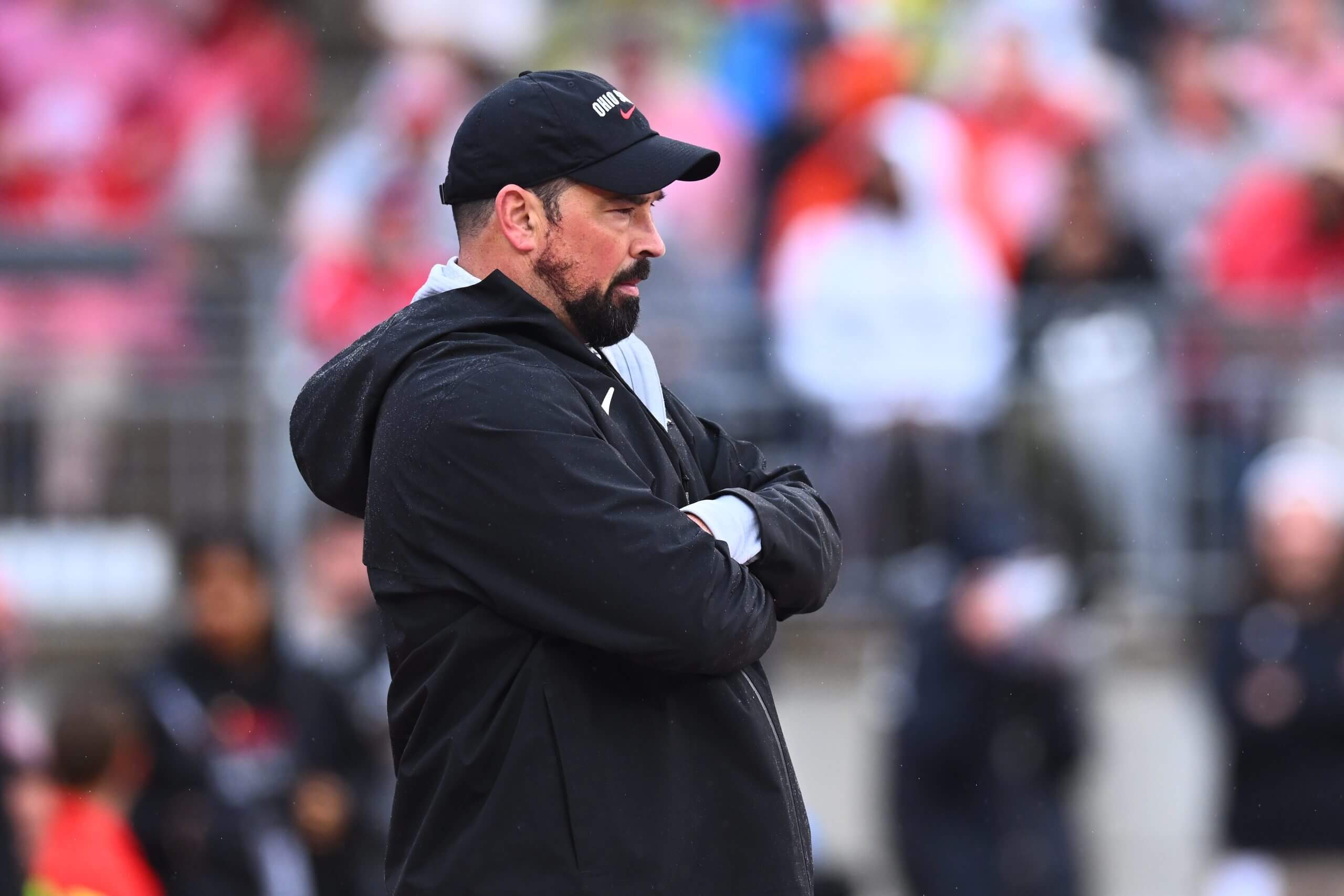
Looking at Dane Brugler’s “The Beast,” Ryan Day looks like a much better recruiter than coach. What would another coach do with Ohio State’s recruits? — Rhodes S.
With that much talent, I think it’s fair to expect someone to win at least 87 percent of his games, make the Playoff at least five out of every seven years and hoist at least one national championship trophy.
Like Ryan Day.
Ohio State will have a plethora of high NFL Draft picks this year. (Ben Jackson / Getty Images)
The Iowa Hawkeyes appear to be having their best recruiting year (2027) in Iowa football history. Kirk Ferentz just turned a very healthy 70. Could he get the Hawkeyes to a national championship?? — Dave O.
Easy, now. Let’s not go reading too much into April recruiting rankings. (Iowa is 19th on 247Sports based on eight commitments.)
But if nothing else, I’d love to see Ferentz reach a Playoff before he’s done. And I don’t see why he can’t. Looking back, the 2025 team was not that far off. Yes, the Hawkeyes went a modest 8-4 in the regular season, but consider:
They were tied with eventual national champion Indiana with less than two minutes left, before giving up a 49-yard Mendoza-to-Sarratt touchdown pass. Even then, they held the Hoosiers to 20 points, their second-lowest all season.
They lost to Iowa State 16-13 on a 54-yard field goal and to Oregon on a last-second field goal, despite holding the Ducks to a season-low 18 points.
They beat a 10-win Vanderbilt team that had only one opt-out in the ReliaQuest Bowl, sacking Diego Pavia five times.
Mind you, the season followed a familiar Ferentz script: Defense was filthy, especially up front, while the offense, though not 2021-23 horrible, still finished in the 100s. Not great when you’re losing games 16-13 and 18-16. If Ferentz and Iowa are ever going to take that next step, they really need to develop some explosiveness. L.J. Phillips Jr. last year’s FCS rushing leader out of South Dakota, could make an impact, though he is a 5-foot-9, 225-pounder known more for bouncing off tacklers than burner speed.
And of course, quarterback is always an adventure. It’s a competition right now between third-year sophomore Jeremy Hecklinski, who’s barely played, and Auburn transfer Hank Brown, who in his one career P4 start two years ago against Arkansas, threw three first-half interceptions and got pulled at halftime.
Ferentz’s teams were not always so out of balance. I’m old enough to remember when Nate Stanley and the Hawkeyes hung 55 points on No. 3 Ohio State in 2017. Or the good old days of Ricky Stanzi-to-Marvin McNutt circa 2009-10. But even those teams back then would not have been CFP material. Iowa would have made a 12-team Playoff in 2009 and 2015.
But that’s ancient history. Let’s get Ferentz in before it’s too late. And without needing Tony Petitti to double the size of the field first.
This question makes me sad, but do you believe any non-SEC or Big Ten team will ever win the national championship again? (Or until the next super expansion?) I realize Miami got close, but for every Miami and Texas Tech, there are SEC and Big Ten teams with as much money or more. — Paul
It will be primarily SEC/Big Ten, but at the very least, Notre Dame, Miami, Florida State and Clemson can absolutely still win a national championship with the right coach. The Irish have Big Ten/SEC money, Miami seems to have a bottomless well of it, and FSU/Clemson successfully got the ACC to drum up a revenue formula that’s rigged in their favor.
Beyond those, though, it might depend on how the entire model evolves or devolves over the next several years.
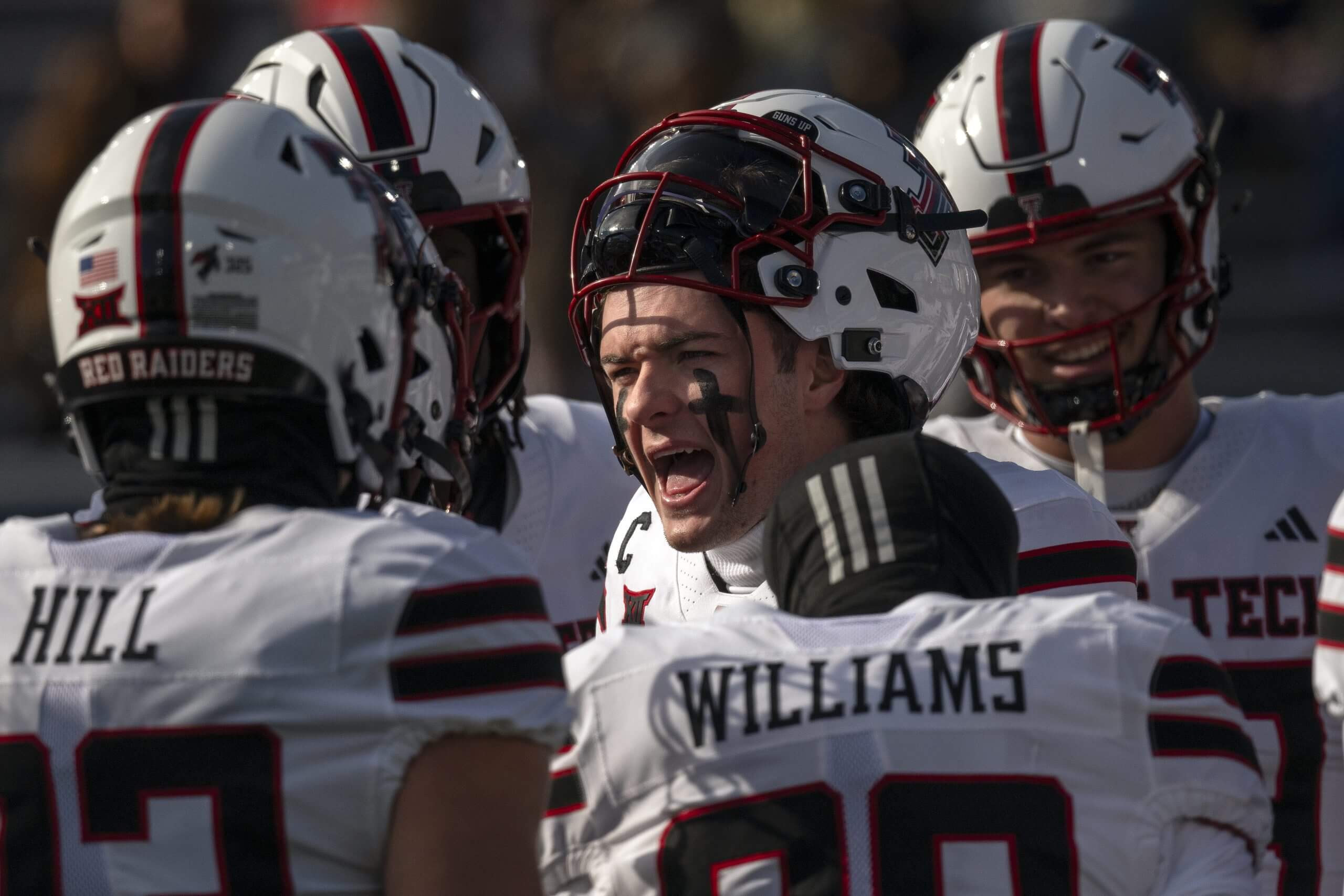
If the schools had actually devised an effective, enforceable hard name, image and likeness cap (CSC is not that), it would theoretically curtail the abilities of a Cody Campbell-type to buy Texas Tech a championship. But given we’re already hearing about $30 million to $40 million rosters, clearly that ship has sailed. Which is good news for a Texas Tech or BYU that has a major benefactor on top of rev-share.
Texas Tech rose to prominence this season after dramatically increasing its spending. (Brien Aho / Getty Images)
But it’s one thing for Texas Tech to reach the Playoff and lose 20-0 to Oregon; it’s another to actually win the whole thing, which seems unlikely. Though Indiana was in theory a great rags-to-riches story, in reality it already had plenty of riches just by being in the Big Ten. If you had to guess today who will be the “next Indiana,” you’d be smarter to pick a currently irrelevant Big Ten/SEC school than ACC/Big 12.
“Ever again” is a long, long time. Indiana alone taught me to believe you should never say never. But if you’re asking me, over the next five years, will a school outside of the SEC/Big Ten and the four programs I mentioned earlier win a natty?
Realistically, no.
What percentage of college football players even pretend to attend class or take school seriously? I attended Wisconsin during the Melvin Gordon-TJ Watt-Jonathan Taylor era. While those guys were big men on campus, you would see them in the lecture halls and libraries with all of us mortals. With how big the money has gotten and with so many players transferring every year, I wonder if there is any illusion that these guys are “student-athletes” anymore? — Sam
I feel like I get questions like this every week. At 50, I’m not exactly plugged into modern campus life, but here’s what I can tell you:
The NCAA still has three key eligibility requirements for athletes: 1. You have to take at least six credit hours each term. 2. You have to maintain at least a 2.0 GPA. 3. You have to remain on track to graduate (i.e., 40 percent completed coursework after Year 2, 60 percent after Year 3). If NIL/the portal is turning athletes into a bunch of slackers, then we’d surely see more cases of players being deemed academically ineligible. We are not.
Obviously, there are shortcuts. They can enroll in an easier major or load up on easy electives. And the major programs in particular have entire departments of academic advisers/counselors/tutors to help. But we all know that was the case long before NIL was ever a thing. See UNC for one.
The biggest change of course is the prevalence of online classes or hybrid in-person/video call classes. Anecdotally, there’s no question a lot of athletes lean heavily on those options, especially during the season. But sometimes they don’t have a choice. The UCLA basketball team can’t exactly hit the lecture halls when it spends an entire week traveling to Penn State and Ohio State.
Online courses are particularly relevant with the portal. If a player’s credits from one school don’t transfer to the next one, he might be able to make it up online in time for the season.
So far, there’s been no real decline in the NCAA’s Graduation Success Rate, which tracks how many athletes graduate within six years of starting college. In 2025, that number was 90 percent among all athletes and 84 percent in FBS football. However, the most recent data was for athletes who enrolled between 2015 and 2018, so we won’t truly know the effect for another few years.
One thing I’m not sure most people realize is that grad rates have gone way up over time. Both those numbers are about 20 points higher than they were two decades ago. Personally, in my admittedly limited interactions — be it news conferences, phone interviews or occasional sit-down interviews, I find today’s athletes to be more well spoken and more engaging than 20 years ago. I believe that’s in part because they’re exposed to so much more than before they even get to college, be it through the recruiting circuit, travel ball, and of course, social media. They’re savvier.
Remember, all the business-y stuff surrounding college sports that we older folks find so jarring — athletes now never knew it any other way. So, though Sam’s question (and others like it) is completely understandable, I’d posit that most athletes are better equipped to deal with this stuff than many give them credit.
Finally, I did survey a few of The Athletic’s current or recent college grads for their feedback. They reported that yes, they do see players in their classes, both online and in person.
Props to them. That would not have been the answer 30 years ago if someone asked Northwestern students whether they saw me in classes.