
“Excellent movement. Good quickness. Runs well.”
_Bengals president Mike Brown’s scouting report dated Oct. 27, 1975, in which he circled the third or fourth round.
Fifty years later, and Mike Brown, a former Dartmouth quarterback now 90 years young, can still remember a certain joy when they took Big Green linebacker Reggie Williams in the third round of that bicentennial draft of 1976 from their hamlet of Hanover, N.H., known more for letters than Xs and Os.
And, no, Dartmouth and the Ivy League hadn’t been playing football that long.
It just seems that way when Brown can recall that the first player who took money to play football was an Ivy Leaguer out of Yale named Pudge Heffelfinger when the Allegheny Athletic Association gave him 500 bucks to play Pittsburgh a few days after Grover Cleveland took back the White House from Benjamin Harrison in 1892.
“It isn’t often you get a guy from the Ivy League who is a top-flight NFL player,” Brown says on the eve of another draft. “But if you look back historically, there’s a good number of them starting with Pudge Heffelfinger.”
But Reginald “Reggie,” Williams? (Which is how he wrote it on the info sheet in exquisite block printing. Before putting “63,” for his jersey number.) With 213 regular-season and post-season, still the most NFL games played by an Ivy League defender. Four years ago, still named Dartmouth’s No. 1 male athlete.
“He was a star player. By Dartmouth standards, a once-in-a-lifetime player,” Brown says. “I knew quite a bit about him. And I was pleased to have the kind of guy who went to Dartmouth and could start for us. That was fun to do.”
Which is probably how Brinker ended up in Flint. Mike Brown, class of ’57, knew all about Williams. He even took in the Dartmouth-Harvard game in ’75 to scout and write his report. Now Brinker could confirm he was man and not an Ivy Frank Merriwell myth.
“Howard was the most detailed and most knowledgeable about everything that went into the system of anyone we ever had,” Brown says. “He was extraordinary. When the coaches had a question, they went to Howard.”
There was still that matter of timing a 40. Brinker couldn’t do it, but he put in his report, “Ran 4.6 On Pro Day. Atlanta had 4.5.”
“That would be odd at Dartmouth then and now,” Brown says.
Exhibit A of how Williams dominated the Ivy.
Before his senior season started, his head coach, Jake Crouthamel, decreed he wanted Williams to work out in August of ’75 before one group of pro scouts. The draft was scheduled to take place Feb. 8-9, 1976, so Williams would have to work out during his season on the schedules of the teams, not his own, and Crouthamel didn’t want to lose his best player to a blown hamstring.
It was big news in Hanover. “Reggie Williams Day,” was bannered across a four-page spread in a Dartmouth magazine headlined “The Trials of Reggie.” The story said more than half the NFL teams were represented and one scout was ga-ga over the Williams’ 4.6 and 4.59, saying he put the stopwatch on 200 players a year and only a dozen ran a consistent 4.6.
(Remember, it was 50 years ago.)
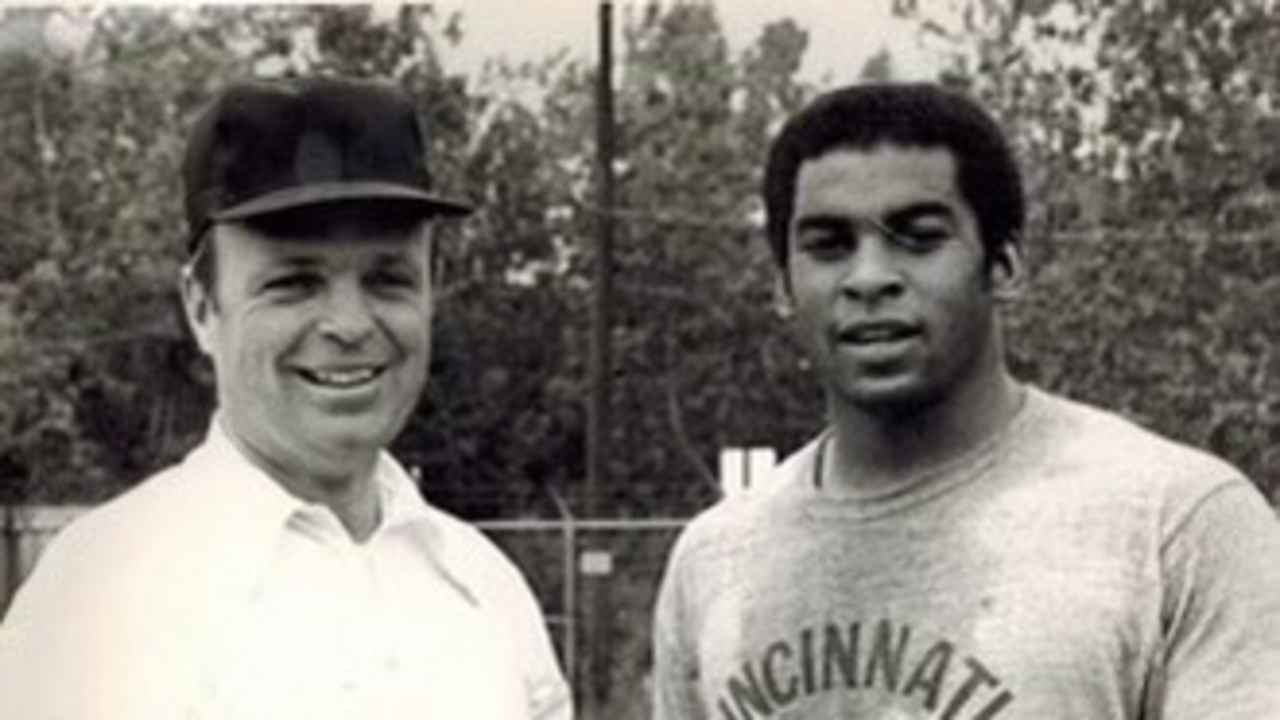
Williams doesn’t remember Reggie Williams Day as much as he does his first day as a Bengal running 40-yarders at Spinney Field about 48 hours after he was drafted. He remembers Brown greeting him with a smile after they put the watches on him. The next thing he knew, someone was taking a picture.
“He was thanking me for confirming that time,” Williams says.