
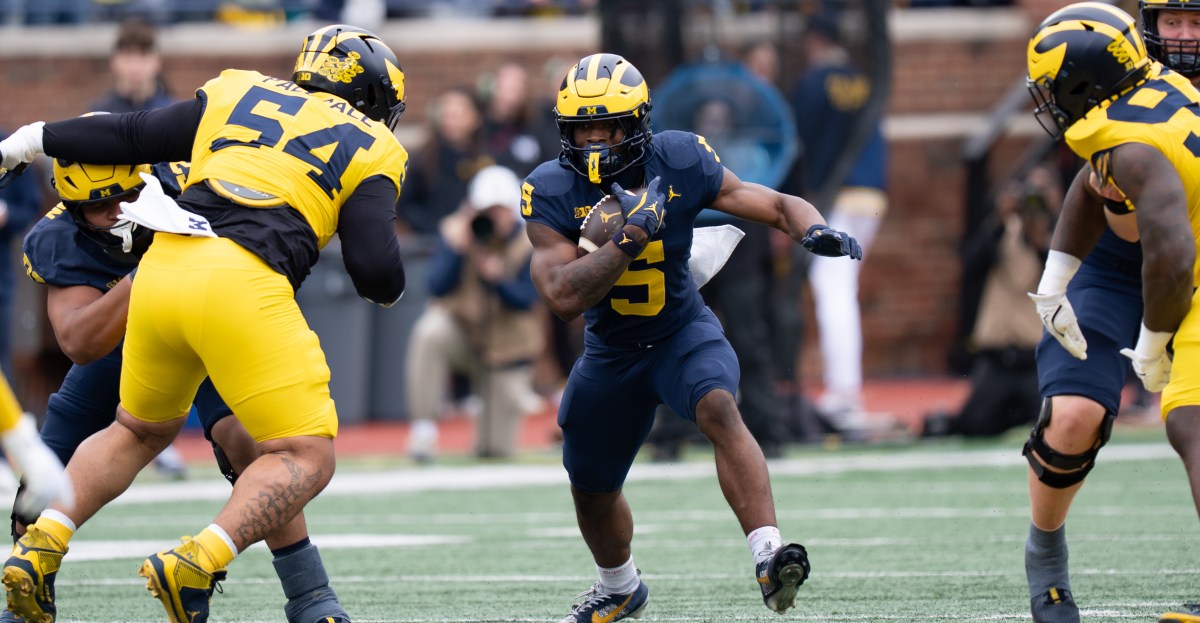
Michigan wrapped up its first spring under head coach Kyle Whittingham this past weekend, giving fans their first real look at a program in transition. While the spring game itself (a 7-6 final score) left plenty to be desired offensively, it also reinforced a few key themes that had been building throughout camp.
Here are three storylines from spring ball that aren’t going anywhere as Michigan heads toward the fall.
There will still be issues to iron out on offense
This was the most obvious takeaway from the spring game, and it’s not something that’s going to magically disappear over the next few months. Michigan’s offense looked very much like a unit still trying to find its footing.
Bryce Underwood’s performance — 3-of-9 passing with some familiar mechanical issues — highlighted the biggest concern. The raw potential remains undeniable, but the consistency, decision-making and fundamentals still need to catch up. That’s not unusual for a young quarterback, but it does mean there’s still plenty of work to be done before this offense can reach its ceiling.
It wasn’t just the quarterback play, either. The offensive line struggled to generate push at times, particularly in short-yardage situations, and the passing game lacked rhythm for most of the day. Even with a limited spring playbook, the overall execution simply isn’t where it needs to be.
That said, spring games are notoriously vanilla, and this is an entirely new system under Jason Beck. There’s time for growth — but as things stand today, it’s fair to expect some early-season growing pains before things fully click.
Michigan has some talented young freshmen that will contribute right away
If there was one clear bright spot from the spring, it was the impact of Michigan’s freshman class.
Quarterback Tommy Carr stole the show, looking poised, decisive and in control of the offense in a way that stood out immediately. His ability to make quick reads and operate within the structure of the offense gives Michigan a very intriguing option behind Underwood and a glimpse into the future of the position.
Carr wasn’t alone. Running back Savion Hiter consistently flashed throughout the spring and carried that into the game, showing off a burst that should translate right away. Wide receiver Salesi Moa also made his presence felt with some impressive catches, continuing to build a case for early playing time.
More broadly, this freshman class looks like it could be a difference-maker sooner than later. There’s legitimate depth and upside across multiple positions, and it wouldn’t be surprising to see some of these newcomers carve out meaningful roles to begin the season.
Michigan’s defense is going to be just fine
While much of the attention was on the offense, Michigan’s defense quietly (or not so quietly) dominated the spring game, which might be the most reassuring takeaway of all.
Even with restrictions in place — limited blitzing, controlled contact — the defense controlled the line of scrimmage from start to finish. The defensive front consistently generated pressure, disrupted the run game and forced the offense into uncomfortable situations.
New coordinator Jay Hill appears to have this group playing fast, disciplined and connected, particularly on the back end where communication looked great throughout the exhibition.
There were plenty of individual standouts across the board, especially along the defensive line, which exceeded some expectations coming into the spring. If that unit continues to play at this level, it could yet again be a major strength for Michigan this season.
If you were looking for clear answers this spring, you probably didn’t get many. But we did get a better feel for where this team stands with spring ball now in the rearview. There’s intrigue, uncertainty, and most importantly, a lot left to unfold between now and Week 1.