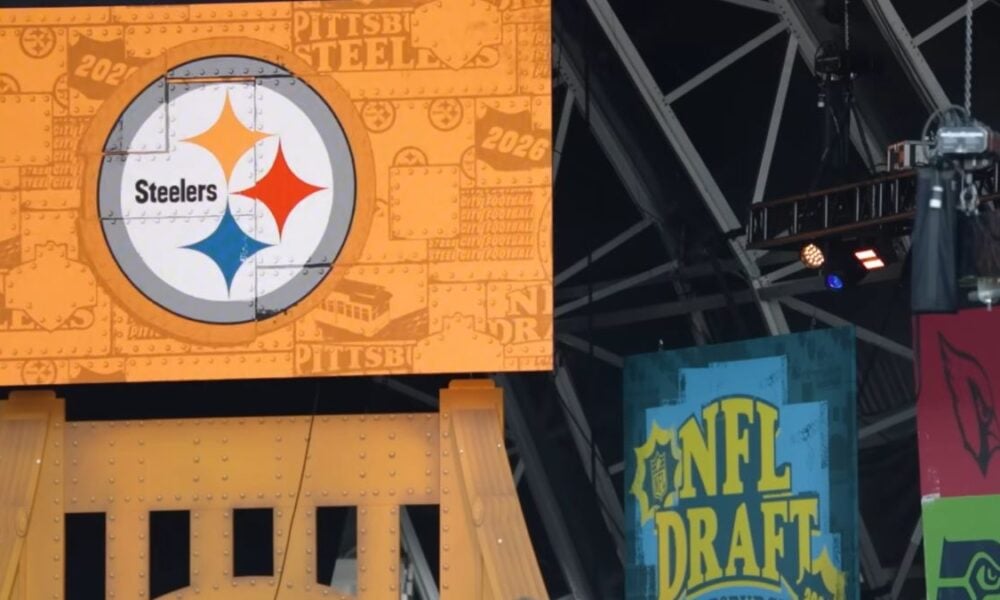
The Steelers entered the draft with 12 total selections and more than enough capital to move up and down the board. They ultimately made 10 picks, packaging some selections to move up in the second and third rounds. Like every fan, I had my own opinions on the players they chose and where they took them.
In this piece, I’ll break down each selection, share my evaluation, and assign a grade based on both my assessment of the player and the value of the pick.
Round 1 (21st Overall): Max Iheanachor/OT/Arizona State
Analysis: Perhaps the biggest surprise of the team’s draft came on opening night. Early last week, reports surfaced that Broderick Jones suffered a setback with his neck injury. While the team publicly disputed those reports, their actions on draft night told a different story.
As a player, Iheanachor possesses immense talent. Despite playing the position for only four seasons, he flashed high-level potential, allowing no sacks in his final year. There’s speculation he could play on either side of the line, but given his limited football experience and primary work on the right side, it would be less than ideal to ask him to learn a new position right away.
My biggest issue with the selection has little to do with the player himself, as I believe he offers arguably the highest upside among linemen in this class. Instead, it’s his overall fit with the team and the process behind the pick that raises questions.
I am firmly against the constant shuffling of the offensive line and moving players away from their natural spots. The Steelers value versatility up front, but drafting Iheanachor will likely force the team to move Troy Fautanu after a stellar year on the right side. Although he played left tackle at Washington, it’s a big ask to have him make a seamless transition after spending his first two NFL seasons on the opposite end.
There’s also no secret about who the team originally hoped to take at that spot. They were already on the phone with new Eagles WR Makai Lemon before Philadelphia traded up in front of the hometown team to secure him. While every team has contingency plans on draft day, the way this unfolded has many feeling like the Steelers backed into this selection.
I won’t be overly harsh with this grade, as I believe Iheanachor can be a long-term fixture on the offensive line. Still, their obvious desire for Lemon and the backpedaling in their comments about Jones leave a salty taste.
Grade: B+
Max Iheanachor Scouting Report
Round 2 (47th Overall via IND): Germie Bernard/WR/Alabama
Trade Compensation: PIT (47, 249) IND (53, 135, 237)
Analysis: This was one of my favorite selections in the draft. Although I didn’t include him in my final mock, Bernard feels like a natural Steeler and a perfect fit for this offense. His game doesn’t feature a glaring weakness, and he should be able to step into the slot alongside Metcalf and Pittman and contribute right away.
Initially, I had some reservations about trading up for Bernard. There was a belief they could have stayed at 53 and still landed him. But after seeing how many players went earlier than expected and the run on receivers in the middle of Day Two, it makes a lot more sense to move up and secure their guy. They also didn’t break the bank to do it, primarily giving up a fourth-rounder to move up six spots.
There’s very little to dislike about this pick. The Steelers may have missed out on Lemon on Day One, but Bernard’s selection makes that pill a lot easier to swallow.
Grade: A
Germie Bernard Scouting Report
Round 3 (76th Overall): Drew Allar/QB/Penn State
Analysis: This was the first pick I viewed as a major reach. But hey, that’s the quarterback tax in the NFL. The team made it clear they had a specific vision for the position, framing it as their ideal “AFC North QB,” and Allar fits that mold physically.
There’s no question that Allar has the highest pure upside as a passer in this class. His arm talent puts him in top-five conversations the moment he steps in the league. But there’s a reason he’s viewed as a reach in the third round: he’s wildly inconsistent and will need significant development if he’s going to become a long-term starter.
In my final mock, I also had the Steelers taking Allar. If McCarthy is the quarterback guru he was hired to be, Allar lands in an ideal situation where he doesn’t have to play right away.
When the pick came in, my immediate reaction was that Aaron Rodgers’ return was all but guaranteed. Allar isn’t someone you want on the field in Week One, and it’s unreasonable to expect him to develop behind someone like Will Howard, who lacks experience himself. However, with recent reports suggesting the team is unlikely to carry both Howard and Allar as backups, it’ll be fascinating to see how the rest of the offseason unfolds.
Training camp and the preseason should be must-watch, with plenty of eyes eager to see Allar’s arm talent on display against NFL competition.
Grade: B
Round 3 (85th Overall): Daylen Everette/CB/Georgia
Analysis: Another selection I have high hopes for. Even after the offseason additions, cornerback was a position I consistently mocked to the Steelers with one of their three third-round picks. While Dean is a solid player, Everette offers the potential to be a long-term running mate for Joey Porter Jr. without being thrown straight into the fire.
We graded Everette as a 7.9 “spot starter,” just shy of the long-term starter tier. He has good size and speed and will benefit from learning behind one of the league’s best starting tandems. His biggest adjustment will be cutting down on his grabbiness at the top of routes, a similar issue Porter had to work through.
Some may argue he came off the board earlier than expected. He wasn’t my top cornerback option at that point in the draft, but at a premium position like this, I don’t mind an earlier pick if you truly believe in the talent.
Grade: A-
Daylen Everette Scouting Report
Round 3 (96th Overall via SEA): Gennings Dunker/OG/Iowa
Trade Compensation: PIT (96) SEA (99, 216)
Analysis: This is the first pick where value is beyond debate. Earlier selections can be argued as reaches based on where they were taken. This one cannot. Dunker was widely projected to go early on Day Two and nearly slipped into Day Three. Outside of a true third wide receiver, left guard remained the most glaring hole on the roster, and Dunker should immediately compete for that job when camp opens.
The biggest concern with this pick goes back to the Steelers’ habit of moving linemen away from their college positions. Dunker primarily played right tackle at Iowa, and while many have projected him to kick inside, he has only 135 career snaps at guard. The Steelers have been flip-flopping positions along the offensive line for years, with mixed results.
If James Campen and Jahri Evans can help him transition smoothly to the interior, Dunker has a chance to be one of the bigger steals of the draft. His nastiness and mauler mentality perfectly match the identity they’re trying to build up front.
And yes, the mullet definitely earns him bonus points.
Grade: A
Gennings Dunker Scouting Report
Round 4 (121st Overall): Kaden Wetjen/WR/KR/PR/Iowa
Analysis: This was a pick many Steelers fans saw coming all offseason. Wetjen’s skill set and the team’s needs line up almost perfectly. Pittsburgh’s special teams have struggled for years, particularly on kick returns, where they haven’t scored since 2017. In response, the team wasted no time drafting arguably the most accomplished college return specialist of the past decade.
While his immediate impact will come on special teams, his offensive potential shouldn’t be dismissed. With Bernard in the fold, Wetjen is unlikely to log major snaps in the slot right away, but he turned heads at the Shrine Bowl. That performance suggested there’s more to unlock in his game beyond just his return ability.
Many fans were frustrated with the pick—not because of the player, but because of the perceived value. Those concerns are understandable when your first Day Three selection is a return specialist. On the surface, it’s not the most efficient use of draft capital, but the logic is clearer when you factor in how poor the return unit has been.
If Wetjen is flipping field position in crucial late-season games, no one will care where he was drafted.
Grade: B+
Round 5 (169th overall via KC): Riley Nowakowski/TE/Indiana
Trade Compensation: PIT (169, 210) KC (161, 249)
Analysis: Nowakowski is another player I’ve consistently mocked to the Steelers since the end of the college season. With Jonnu Smith and Connor Heyward departing, they needed someone to step into that third tight end spot.
At 6’2″, he plays with a classic Steelers mentality. He embraces the dirty work as a physical blocker, both in-line and on the move, and he clearly enjoys the contact. He’s not a high-end receiving threat, but he’s no non-factor either. His 4.66-second 40-yard dash shows there’s some real speed to work with.
He should see some snaps as an in-line tight end, but his most natural role projects to be as an H-back. Mike McCarthy loves his fullbacks, and in Nowakowski, he essentially got one.
The biggest knock on this pick, once again, is value. Many would argue this is a bit rich for what will likely be a niche role. That said, at this stage of the draft, it’s rare to find true every-down contributors, so it makes sense to target players who can fill specific, clearly defined roles.
Grade: B
Riley Nowakowski Scouting Report
Round 6 (210th Overall): Gabriel Rubio/IDL/Notre Dame
Analysis: This was the most criticized selection of the draft. After familiarizing myself with the class dating back to the summer of 2025, I still had the same reaction as many others: Who is Rubio? Despite Steelers Depot compiling roughly 300 scouting reports for this process, he wasn’t among them.
Teams build their own boards that often differ significantly from consensus, and it’s clear the Steelers felt strongly enough about Rubio to take him in the sixth round. His measurables fit their prototype up front: at 6’5″ with over 33-inch arms, he checks the boxes they typically look for in interior defensive linemen.
On tape, he’s a rock-solid run defender who should provide valuable depth in a rotational role. His best college moment came when he held his own — and at times won — against Ravens first-round pick Olaivavega Ioane.
The concern is his medical history. He missed significant time in three straight seasons, which understandably hurt his stock and makes this pick even more questionable.
It’s likely the Steelers had him graded higher than the consensus. Even so, it feels like they could have landed him with one of their seventh-round picks or possibly as an undrafted free agent.
Grade: C
Round 7 (224th Overall): Robert Spears-Jennings/S/Oklahoma
Analysis: After a Day Three filled with picks many viewed as reaches, I thought their best value came in the final round. Personally, I would’ve preferred to see safety addressed earlier, but better late than never. Spears-Jennings is unlikely to develop into a long-term starter, but he brings outstanding physical traits.
His height/weight/speed profile is eye-popping for a safety. That speed shows up on tape with his deep range and click-and-close ability. As a seventh-rounder, he faces an uphill battle to make the roster, but his measurables make him an intriguing candidate to compete for a special-teams role.
There’s very little to dislike about this pick. Finding a reliable every-down starter this late is rare, but the Steelers still landed a player with elite speed and range. Even if he tops out as a core special teamer, this selection would still be a win.
Grade: A-
Robert Spears-Jennings Scouting Report
Round 7 (230th Overall): Eli Heidenreich/RB/Navy
Analysis: Perhaps my favorite selection in the entire draft came with their final pick. Since late February, I consistently mocked Wetjen or Heidenreich to the Steelers as returners and offensive weapons. Instead of choosing between them, they managed to land both.
Heidenreich was one of my draft crushes throughout the process and was firmly on my final wishlist for the Steelers. Limited opportunities for late-round picks bring regret for not drafting him sooner.
He left Navy as the program’s all-time leader in receiving yards and touchdowns, becoming a natural playmaker with the ball. Because of the uniqueness of Navy’s offense, he’ll need to prove he wasn’t simply a product of gadget plays. On film, though, he consistently shows the ability to separate in space.
Though listed as a running back, coaches could deploy him wider and increase his receiving snaps. He brings a dynamic skill set that Mike McCarthy already seems eager to tap into.
It might have been their last selection, but the Steelers absolutely knocked it out of the park with this pick.
Grade: A+
Eli Heidenreich Scouting Report
Overall, I’m higher on the Steelers’ haul than I was in the moment. My initial reaction focused heavily on the value of each pick, and I felt the team reached on several occasions. After letting the class settle, though, many of those decisions look more justified.
Most of the perceived reaches on Day Three tie back to Wetjen and Nowakowski, given their likely roles out of the gate. The Steelers entered the draft with few glaring holes and used extra picks to target specific role players. That approach makes more sense than taking swings on fringe prospects who may never develop into starters.
Allar, while taken earlier than expected, is easier to defend when you factor in the quarterback tax. Teams routinely overdraft quarterbacks, especially when they see physical tools like Allar’s. After years of searching for a quarterback, taking a shot on the class’s most gifted passer isn’t a bad move.
I wish they’d addressed off-ball linebacker differently, especially given this year’s strong class. Patrick Queen and Payton Wilson lack consistency, and the depth behind them isn’t a reliable long-term solution.
Overall Class Grade: A-