
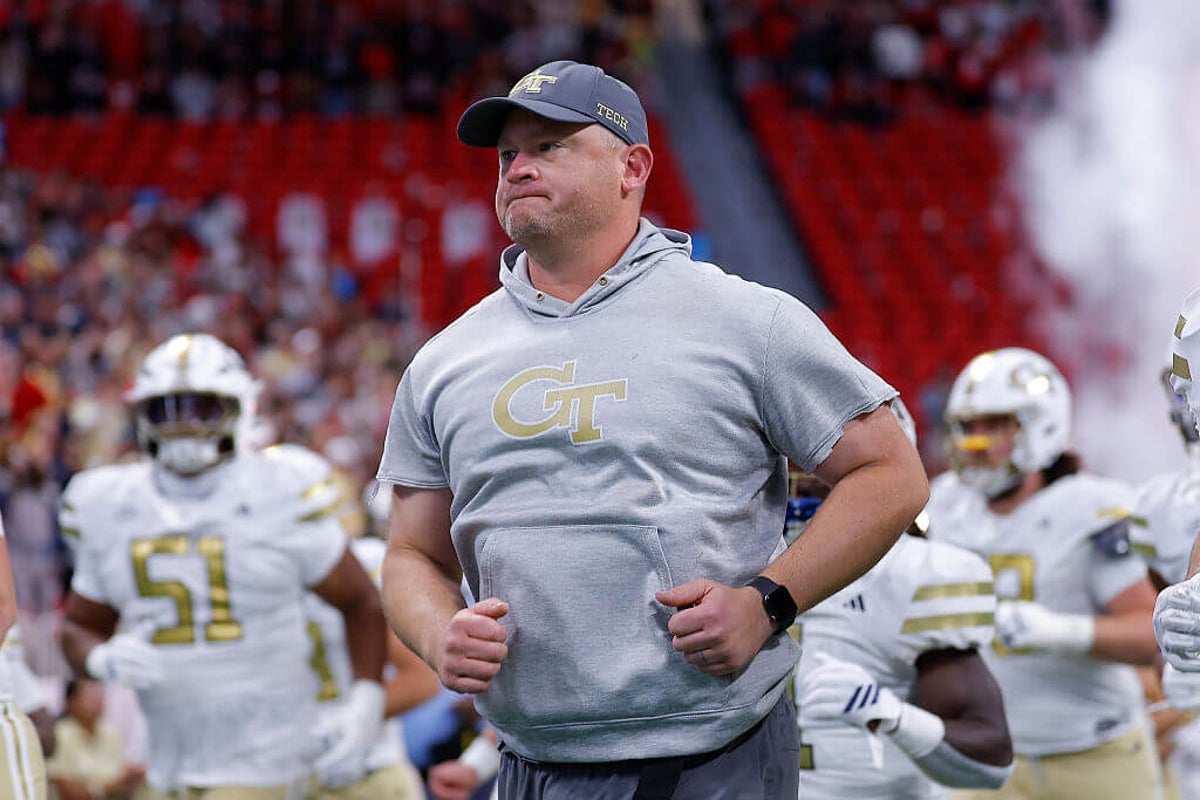
Every Sunday afternoon of this past football season, Georgia Tech sports information director Mike Flynn texted coach Brent Key about where the team was in the updated polls. Normally, Key just sent a one-word reply: “Thanks.”
Then came the third Sunday of October, after Georgia Tech stayed unbeaten with a win at Duke. Key looked at his phone, saw Flynn’s text that they had risen to No. 7. Again, Key replied with a one-word text.
But this time the one word was not fit for print.
Key worried his team was a product of its schedule, lulling everyone — including coaches — into a false sense of superiority. Coaches always worry, but Key proved to be right. Georgia Tech lost four of its final five games, taking some shine off what had been the program’s best season in more than a decade.
Now Key, in his fourth full season coaching his alma mater, enters a season with a measure of pressure attached. Can he keep winning without star quarterback Haynes King, out of eligibility, and offensive coordinator Buster Faulkner, who left for Florida. Does that mean pressure?
“I give that many (cares),” Key said, holding his hand in a zero, and not using the word cares. “I can count them on no hands. Good! I like that. That’s awesome.”
But as good as the last three seasons were for his program, springing it back to national relevancy, Key saw it as also a failure of maturation. Especially last season’s slide. What happened? The schedule got harder, Key admitted. But there were also too many inside the program buying into the hype as they climbed to 8-0 — all against unranked opponents — not ready for success, not addressing their flaws.
A defense giving up too many points. An offense that put up great stats but was too reliant on King and not great in situational football. And a feeling inside the building that things were still fine.
“I think the biggest thing was the sense of not wanting to (mess) it up. Players and coaches,” Key said.
It started to burn the team when it suffered its first loss, 48-36 at unranked N.C. State. The Yellow Jackets’ defense was obviously a sieve. The offense on paper racked up 600-plus yards. But it failed in short yardage and goal-line, and kicked too many field goals.
“But what was out there? Stats,” Key said. “What do stats do? They inflate the sense of reality and competitiveness of the football team. They don’t tell the whole story.”
A week later, Georgia Tech barely escaped at hapless Boston College, 36-34. But the chance was still there for an ACC title, and the College Football Playoff. And if Georgia Tech just beat Pittsburgh at home, it set up the biggest Georgia-Georgia Tech game in years.
Instead … disaster: Pittsburgh jumped out to a 28-0 lead, and while Georgia Tech mustered a comeback, it still lost by two touchdowns. The luster was off the Georgia game, where the Yellow Jackets actually played well on defense, but the offense struggled in a 16-9 loss.
And amid all this, Key said he sensed too many in the building already moving on. The transfer portal and coaching carousel approached. Key himself was being mentioned for other jobs, ultimately signing a contract extension. But there were too many distractions.
“It’s like adults are no different than the kids,” Key said. “Near the end of the year, what’s everyone wants to talk about — oh, the portal’s coming, everyone’s talking to them. They’re talking to the coaches, too. Kids wouldn’t act like kids act if the adults weren’t acting the same. Chew on that one for a minute.
“Put all those things together, that’s where I think, where you’re playing teams that are equal or better than you, you can’t have any one of those things. I’m not saying you can cure it. I’m not saying you can’t blame me. I have to do a better job, I’m the head coach, I take full accountability and responsibility. But you also make the adjustments and changes needed to best fit you for the next season, to stay out of those situations.”
Faulkner was the first coach to leave. Georgia Tech tried to keep him, with sources at the school saying it offered a bump in salary, but it was the attraction of the SEC, plus the chance to work for a purely defensive-minded head coach in first-year Florida coach Jon Sumrall. (Key was the offensive line coach when elevated to head coach.)
Eventually, five more assistants left, including defensive coordinator Blake Gideon, who went to his alma mater Texas after just one year at Georgia Tech. There was also turnover on the support staff. When it came time to hire replacements, Key went for familiarity.
George Godsey, the former Georgia Tech quarterback and NFL assistant coach, took over the offense. Godsey and Key are close friends — Godsey was best man at Key’s wedding. Faulkner modernized the offense, got it passing more and putting up bigger stats. Godsey may be a return to pro-style, conventional football. But if Key is right that the talent and depth has improved, he sees that as a plus.
“We’re a lot more detailed in terms of what we’re going to do schematically,” said quarterbacks coach Chris Weinke, one of the few holdovers. “With Haynes, I called Haynes the eraser, right? He could get you out of a bad play and make an explosive play.”
The likely new starter is Alberto Mendoza, the Indiana transfer and brother of Fernando Mendoza. He’s not the athlete that King is, but between his skill set and smarts, the offense is expected to be a bit less free-wheeling.
The new defensive coordinator is Jason Semore, who was on staff with Key in 2022. He spent the last three years running the defense at Southern Miss and Marshall.
The roster may also look more like what Key, the old offensive line guy, prefers. It was a more pass-heavy and King-heavy approach that got Georgia Tech back to relevancy. In Key’s mind, it will take a more line-heavy approach to stay there. There was “heavy investment” in the defensive line, according to Key, and they also got bigger on the offensive line. And deeper, in Key’s mind.
This was also part of the lesson from last year’s collapse: They were not big or deep enough in the trenches to sustain late into the season.
“I never felt we were as good as people externally said we were. I never felt that,” Key said. “The reason a lot of change was made on the coaching staff is the trust you have to have in coaches. That sense of energy. And not hearing guys say, ‘We’re 6-0, what the hell he’s tripping about?’ …
“Until you’ve been on one of those runs, do you truly understand what it means to block out noise. Because you’re going to hear every bit of it. People aren’t stupid. People don’t go home and not have a TV or not have a radio or not have the internet, not have Twitter. You have all this stuff. Everybody else. But I don’t want to use that as part of the excuse. Or part of the reasoning.”
Key, 48, said he’s learning as a head coach too. He worked for Nick Saban, who adapted and learned. And Key sees last season — the good, then the bad — as part of the program’s maturation.
“The program’s the program, that ain’t changing. I’ve tweaked and altered things every year,” Key said. “Confidence comes through experience. But the program’s not changing. We’re elevating the things I think we need to elevate. We’ll see how it goes this year. …
“I really like this team. I really like this staff. I really do.”