
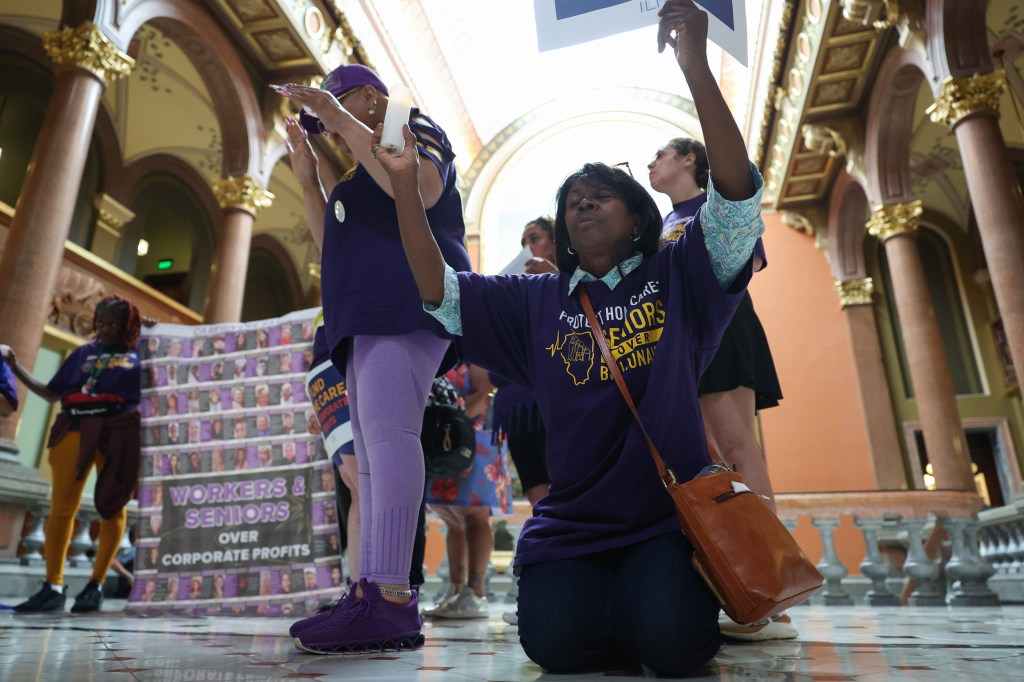
SPRINGFIELD — With one day left before their scheduled month-end adjournment deadline, Illinois state lawmakers Saturday worked to put together a limited package of tax increases and revenue diversions to finance a new state budget of more than $55 billion. But finding agreement on a plan to keep the Chicago Bears in Illinois appeared to be back at square one.
Democratic Gov. JB Pritzker and the Democrats who lead supermajorities in the House and Senate, House Speaker Emanuel “Chris” Welch and Senate President Don Harmon, used the day to follow the advice and admonition that late Republican Gov. Jim Edgar once gave to Pritzker — that the governor’s most “important job is to pass a balanced budget.”
 Scott Hagel, senior vice president of public and governmental affairs for the Chicago Bears, waits outside the Senate and House chambers during the spring legislative session at the State Capitol, May 30, 2026, in Springfield. (John J. Kim/Chicago Tribune)
 House Speaker Emanuel “Chris” Welch, front left, and Senate President Don Harmon exit after a meeting with Gov. JB Pritzker during the spring legislative session at the State Capitol, May 29, 2026, in Springfield. (John J. Kim/Chicago Tribune)
However, talks on the fate of the Bears — who are being lured by a taxpayer-financed stadium package in Hammond, Indiana — hit a critical juncture in a closed-door meeting of Senate Democrats on Saturday night when some Chicago Democrats led the rejection of a long-discussed megaprojects proposal to allow the team to negotiate local property taxes for a site it purchased in the northwest suburb of Arlington Heights. Some Chicago lawmakers want the state to leave open the option of keeping the team in the city — something Pritzker and the team had ruled out.
“The same sticking points are there that have always been there. Discomfort in the caucus with the Bears’ proposal regarding property tax breaks. We’re having a difficult time working through that. We also have members of the Chicago caucus who would like to find some sort of path where the city of Chicago would also have the ability to compete for a stadium,” said state Sen. Bill Cunningham, a Democrat from Chicago and the Senate point person on stadium negotiations.
“It’s fair to say the proposal that the Bears put out there (for negotiated payments to local taxing districts in lieu of taxes) does not have the support to pass,” Cunningham continued. “So we are trying to devise a different approach.”
The combination of the budget and the Bears positioned Sunday, and its scheduled midnight spring session adjournment deadline, as a pivotal day in Illinois’ political and legislative history.
Around 9 p.m., the Senate released a new draft of the state spending plan for the budget year that begins July 1. Buried inside the 3,551-page document were 3.2% cost-of-living increases for the 177 members of the General Assembly, boosting their base salaries to $101,450 — breaking six figures for the first time.
Salaries for the governor, other statewide elected officials, and the heads of state agencies also would increase by about 3.2%, though Pritzker, the billionaire businessman and heir to the Hyatt Hotels fortune, does not take a salary.
The spending plan is likely to undergo additional tweaks before it is called for a vote on the Senate floor. Lawmakers were scheduled to return to the Capitol at 9 a.m. on Sunday to begin their arduous grind toward the finish.
A legislative draft of the tax proposals wasn’t released Saturday night. But proposals being discussed behind closed doors throughout the day included a mix of items Pritzker introduced in his February budget plan and measures pushed by the progressive wing of the House and Senate Democratic caucuses.
While some progressive lawmakers continued to push for additional taxes on wealthy residents and business interests, with support from allied groups that rallied at the Illinois Capitol, consensus appeared to be forming around a smaller package that would likely raise enough revenue to stave off potential cuts feared by some moderate Democrats. They joined colleagues on the political left in pushing for more revenue to bolster social services against federal funding reductions from Republican President Donald Trump’s administration.
Leaving the governor’s office Saturday morning after about a half hour, Harmon, of Oak Park, said talks were going “very well.”
“I’m not expecting any new taxes on real people,” Harmon said. Asked to clarify, Harmon said: “Human beings.”
Welch, of Hillside, echoed that he was “feeling pretty good” about the status of budget negotiations.
“I think we’ll be out of here before June 1,” he said, referring to the deadline to pass a budget before the end of the spring session.
Gas tax talks
In an election year in which Democrats are campaigning on affordability issues and railing against high gas prices stemming from Trump’s war in Iran, one source of additional revenue is an ironic offshoot of their criticism: an unexpected boost in tax revenue from sales based on higher pump prices.
By Saturday afternoon, there was support for the idea among key budget negotiators, despite some resistance from outside groups.
 A demonstrator talks with a police officer as fellow demonstrators hold banners about stopping corporate tax breaks and using tax revenue to fund communities and education during the spring legislative session at the State Capitol, May 30, 2026, in Springfield. (John J. Kim/Chicago Tribune)
 Marc Poulos, center left, talks with colleagues outside the House chamber during the spring legislative session at the State Capitol, May 30, 2026, in Springfield. (John J. Kim/Chicago Tribune)
In the fall, lawmakers agreed to use revenue from the gas sales tax to fund the state’s $1.5 billion transit overhaul. But now, with prices even higher, revenue that’s set to go into transit funding could be roughly $350 million higher than previous projections, said Marc Poulos, who represents the International Union of Operating Engineers Local 150. A one-time diversion of $150 million of that unanticipated surplus to the state’s all-purpose checking account is under discussion.
But even before any legislative language had been introduced, a group of environmental organizations and their allies urged lawmakers “to commit to this being a one-time measure taken in this extraordinarily challenging budget year.”
“Failure to fund transportation for everyone has ripple effects that undercuts our shared goal of an Illinois that works for everyone,” a statement from the Illinois Clean Jobs Coalition said. “It would be a mistake to set this as a precedent, recognizing transit operating costs are rising too as a result of fuel prices and transit is the affordable solution to the household transportation cost crisis for Illinoisans.”
Harmon didn’t comment on the prospect of using gas sales tax revenue to balance the budget when asked about it Saturday morning. Instead, he said there were no plans to raise the gas tax, a prospect that didn’t appear to be on the table.
There have been discussions, however, to temporarily suspend the state’s scheduled July 1 increase in motor fuel taxes, which are dedicated to road construction. The motor fuel tax is set to increase by 1.3 cents on July 1, to 49.6 cents per gallon from the current 48.3 cents. Pritzker has indicated the state could withstand “some sort of pause” in the motor fuel increase and other states, including Indiana and Georgia, have suspended their gas taxes.
This wouldn’t be the first time Illinois has suspended the inflationary increase. Ahead of Pritzker’s first reelection bid in the 2022 general elections, a period of high inflation, lawmakers paused the inflation adjustment for six months.
Republicans, including Pritzker’s opponent, GOP governor nominee Darren Bailey, have repeatedly called on Pritzker to suspend the gas tax hike.
Other revenue ideas
In addition to diverting gasoline sales taxes to the operating budget, the list of proposed revenue measures included a few concepts Pritzker pitched to lawmakers in February.
They include a per-user tax on large social media companies, a one-year shift of state revenue from sales tax on candy, soft drinks and grooming products from infrastructure projects to day-to-day operations, and an extension of a cap on how much corporations can deduct from their state taxes for operating losses.
A tax on digital advertising, a progressive priority, was also on the table, although the final spending plan was unlikely to rely on any funding from the proposal due to uncertainty about its revenue-generating potential and the possibility of legal challenges. Proposals for a tax on online prediction markets and a measure to separate the state from a federal tax break for business owners who sell stocks were in similar positions.
Meanwhile, Pritzker’s proposal to lower the percentage of state income tax revenue that is distributed to local governments, which the governor’s office estimated would boost state revenue by $60 million, was off the table. The proposal was met with consistently stiff resistance from mayors across the state and did not garner enough support among lawmakers to be included.
 State Sen. Celina Villanueva works at her Senate chamber desk during the spring legislative session at the State Capitol, May 30, 2026, in Springfield. (John J. Kim/Chicago Tribune)
With negotiations ongoing late Saturday afternoon, Sen. Celina Villanueva, a Chicago Democrat who chairs the Senate Revenue Committee, said, with many components still in flux, “the goal is to try to help Illinoisans as much as possible, help the people who reside in the state and provide them with a budget that doesn’t come off of their backs because they’re already taking on too much.”
Bears’ megaprojects plan sacked
Cunningham said that after opposition to the long-considered property tax plan for the Bears stadium in Arlington Heights, he hoped to come up with a new plan on Sunday morning that would satisfy lawmakers from Chicago who want the city included as an option.
“Obviously, the city has made it clear they would like to be considered for a new stadium,” he said. “We’d like to come up with some sort of proposal that would put them on an equal plane” with Arlington Heights.
Asked what kind of state incentives would be required for the cash-strapped city or what might emerge as an alternative to the megaprojects plan, Cunningham offered no details.
“I think there’s always been, from day one, there has always been a Chicago problem with the Bears’ proposal,” Cunningham said. “The Bears have had a proposal on the table for a couple of years that asks Chicago members of the legislature to vote for a tax credit that would encourage a business to leave Chicago. Legislators generally don’t do that. That’s always been an obstacle to passing this bill. That’s something we’re working on addressing with our proposal.”
 State Sen. Bill Cunningham works at his Senate chamber desk during the spring legislative session at the State Capitol, May 30, 2026, in Springfield. (John J. Kim/Chicago Tribune)
Legislators, Cunningham said, “want to be comfortable with something that protects the taxpayers, something that their constituents can live with, whether or not the Bears are supportive of it, (which) is very much a secondary concern.”
As for an alternative, Cunningham acknowledged “we haven’t landed on anything yet” but said he was hoping to “be able to land on a plan.”
The collapse of the megaprojects deal came weeks after the House, in late April, sent the Senate a measure that would allow the Bears to enter into special payments in lieu of taxes, or PILOT, agreements with local governments involving the 326-acre site of the former Arlington International Racecourse. The team acquired the property in the northwest suburb of Arlington Heights for $197.2 million in February 2023.
The House bill would have allowed large-scale developers, such as the Bears, to freeze their property tax assessments for 25 to 45 years in exchange for the PILOT payments. The Bears were also seeking roughly $855 million in infrastructure funding.
Unlike Indiana’s package, the Illinois bill would not fund stadium construction directly but would aim to provide the Bears with the financial certainty team officials said was essential to moving forward at Arlington Park.
In addition to opposition from Chicago lawmakers, Democratic sources said Cunningham also was having difficulty with some progressive Democrats who contended the plan was a giveaway to a multibillion-dollar professional sports enterprise. Supporters countered that the Bears would be forced to negotiate any property tax breaks with local schools and other property tax districts.
The opposition of Chicago lawmakers to the Arlington Heights plan intensified when Mayor Brandon Johnson visited Springfield in early May and raised the prospect of resurrecting a $4.7 billion lakefront stadium proposal from 2024 that Pritzker and top lawmakers rejected out of hand as too costly to taxpayers. But Cunningham maintained that even as lawmakers were considering the Arlington Heights plan, “the Bears have met repeatedly with the city of Chicago over the last several months to talk about” a city stadium proposal. Still, the Bears have maintained publicly that the team’s only viable options for a new stadium remain in Arlington Heights or Hammond.
Pritzker and Johnson have bickered recently over the bill, with the governor insisting the mayor had “no plan” for a new Bears lakefront stadium, while Johnson said the 2024 plan never got a “fair” hearing in Springfield.
Pritzker’s housing plans struggling
Pritzker’s high-profile package of proposals to promote housing affordability statewide, one of his most ambitious policy pushes this year, appeared to be flagging Saturday.
The core of the proposal, a pitch to generally allow multi-unit housing statewide on lots currently zoned for single-family homes, seemed headed toward continuing negotiations over the summer, said Austin Busch, a staff member with the organization YIMBY Illinois, which stands for “Yes In My Back Yard.”
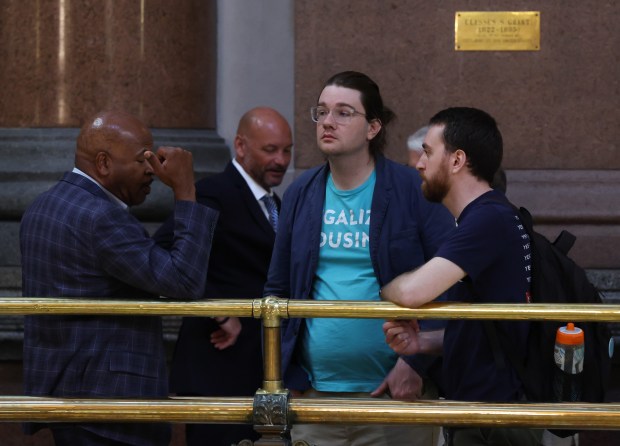 Austin Busch, state advocacy coordinator for YIMBY Illinois, center right, talks with colleagues outside the House chamber during the spring legislative session at the State Capitol, May 30, 2026, in Springfield. (John J. Kim/Chicago Tribune)
“Everything we’re seeing out of the legislature shows that it’s going to be worked on more over the summer,” Busch said Saturday afternoon, noting that the latest version in the Senate “hasn’t been heard in committee, let alone the floor” or in the House.
The governor’s proposal to reduce housing permitting timelines also seemed to be on the same path, Busch said. A spokesperson for the governor did not immediately respond to a request for comment Saturday.
Less than two weeks ago, when asked about his collection of housing proposals, Pritzker had said he believed there was “a pretty good prospect of many of them, maybe most of them, passing.”
The latest version of the so-called middle housing bill included language to protect some buildings in designated anti-gentrification zones, seemingly aimed at the Northwest Side Preservation Ordinance area in Chicago.
Progressives in that region of the city have expressed concerns that broadly allowing more multi-unit buildings could end up actually replacing more affordable existing options. Gary Jimenez, a housing organizer with the Northwest Side group Palenque LSNA, on Saturday said his group was grateful for that provision but that there was “still some work to be done.”
On energy and technology, measures that would require data centers, whose power demands have strained the electric grid, to draw from local renewable sources and meet new water and electricity reporting requirements seemed to be on the ropes as well.
 Demonstrators gather for a rally about proposed legislation to regulate construction of data centers during the spring legislative session outside the State Capitol, May 30, 2026, in Springfield. (John J. Kim/Chicago Tribune)
 State Sen. Ram Villivalam speaks at a rally about proposed legislation to regulate construction of data centers during the spring legislative session outside the State Capitol, May 30, 2026, in Springfield. (John J. Kim/Chicago Tribune)
Despite growing public frustration with data center energy and water use, a push by progressives for a slew of new data center regulations lacked sufficient support. Chicago Democratic state Sen. Ram Villivalam, the main Senate sponsor of the so-called POWER Act, skirted the issues that held up the bill, but he said more community outreach was needed.
“When we’re trying to accomplish a major goal change, it’s going to take time to, you know, work with our constituents, work with stakeholders, to get something that I think is really groundbreaking done,” Villalavam said.
Under the measure, “hyperscale” data centers would face stricter water and energy reporting requirements, set water efficiency standards and pay their own energy costs.