
As part of our Language of Soccer World Cup series, The Athletic is speaking to supporters of all 48 nations competing at the 2026 edition to capture their unique football culture, distilled into a single phrase. You can read the articles in one place here.
Diverse. Complicated. United.
That, in three words, is U.S. soccer fandom. It’s the faithful few who travel coast to coast. It’s the millions attached to this infectious but fragmented sport, their interest divided among dozens of different leagues and teams. It’s also the soccer agnostics, the rabid sports fans who obsess over basketball or American football but ignore the world’s football for years at a time. Every fourth year, all those groups rally around the U.S. men’s national team, united by a belief that their overlooked squad — and this overlooked sport — can rise and shock the world.
“It’s a relentless optimism,” says Antonio Borjon, a U.S. fan in Southern California.
Throughout the 2026 World Cup, it will stretch from SoFi Stadium to suburban Illinois; from bars in Manhattan to homes in Birmingham, Alabama; from Denver to the Dakotas, from New Hampshire to New Mexico, all across the 50 United States.
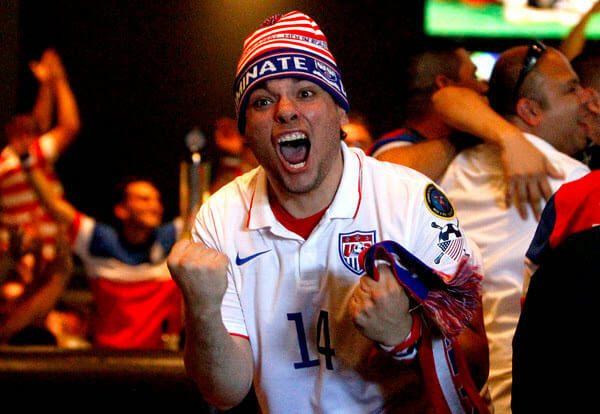
Antonio Borjon is a passionate USMNT supporter (Antonio Borjon)
And it will overwhelm any cynicism, apathy or frustration that typically trails the USMNT — the now-popular moniker for the U.S. team.
Its fanbase, like the vast country it represents, is varied and difficult to define. It’s also relatively nascent. American soccer, just a few decades ago, existed in society’s shadows. “I loved soccer as a child,” says Gerald Foston, whose fandom dates back to the 1970s. “Unfortunately, growing up in the South Bronx, I didn’t find many people who loved it like I did.”
Then, throughout the 1990s and 21st century, soccer began attracting people from all walks of life, from all regions and backgrounds.
Some, including Randy Hernandez, came to it naturally. The California-born son of Mexican immigrants, he latched onto his local team, the LA Galaxy, and later to the U.S. national teams.
Others, such as Craig Hahn, adopted soccer when “it was still a very niche thing.” Growing up in Pittsburgh, he played the sport but rarely found it on TV. The EA Sports video game “FIFA,” and later the internet, became his “gateway” to the broader soccer world. But it was American soccer — and the idea of “building to something, hopefully some day to win a World Cup,” Hahn says — that “piqued my interest.”
American soccer’s gorgeous complication, though, has always been that millions of Americans latch onto teams other than the USMNT. When compared to other countries, and even to other American sports, this is one of several dynamics that makes U.S. fandom distinct.
If, by contrast, you were born into a family of Newcastle United fans in England’s north east, you probably support Newcastle and England’s national team. If you were born in Montevideo, you likely support either Penarol or Nacional and almost certainly love the Uruguayan national team.
If, however, you are born in Wisconsin to parents who love the NFL’s Green Bay Packers; or in Washington, D.C., to parents who came from Colombia, you might feel no organic attachment to the USMNT. In a family of immigrants, you might support the motherland’s team.
And in Wisconsin, you’d have to choose soccer — but you might choose FC Barcelona over a middling national team that never comes to your state, charges objectionable ticket prices, and only plays a handful of meaningful games per year.
As a result, “the hardcore fanbase for the USMNT that travels around to different games is actually quite small,” Hahn, a member of the Sammers supporters’ group, says.

The Sammers are one of the most prominent USMNT fan groups (Sammers SC)
The generational fandom that follows the Packers or New York Yankees, or Liverpool or the Colombian national team, doesn’t yet exist in American soccer.
Others explain that the size of the country and the lack of a national stadium, which turn the USMNT into a “traveling circus,” disrupt continuity and hinder the formation of any consistent, identifiable supporter culture.
Many U.S. supporters have even grown accustomed to feeling like away fans on American soil. Over the past few years, they’ve been outnumbered by Morocco supporters in Cincinnati; by Colombia supporters in Maryland; by Turkey supporters in Connecticut; by Guatemala supporters in St. Louis; by South Korea supporters in New Jersey; and by Mexico supporters virtually anywhere.
It’s a byproduct of the country’s diversity. The games are opportunities for immigrant families to lean into identities and feel connections to home. But still, says Monty Rodrigues, a longtime U.S. fan who emigrated from India when he was young, it “feels so weird, and it’s disappointing. And at times, it’s heartbreaking.”
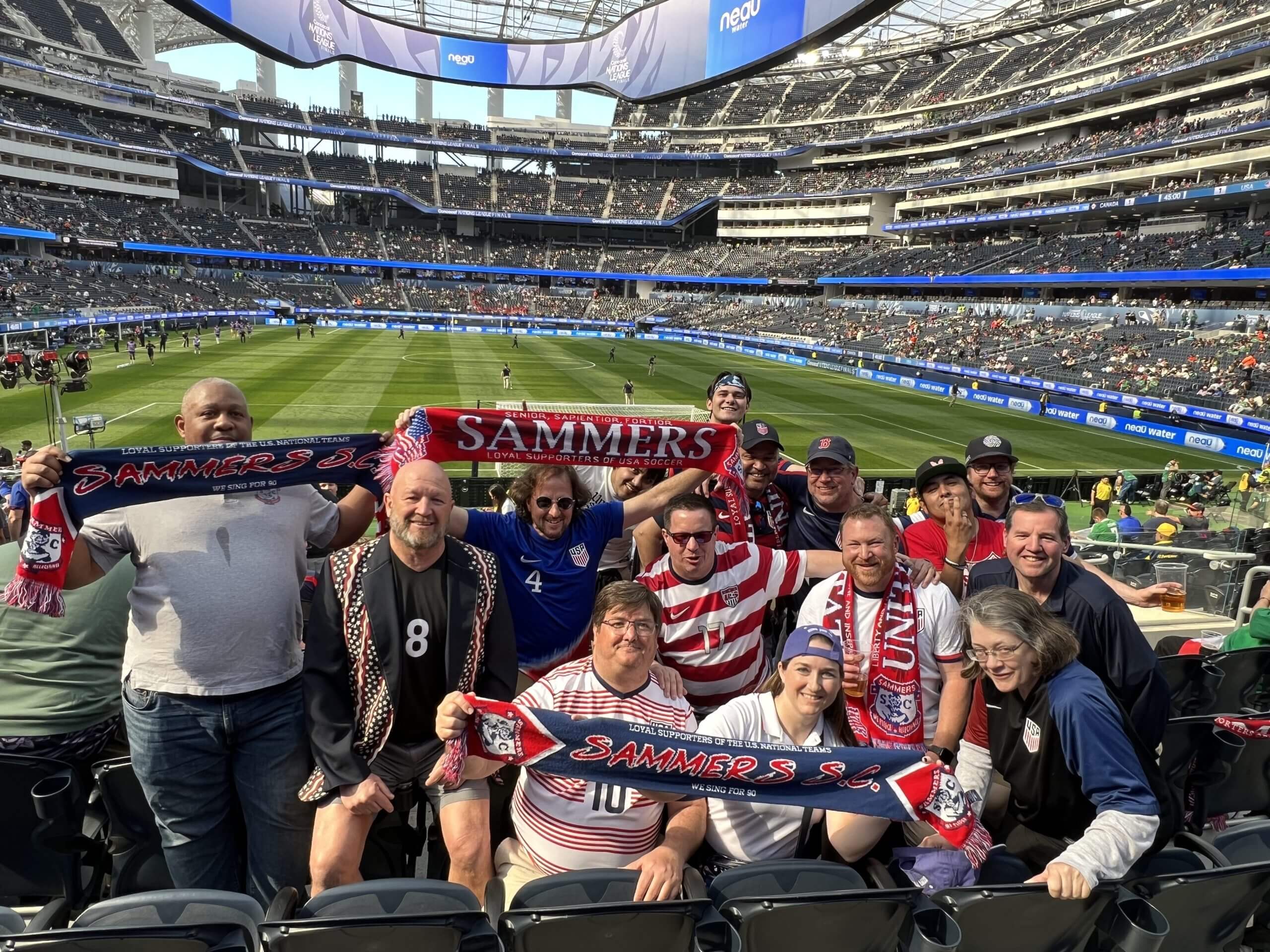
The Sammers group will get the chance to support their team on home turf this summer (Sammers SC)
Some of those same fans of other countries, though, also develop attachments to the USMNT. Elliott Montalvan, a New Yorker whose father moved to the U.S. from Ecuador as a teen, remembers watching the Ecuadorian national team as a child, and “the culture of being raised in an Ecuadorian household” being “very instilled into me.” But his father didn’t force any fandom onto him. As he grew, he also fell in love with his local team, the 2015 MLS expansion club NYCFC; and then with the USMNT.
When the U.S. and Ecuadorian national teams would face off, he felt conflicted. “I mean, I grew up wearing Ecuadorian jerseys all my life,” he explains — and his father still wore them. Nonetheless, Elliott would throw on a U.S. jersey. He’d watch with dad. “We’d sing both national anthems, and we’d celebrate every goal, no matter who it came from,” he says.
His story, and countless similar stories across the States, are “what makes us unique,” Montalvan says.
Whereas “Ecuadorian fans are Ecuadorian fans through and through,” he explains for the sake of comparison, “here in the United States, it’s a melting pot, bro. It’s cliche to say, but like, you have everybody, from all ethnicities… celebrating and supporting U.S. soccer.”
And now, as the president of Barra 76, a U.S. national team supporters’ group, Montalvan lets that diversity drive the culture that he and others are trying to pioneer and shape.
“We have everybody’s culture,” he says. “It’s like creating the ideal superhuman. Like, what’s one superpower you want? Well, USA has got all of them.”
He and others know that outside perceptions of U.S. soccer fan culture range from “corny” to “shallow” to “nonexistent.” With respect to matchday atmospheres and chants, Montalvan says: “You see the commentary or the criticism: It looks very Chucky Cheese, or it looks very cringe, or it looks very, ‘They don’t know what they’re doing.’ It sounds very nursery rhyme-ish. Whatever elementary school adjective you want to give, that’s what it sounds like.”
But he and his peers see opportunity. Opportunity to change the perception. Opportunity to bring people in. Opportunity to blend soccer cultures and flavors from around the world — from Latin America to Eastern Europe, from Africa to China — and create something fresh.
“We don’t want to copy (other regions); we want to be authentic,” Hernandez, another Barra 76 member, says. “Sure, we’re a nation of immigrants, but at the end of the day, we’re the United States; we mix together to make something new.”
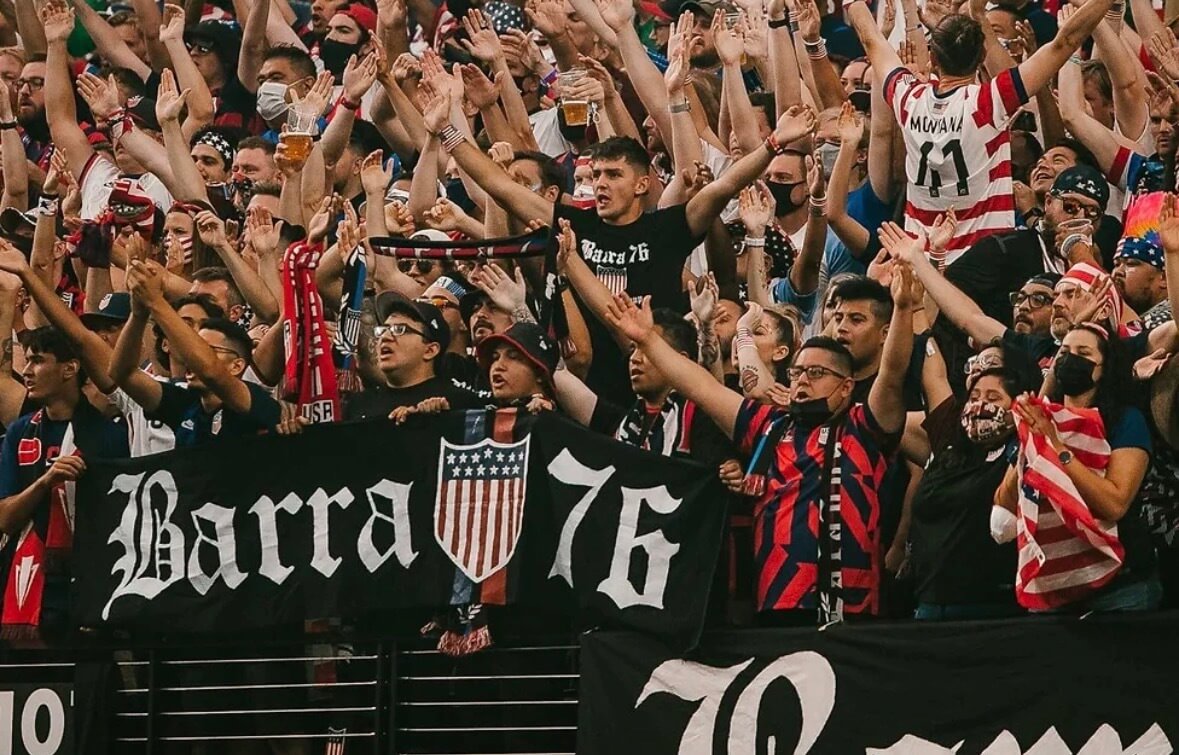
The Barra 76 fan group make themselves heard at a USMNT game (Randy Hernandez)
And the 2026 World Cup, of course, is an unparalleled opportunity to do all of that.
For consequential games — World Cup qualifiers and continental championships — the USMNT fanbase expands multifold. The people obsessed with Barcelona or Arsenal become aware. The NFL zealots who also follow their city’s MLS team, perhaps originally fueled by local pride, might tune in.
And then, when the World Cup rolls around, the base explodes. Patriotism swells. Bandwagons fill.
Some see analogies to the Olympics. But the men’s World Cup is different. “If you’re talking about the U.S. basketball team, hockey, baseball, the U.S. is always one of the favorites, or expected to win,” Hahn explains. “In men’s soccer, it’s the opposite.”
And that’s part of the allure. It’s an opportunity for America, the juggernaut of all juggernauts, the richest and most powerful country on the planet, to identify with an underdog.
“I don’t know that I would care to go watch the USA baseball team play anywhere,” says Christine Mule, a member of the American Outlaws supporters’ group. “The USA basketball team plays in the Olympics and they’re pretty much gonna crush anybody that they come up against.”

The American Outlaws support their team against Belgium in March. (Kevin C. Cox / Getty Images)
Soccer, on the other hand, “is still in a phase where it’s growing,” she continues. And people want to grow with it.
That’s part of why the diehards travel to games, enduring awkward conversations with locals who don’t even know it is happening.
“It’s the opposite of frontrunning,” says Jon Strauss, a Boston-area fan since the 1990s. “It’s that ethos: Get in on the ground floor and work your way up.”
And it’s part of why millions will jump aboard and join them this summer. It’s to build, and rise, together.
And when they all do, for hours or days at a time, the fragmented fanbase will feel like one. Complications will be forgotten. Differences will dissipate.
“There’s this unifying force,” Trevin Wurm, an American Outlaws member and staffer, says of USMNT games. No matter the locale, “it’s the same country, it’s people cheering toward the same goal, and coming together to create community before the game, and celebrating the team in the stadium. It’s kind of this amazing thing.”
The Language of Soccer series is sponsored by Google.
The Athletic maintains full editorial independence. Sponsors have no control over or input into the reporting or editing process and do not review stories before publication.