
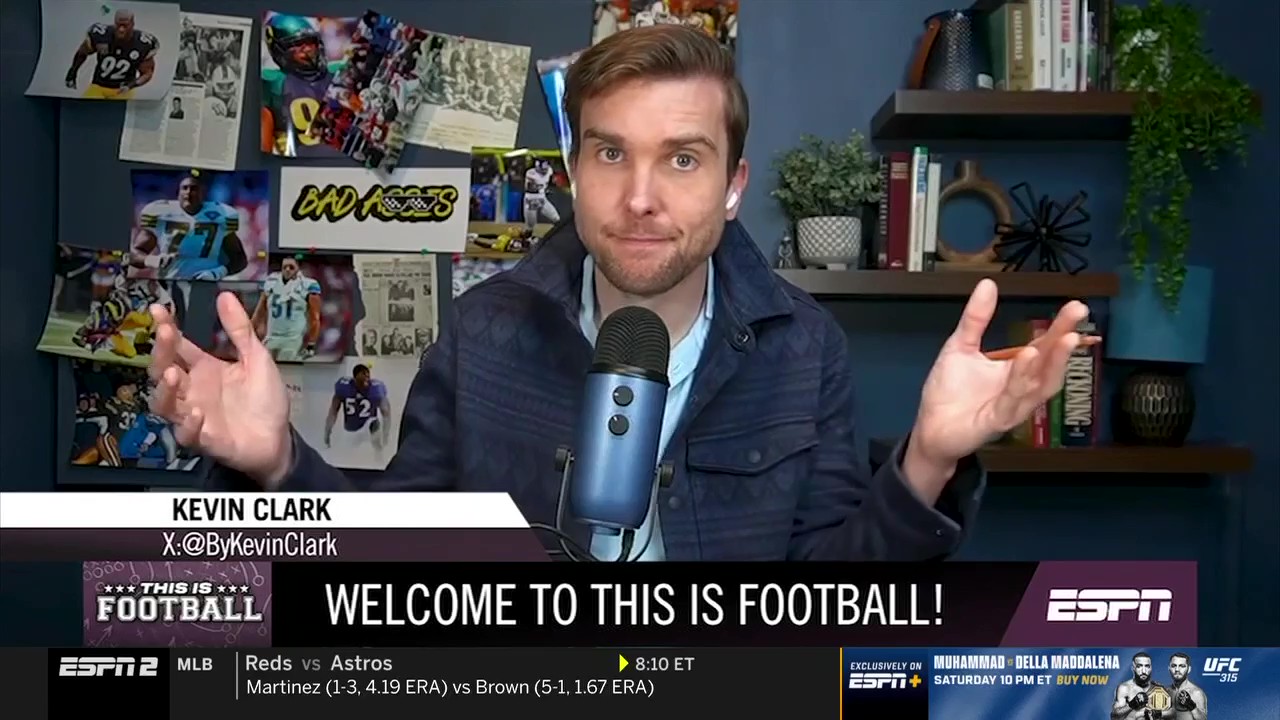
Kevin Clark’s first brush with Bill Simmons came and went without leaving a mark, at least for The Sports Guy.
Clark was a teenager, trailing his family through a Super Bowl week near their place in St. Augustine, Florida, when he recognized Simmons across a restaurant and worked up the nerve to introduce himself. Simmons was gracious about it, the two bantered for a moment about who’d win on Sunday, and then the encounter evaporated as quickly as it had materialized.
“It was like seeing Michael Jordan for me,” Clark recalls.
What actually mattered happened years later and had nothing to do with that brief handshake. By then, Clark had spent years building a name for himself covering the NFL at the Wall Street Journal, and that body of work was what landed him in Simmons’ orbit. The email that followed arrived without preamble or pleasantries.
“I think that what you’re doing would be a really good fit for what we’re building,” Simmons wrote. “When can you talk?”
Clark’s contract at WSJ was running out, and he had at least three offers on the table, including one from Sports Illustrated. Clark turned all of it down for a company that didn’t have a name yet, run by someone he’d met exactly once, in passing, at a Super Bowl
“I remember my dad laughing and was just like, if you heard two years ago that Sports Illustrated would offer you a job,” Clark recounted to host Brandon Contes on this week’s Awful Announcing Podcast. “I love the concept of Sports Illustrated, all that stuff. I love Sports Illustrated, they still do great work. But my dad was like, if you’d been told two years ago, three years ago, Sports Illustrated offers you a job, and the no-brainer was a startup podcast company — and again, that’s nothing against Sports Illustrated, that’s for what new media had become — you would’ve been like, what the hell is going on, right?”
Clark was traveling for the Journal at the time, so the two connected by phone once he was back in New York. Simmons laid out his vision, Clark talked to Sean Fennessy and a few others who were already on board, and that was enough.
“It was just a home run,” Clark said. “The Ringer was the no-brainer for me.”
What made the decision feel obvious in the moment, Clark said, was advice he’d gotten from Brian Rolapp, now the PGA Tour commissioner, who at the time was running NFL Media’s digital and rights operations. Rolapp told him that the old hierarchy — where the best job in sports media meant Sports Illustrated, or the New York Times, or the Washington Post — no longer applied.
“Any job can be the best job in America now,” Clark said, recalling Rolapp’s framing. “It used to be you had to go work at Sports Illustrated, you had to go work at the New York Times, you had to go work at the Washington Post in order to have the best job in the country. And the best job in the country was the most powerful beat at the place with the most reach. That was literally it for 100 years. And then after 2012, 2013, 2014, you could literally just become the most powerful person on your own. You could just start a YouTube page, you could just start a Substack, and make millions of dollars. When you think about people who actually have the best jobs, none of those people are what we thought the best job was 25 years ago.”
That same logic is part of why Clark didn’t think twice about Simmons specifically.
“I’ve said this before — if Bill was like, ‘Do you want to be a janitor? I’m gonna start a math textbook company, and you’re going to be my janitor,’ I’d be like, alright, I’ll be it for a couple years,” Clark said. “If you align yourself with really smart people, good things are going to happen.”
Clark spent seven years at The Ringer before leaving for Omaha Productions and ESPN in early 2024 to launch what became This Is Football. He said the exit was the kind he hopes to have for the rest of his career, with Simmons and the rest of The Ringer staff among the people he’s still closest with.
“I work my ass off for these companies,” Clark said. “I try to do everything the right way. I try to be upstanding. I’m not a douchebag. I’m not a jerk. And so my goal at any place for the next 50 years where I work is to have the kind of calls I had at the end of The Ringer, or frankly at the end of the Journal.”
The bet on Omaha and ESPN has paid off about as well as it could have. This Is Football made its TV debut on ESPN2 in September 2024 after building an audience on ESPN’s digital platforms, and the show expanded from a half hour to a full hour the following spring. Clark has also become a fixture on ESPN’s debate and studio shows, including First Take, and that range helped him land on Awful Announcing’s 2026 Rising Stars list, which singled him out for being as comfortable talking Xs and Os with Mina Kimes as he is chatting college football with Paul Finebaum.
Contes also asked Clark whether Simmons had ever expressed any reservations about him leaving for ESPN, the network Simmons himself departed under famously contentious circumstances years earlier. Clark said it never really came up between them.
“I don’t really know much about his perspective on that right now,” Clark said, noting that much of the ESPN leadership from Simmons’ time at the network has since turned over.
Contes pushed the thought further, wondering aloud whether Pat McAfee’s reported $60 million-a-year ESPN extension could have ever been part of a world where ESPN found a way to bring Simmons or pieces of The Ringer back into the fold, especially before The Ringer’s Netflix deal and renewed Spotify partnership.
“Maybe,” he said. “Above my pay grade, thankfully.”