
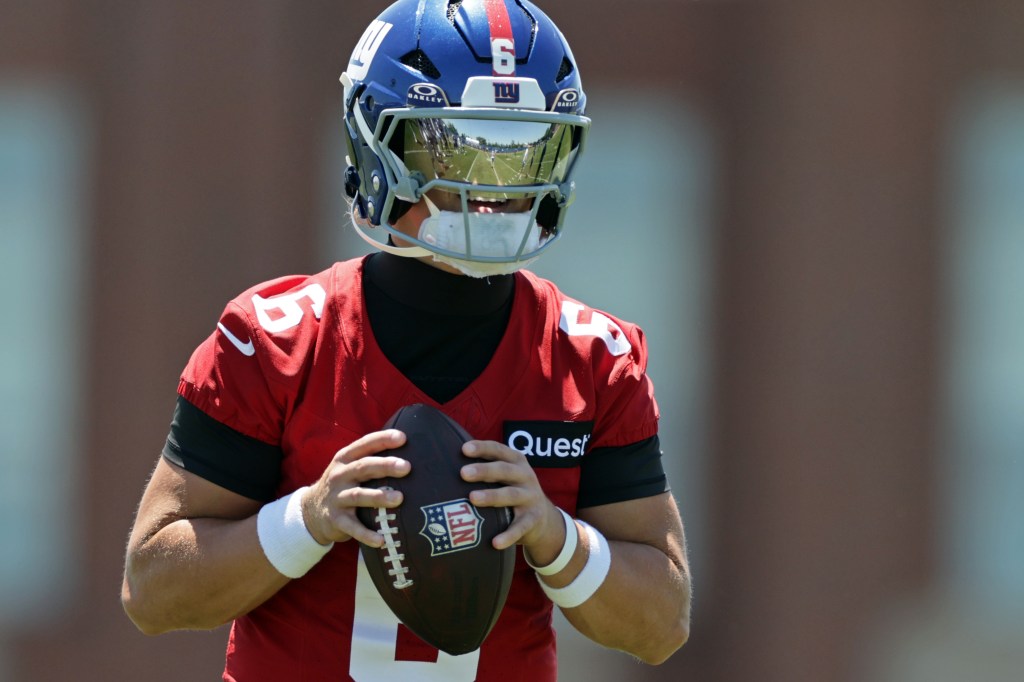
Giants quarterbacks coach Brian Callahan said Jaxson Dart’s timing, which connects to his eyes and footwork, is an emphasis to improve the second-year QB’s performance in the pocket.
“It’s a first-year player coming into the second year, so [we’re looking to improve] everything from knowing the new system and tying the footwork in and eyes and feet,” Callahan said Wednesday after the team’s final minicamp practice. “It’s really ground zero for us because everything’s new. So we just start there and keep teaching.”
“I think for him eye discipline and footwork consistency have been the two things that we focus a lot on, and I think he’s really answered the bell over the course of the spring,” Callahan added later. “There’s a lot of good things he did [last year]. Just trying to build on that and then try to refine it. And to me the biggest mark for the quarterbacks in this league is how consistent are you with those things.”
Callahan, who was fired after two seasons as the Tennessee Titans head coach, was Peyton Manning’s Denver Broncos QB coach for the Super Bowl 50 winners in 2015. He was Joe Burrow’s offensive coordinator in Cincinnati prior to his time in Nashville. Then he had a chance to work with last year’s No. 1 overall pick Cam Ward with the Titans.
The son of longtime NFL and offensive line coach Bill Callahan is now the Giants’ passing game coordinator on top of coaching Dart and the QBs. And his voice was a prominent one on the practice field this spring.
That’s partially due to how head coach John Harbaugh and Matt Nagy delegate. It’s also because Callahan is charged with the most important element of Harbaugh’s team: The retraining and improvement of Dart.
To hear Callahan tell it, he has not sugarcoated any of the coaching points for Dart, and the quarterback has been coachable in taking his coach’s advice and applying it on the field.
Not that Callahan is trying to change everything. The Giants remain high on plenty of Dart’s qualities as a player. They’re just trying to refine them and marry them into Nagy’s new system.
“[You] try really hard to let Jaxson be Jaxson,” Callahan said. “He’s got a skill set that’s unique to him, and he’s done a lot of really nice things so far early in his career. His ability to improve on things I think is important. And we had some very direct conversations about what those things are and a very specific plan for the spring.
“[We planned] what we wanted to get better at and how we wanted to get better at it, what drills we’re going to do, how it’s going to integrate with what we’re going to do, the teamwork,” he continued. “So it was planned out. We talked about [it in] one of our early meetings, but very, very strategic in that regard. And he did a really nice job with it. I think he’s gotten better over the course of the spring.”
Callahan said the primary coaching point on pocket presence has to do with making sure “your feet are in rhythm with what the play design is.” To stay on time, Dart needs consistent “eye discipline,” and the Giants’ coaches can continue to tailor the system and play wrinkles to Dart’s unique rhythm, as well.
That “helps that decision making process and that timing and that tempo that you want to play with the rhythm in the passing game,” he said.
Situational work is putting constructive pressure on Dart to learn from mistakes or overcome odds in practice so he’ll be ready for it when he sees them in the games, too.
“His ability to take coaching, make corrections, make mistakes and then fix them I think has been really fun,” Callahan said. “It’s been a fun coaching journey this spring.”
For example, Callahan said, Tuesday’s second minicamp practice included a “very specific, very, very challenging period where we did all fourth downs. So fourth and sixth to 10, obviously not a very high conversion percentage down.
“The defense has given us all kinds of different looks and pressures. It’s really hard for the quarterbacks,” he said. “They don’t like it. It’s very tilted in the favor of the defense. But those are the moments that you can actually, I think, get the most growth … because there’s failure involved and there’s really hard challenging things that come up.”
Dart had “one or two” plays in that period that were “pretty dang good,” Callahan said, and “the defense nailed a few too,” as is to be expected.
Regarding Dart’s running and decision making outside the pocket — the elephant in the room with the young QB — Callahan did note that while reviewing some of Dart’s mistakes last year, the quarterback and his coach didn’t agree on how Dart should have approached some of those situations, even in hindsight.
“You’re honest about it. You approach it pretty straightforward,” he said. “And when you have a chance to point something out like that, you point it out. You know, we don’t always have to agree on every situation. And the best thing is, is those are all now in the past. And it’s more about what he does moving forward at this point… He’s incredibly coachable. He’s very open minded. And I think he understands that for us to be the team we want to be, we need him on the field. And I think that’s really important.”
Callahan said Dart’s running ability is “unique.” But the coaches clearly have tried to hammer into Dart’s head that there is a difference between taking chances on conversion downs rather than on first and second downs, from a risk-reward perspective.
“You maybe get to a point where, hey, look, it’s a first and 10, I don’t need you to lower your shoulder and try to run through somebody,” he said. “Just get on the ground or get out of bounds and we’ll move on to the next play. But I never want to take that ability for him to affect the game with his legs, because it’s something that makes him a really dangerous player in the league.”
Dart’s legs make him dangerous. His footwork and eye discipline and timing in the pocket, though, can differentiate him if he takes Callahan’s coaching points to the practice field in training camp and the regular season games this fall.