
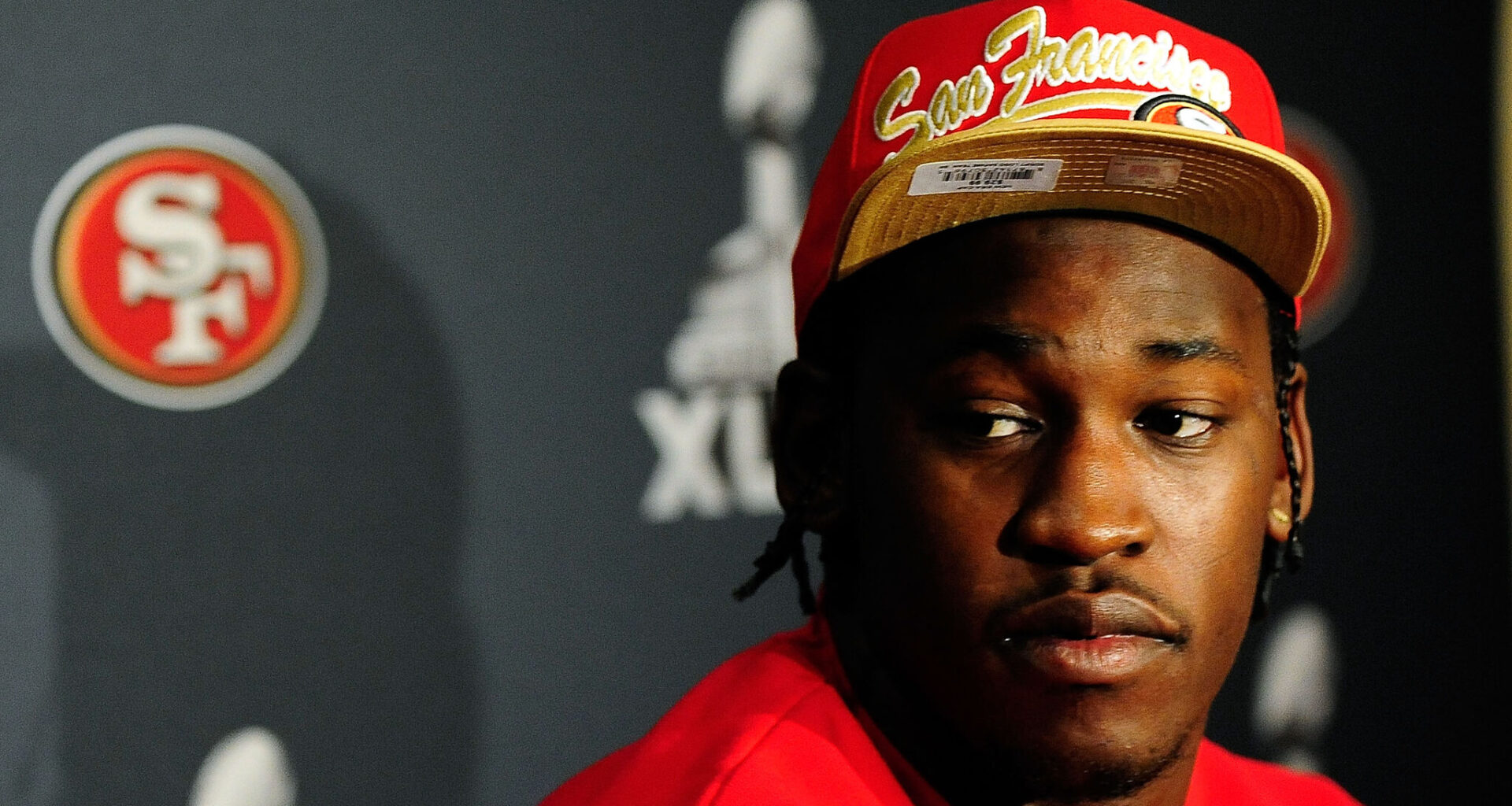
San Francisco 49ers defensive end Aldon Smith speaks on Jan. 28, 2013, during a media availability session for Super Bowl XLVII in New Orleans, La. In a “Laced Up” interview posted days before his death, Smith spoke candidly about gratitude, struggle, life after football and his bittersweet return to the Bay Area.
Stacy Revere/Getty Images
Days before former 49ers pass rusher Aldon Smith died in the South Bay, he appeared in a Bay Area barber’s YouTube interview reflecting on a difficult return to the region where his NFL career began.
“I’ve definitely had better days,” Smith told Tee Maultsby in a video interview posted to YouTube in the days before the former San Francisco 49ers star died at 36.
When Maultsby, host of the barbershop interview series “Laced Up,” asked whether Smith wanted to elaborate, Smith hesitated.
Article continues below this ad
“Yeah, but I kind of don’t,” Smith said in the first clip, posted June 9. “It’s along the lines of something I think I’ve been dealing with my whole life and I’m just struggling with accepting how it’s playing out right now.”
Then he corrected himself.
San Francisco Chronicle Logo
Make us a Preferred Source to get more of our news when you search.
Add Preferred Source
“To be honest, I’m grateful, man,” Smith said. “I’m in a place of gratitude right now. It’s been a tough week, but it’s been rewarding, and it’s starting to pay off. Things are starting to happen.”
The interview, posted as part of a conversation with Smith on Maultsby’s YouTube channel, has taken on new weight after Smith’s sudden death Saturday. The most recent clip was posted Friday.
Article continues below this ad
Smith was found unresponsive in a friend’s pickup truck in Los Gatos and was later pronounced dead at Good Samaritan Hospital in San Jose, according to the Santa Clara County medical examiner and a friend who spoke with the Chronicle.
As of Monday, no official cause had been released.
Smith, drafted seventh overall by the 49ers in 2011, became one of the NFL’s most dominant young pass rushers almost immediately. He had 14 sacks as a rookie and 19.5 in 2012, still the 49ers’ single-season franchise record, earning first-team All-Pro honors and a Pro Bowl selection.
His career later unraveled through suspensions and legal problems, many tied to substance abuse. After stints with the 49ers, Oakland Raiders and Dallas Cowboys, Smith last appeared in an NFL regular-season game in 2020.
Aldon Smith of the San Francisco 49ers looks on from the bench during the fourth quarter of a preseason game against the San Diego Chargers on Aug. 24, 2014, in Santa Clara. Smith died suddenly on Saturday at age 36.
Thearon W. Henderson/Getty Images
In the interview with Maultsby, Smith described the end of his career as painful and unfinished.
Article continues below this ad
“My career didn’t end with the ending that I think it maybe should have,” Smith said. “I wasn’t proud of how things ended.”
Smith said he moved to Texas after football, unsure what he wanted to do next. He said he stayed in an extended-stay hotel in Frisco, began trying to finish school and briefly worked for a roofing company, knocking on doors to sell roof packages.
“I was broke. I was broken,” Smith said. “I was in a relationship, I got my heart broken in that. And so it was just — I was dealing with a lot of adversity.”
He described the job as humbling. The work, he said, forced him to adjust his ego and gave him a way to feel useful outside the identity that had defined him since high school.
“It made me feel like everything was all right because I found myself looking forward to doing normal” things, Smith said.
Article continues below this ad
Smith told Maultsby he did not want to coach football or become a broadcaster after leaving the NFL. He said he learned the game in an unorthodox way and did not feel suited to teaching it.
“I have nothing against football,” Smith said. “But I knew that environment — on the coaching side — it’s not something that I had interest in, or being an analyst. That’s just not me.”
The most poignant parts of the interview centered on Smith’s return to the Bay Area, where he built his NFL reputation and where his career began to slide.
Asked what it felt like to be back, Smith called it “bittersweet.”
Article continues below this ad
“I’ve gotten such a warm reception from people and places I’ve gone,” he said. “But I don’t feel as if I’m ready to be back here right now. Just ’cause this is like home, the people are like family.”
He described the Bay Area as a place where people could stumble into kindness.
“The hospitality, and just the vibe you get,” Smith said when asked what made the Bay feel like home. “I’ve lived (in) a lot of places, I’ve traveled a lot, and some places you go, you feel like you can leave the house with whatever you got. And some places you feel like you got to leave the house and you got to make sure you got everything planned out.”
Still, Smith said he had not fully settled into being back.
“I wasn’t expecting to be back in the Bay,” he said. “It hasn’t really sank in that my situation has changed and I’m back here. And so I don’t know if I’ve gotten a chance to really enjoy it or let my guard down.”
On Saturday, according to Smith’s friend Amir Shirazi, Smith helped deliver pizzas to a homeless charity before he was found unresponsive.
Shirazi told the Chronicle that Smith had been struggling financially and was staying with friends while waiting for his NFL pension to begin.
The 49ers said in a statement that the organization was “devastated by the sudden and tragic passing of Aldon Smith,” remembering both his “undeniable talent” and an “infectious smile that lit up every room he walked into.”
Former 49ers running back Anthony Dixon, who Shirazi said helped perform CPR on Smith, mourned him in a raw Instagram post, calling Smith “my brother, my teammate, my friend.”
“His presence, his passion and his Aura meant a lot to me as a brother and I wish I could’ve did more to help him,” Dixon wrote.
Dixon apologized to Smith’s family and said he was grateful to have seen Smith before his death.
“These are truly hard moments and something I can admit I was not ready for,” Dixon wrote, adding that he would continue to “spread your message on mental health awareness because it’s real.”
“I love you bro,” Dixon wrote. “Fly High.”