

Steelers Analysis•Steelers News
 Pittsburgh Steelers quarterback Aaron Rodgers in a game against the Baltimore Ravens on Jan. 4, 2026. — Ed Thompson / Steelers Now
Aaron Rodgers is officially the Pittsburgh Steelers’ quarterback for the 2026 season, and the move was hardly surprising.
After all, Rodgers is a future Hall of Famer, a four-time NFL MVP, and one of the greatest quarterbacks to ever play the position. Even at 42 years old, there is value in a quarterback who has seen every coverage, played in every situation, and understands how to operate an NFL offense at a high level. But as the dust settles, it’s fair to wonder whether Pittsburgh once again chose the safer option over the potentially more rewarding one.
The most fascinating comparison isn’t another veteran quarterback. It’s Malik Willis. At first glance, the comparison sounds ridiculous. Rodgers is one of the most accomplished quarterbacks in NFL history. Willis was nearly written off as a bust just a few years ago. Yet when looking at where both players stand entering 2026, the conversation becomes much more interesting than many Steelers fans might expect.
The first thing that stands out is the money. Rodgers signed a one-year deal worth roughly $22 million. Willis signed a three-year contract with the Miami Dolphins that averages roughly $22.5 million annually. In other words, the Steelers and Dolphins are committing nearly identical money to two completely different quarterback situations. One is a 42-year-old quarterback likely entering the final chapter of his career. The other is a 26-year-old quarterback whose best football may still be ahead of him.
That difference matters because no matter how well Rodgers plays in 2026, he is a short-term solution. Even in a best-case scenario, Pittsburgh will likely enter next offseason asking the same question it has been trying to answer since Ben Roethlisberger retired: who is the quarterback of the future? Willis at least offered the possibility of being that answer.
To understand why, it’s important to understand how he got here. Coming out of Liberty, Willis was viewed as one of the most physically gifted quarterbacks in the 2022 NFL Draft. Scouts loved his arm talent, athleticism, and ability to create outside of structure. The concerns centered around his processing, consistency, and overall refinement as a passer. Those concerns looked justified during his time in Tennessee. Across two seasons with the Titans, Willis completed just 53 percent of his passes, threw zero touchdowns against three interceptions, and frequently looked overwhelmed by NFL defenses. By the time Tennessee traded him to Green Bay for a seventh-round pick, most around the league had already labeled him a failed experiment.
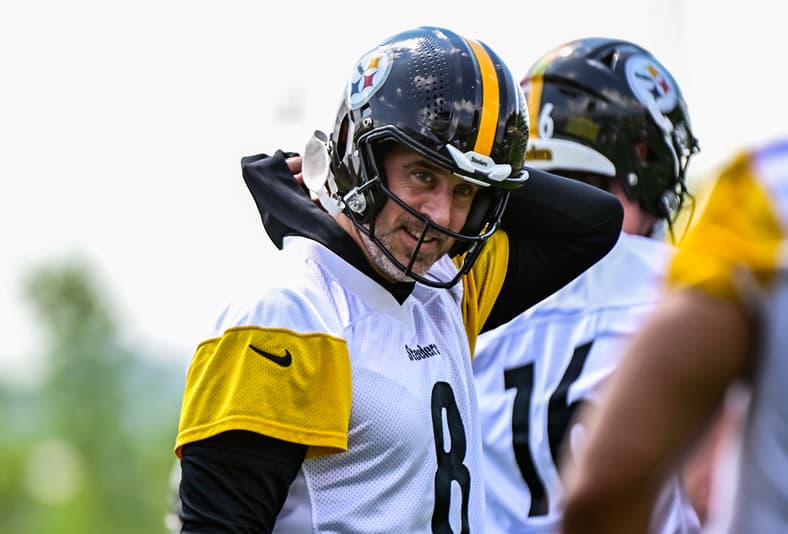 Pittsburgh Steelers quarterback Aaron Rodgers at OTAs on May 18, 2026. — Ed Thompson / Steelers Now
Then everything changed. Instead of being thrown into the fire, Willis landed with Matt LaFleur and one of the NFL’s best developmental environments. He was allowed to sit, learn, and develop rather than being asked to immediately save a franchise. When Jordan Love missed time, Willis got his opportunity and made the most of it.
The results were eye-opening. Willis completed over 74 percent of his passes, posted a 124.8 passer rating, averaged more than 10 yards per attempt, and didn’t throw a single interception. According to PFF, he recorded three Big-Time Throws and zero Turnover-Worthy Plays. On traditional non-play-action dropbacks, he completed 48 of 57 passes while posting one of the lowest off-target rates in football despite pushing the ball downfield. Most importantly, the film matched the numbers. The same quarterback who looked completely lost in Tennessee suddenly looked comfortable working through progressions, finding second and third reads, and delivering accurate throws from the pocket. For a player whose biggest weaknesses centered around processing and decision-making, the growth was impossible to ignore.
Of course, the biggest argument against Willis is obvious: the sample size. Maybe Green Bay’s system inflated his numbers. Maybe defenses simply didn’t have enough film on him. Maybe he regresses now that he’s expected to handle a larger workload. Those are all fair concerns.
But that’s also the point.
The Steelers were in a similar position just one offseason ago when they had opportunities to pursue Sam Darnold. Instead, they spent months waiting on Rodgers. Fast forward a year later and Darnold is coming off a Super Bowl-winning season in Seattle while looking every bit like a franchise quarterback. The lesson isn’t that Willis is guaranteed to follow Darnold’s path. It’s that quarterback development is rarely linear. Sometimes talented players simply need time, coaching, and the right environment before things finally click.
The other factor is fit. The modern NFL increasingly revolves around quarterbacks who can create when things aren’t perfect. Players like Jayden Daniels, Lamar Jackson, and Josh Allen don’t just win from the pocket. They create offense when protection breaks down and turn negative plays into positive ones. Rodgers used to be one of the best in football at doing exactly that. At 42 years old, that simply isn’t his game anymore. For a Steelers team that still has a young offensive line with questions to answer, having a quarterback who can create outside of structure carries real value. Willis provides that element. Rodgers largely does not.
At the same time, it’s important to acknowledge that Pittsburgh didn’t completely ignore the future. The Steelers invested a third-round pick in Drew Allar, one of the highest-upside quarterbacks in the 2026 draft class. But even that decision reinforces the larger point. The Steelers are already betting on projection with Allar. They’re already betting on traits, upside, and development. Willis represented a similar bet, except one that already had tangible NFL growth attached to it.
As for Rodgers, none of this is to say he was a bad signing. There is a reason Pittsburgh pursued him. But the idea that Rodgers remains an elite quarterback is difficult to support based on what happened in 2025. According to ESPN’s Ben Solak, Rodgers ranked 33rd out of 38 quarterbacks in dropback success rate. He finished near the bottom of the league in multiple efficiency categories and looked far more reliant on quick-game concepts than the off-script wizardry that once defined his career. At this stage of his career, Rodgers wins primarily with experience and processing. He still understands defenses at an elite level, but much of the mobility and creativity that once made him special has disappeared.
That can still work. But it also means the margin for error is much smaller than it once was. Rodgers is entering his age-42 season and is only a few years removed from a torn Achilles. Even if he plays solid football, there is always the possibility of further decline or injury simply because of where he is in his career. And that’s ultimately what makes this debate so interesting.
 Green Bay Packers quarterback Malik Willis (2) throws during the third quarter of their game against the Baltimore Ravens Saturday, December 27, 2025 at Lambeau Field in Green Bay, Wisc. Mark Hoffman / Imagn ImagesCredit: Mark Hoffman / Milwaukee Journal Sentinel / USA TODAY NETWORK via Imagn Images
The risk with Willis is that the sample size was too small and he regresses. The risk with Rodgers is that we’ve already seen signs of decline, and at 42 years old there is no guarantee it stops there.
Ultimately, this isn’t really a debate about Aaron Rodgers versus Malik Willis. It’s about organizational philosophy.
Since Ben Roethlisberger’s retirement, the Steelers have repeatedly prioritized certainty over upside at quarterback. Time and time again, they’ve chosen the option with the higher floor instead of the one with the higher ceiling. Sometimes that’s understandable. There is comfort in knowing what you’re getting.
But the downside of that approach is that it becomes incredibly difficult to find greatness. Finding a franchise quarterback often requires taking uncomfortable risks. It requires betting on development. It requires believing in what a player can become rather than simply what he is today. The irony is that Pittsburgh is still searching for a long-term answer because it has spent years avoiding those types of risks.
Maybe Rodgers proves everyone wrong and turns back the clock. Maybe Willis regresses and Miami looks foolish. Maybe Drew Allar develops into the quarterback Pittsburgh has been searching for all along. But if Willis continues the trajectory he showed in Green Bay, the Steelers may once again find themselves asking a familiar question:
Did they miss on a quarterback because they were too focused on finding the safest answer instead of the right one?
Mentioned In This Article: Aaron Rodgers Malik Willis Pittsburgh Steelers Steelers