
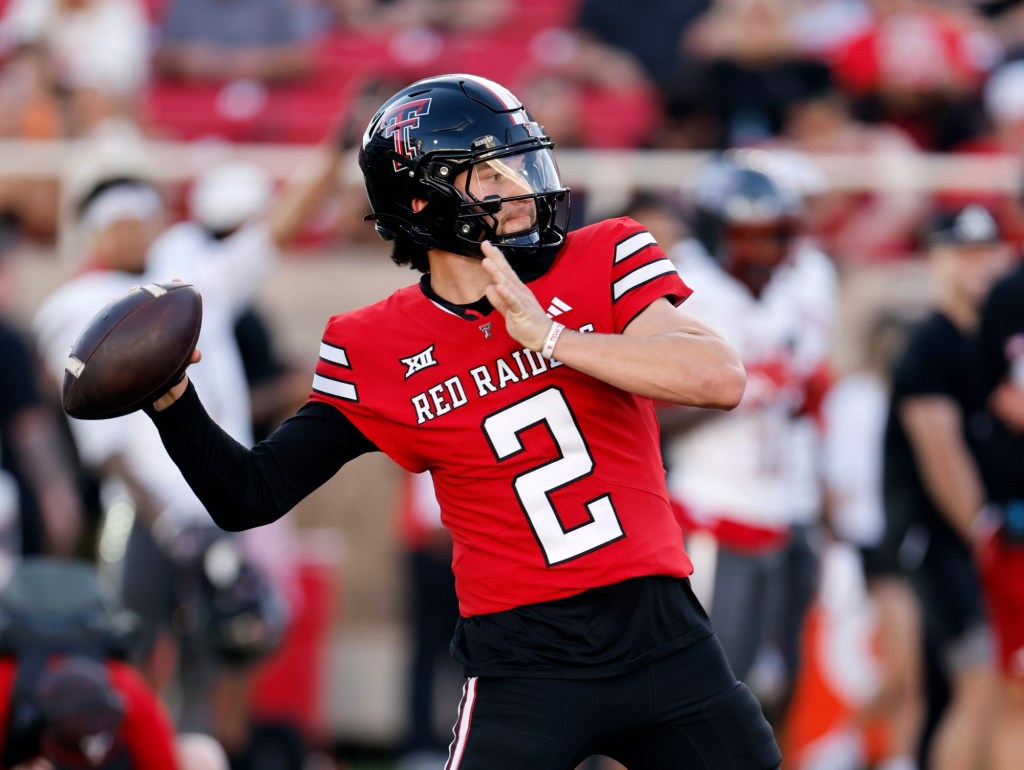
For most National Football League prospects, the road from college football to the pros follows a familiar route: Saturdays, scouts, combine interviews, scripted pro-day throws and, if everything goes right, the main stage in April.
Brendan Sorsby’s route ran straight through the mess.
His path has wound through gambling disclosures, inpatient rehabilitation, an NCAA reinstatement denial, a Texas courtroom, a Big 12 fight, fierce public backlash and, finally, a June 22 supplemental draft deadline that left him with only one sensible move.
Leave now.
The former Indiana, Cincinnati and Texas Tech quarterback has applied for the NFL supplemental draft, choosing the narrowest doorway into the league rather than waiting to learn whether a temporary injunction, a Big 12 lawsuit and an NCAA appeal would leave him eligible, suspended or stranded — or leave the Red Raiders exposed to sanctions.
Sorsby is not a fringe prospect trying to sneak into the league through a side door. He is a 6-foot-3, 235-pound quarterback with starter traits, a high-end arm, legitimate rushing ability and enough 2025 production with the Bearcats to enter this offseason as one of the most coveted players in the transfer portal.
Texas Tech expected him to be the centerpiece of a roster built to contend. He was also expected to be one of the sport’s highest-paid players, with a reported NIL package north of $5 million.
Now he is the most fascinating supplemental draft case in years, assuming the NFL chooses to hold one.
What is the NFL supplemental draft?
The supplemental draft is the NFL’s emergency hatch for players whose eligibility status changes after the deadline for the regular draft.
It is not held every year, and the league still must approve Sorsby’s application before there is a supplemental draft this summer.
The format is like a blind auction. The NFL sets an order through a weighted lottery, split into three groups: teams with six or fewer wins, non-playoff teams with more than six wins and playoff teams.
Once the order is established, teams submit bids by round. If a team bids, say, a second-round pick on Sorsby and wins, it gets the player and forfeits its second-round pick in the 2027 draft.
If multiple teams bid in the same round, the team highest in the supplemental order wins. If nobody bids, Sorsby becomes an undrafted free agent.
That makes this a complicated calculation. Teams must judge Sorsby not only against their current quarterback rooms, but against a 2027 draft class expected to be teeming with high-end talent.
The last supplemental draft was held in 2023, and no players were selected. The last player picked was safety Jalen Thompson, whom Arizona took with a fifth-round bid in 2019.
The last quarterback selected was Terrelle Pryor, a third-round pick by the Raiders in 2011. The last quarterback to command a first-round supplemental bid was Dave Brown, selected by the Giants in 1992.
There have been hits.
Bernie Kosar became a Cleveland icon after entering through the supplemental draft in 1985. Cris Carter became a Hall of Fame wide receiver with Minnesota after Philadelphia took him in the fourth round in 1987.
Josh Gordon, Ahmad Brooks and Jamal Williams all became impact players.
There have also been cautionary tales.
Sorsby the prospect
On my draft board, Sorsby would’ve ranked ahead of Ty Simpson had he entered the April draft, behind only Fernando Mendoza.
Looking ahead to 2027, only Texas’ Arch Manning and Oregon’s Dante Moore would have entered the season ahead of him.
That isn’t because Sorsby is polished. He isn’t.
It’s because the ceiling is obvious.
He has the prototypical build, the live arm and the movement profile NFL teams prioritize. His release is quick and whippy from a three-quarters slot, and he can drive deep outs, backside digs and crossers from the opposite hash without needing a pristine platform.
The athleticism is not decorative, either. Sorsby can hurt defenses on scrambles, zone-read keepers and designed quarterback power.
He reportedly hit 19.9 mph on a scramble, and he runs like a 235-pounder who understands exactly how big he is. He can absorb contact, escape through arm tackles and extend plays without immediately drifting into panic.
That is the good stuff.
The problem is that the same confidence that makes Sorsby exciting also gets him into trouble. He believes he can make every throw, and too often, he tries to prove it.
The hero ball shows up on tape. So do the late throws into bracket coverage, the forced balls into windows that never existed and the negative plays created by refusing to check the ball down or throw it away.
When pressure speeds him up, his feet can get choppy and his base can flatten, which causes his accuracy to scatter.
There is also a level-of-competition question. His best production came against lesser defenses. Against better coverage structures, the processing was less clean.
If Sorsby were spotless, he would not be entering the supplemental draft. He would be preparing for a season at Texas Tech, building a Heisman Trophy campaign and trying to force his way into the top of the 2027 NFL Draft.
Instead, NFL teams are left with the Sorsby Paradox: the traits are first-round interesting, the circumstances are anything but.
And that leads to the bigger question.
Trust.
The quarterback touches the ball on every play. He is the face of the franchise and the center of the locker room.
Still, the league has not treated every college gambling case as career-ending.
Former Iowa State quarterback Hunter Dekkers, who was ruled ineligible after betting violations, eventually signed with New Orleans in 2025 as an undrafted free agent after a junior college stop.
Patriots receiver Kayshon Boutte faced underage gambling charges from his LSU days, but the charges were dropped and he was not disciplined by the NFL.
Before teams judge how Sorsby throws at his July 10 Dallas-area pro day, they will have to decide how much risk they are willing to absorb with everything surrounding him.
Teams will have to be comfortable with his treatment, accountability, support structure and the possibility of league discipline. They will have to assess whether this is a player who has made a serious mistake and begun rebuilding his life, or a player whose risk profile remains too unstable for the most important position in sports.
What is Sorsby worth?
A first-round bid would be bold, maybe reckless, considering no supplemental player has gone that high in more than three decades. A third-round bid would be comfortable but probably too light.
If Sorsby is approved and the league holds the draft, likely in mid-July, one team probably will be willing to spend a 2027 second-round pick on a quarterback who might have become a top-10 pick with a clean season in Lubbock.
Six teams stand out, with three dark horses worth watching.
Jets: They make the cleanest football sense. Geno Smith is under contract for 2026, which means Sorsby would not have to be rushed into action. New York drafted Cade Klubnik in the fourth round this spring, but that is not enough of an investment to block another swing. If the Jets believe Sorsby can sit for a year, reset and grow behind a veteran, they should be in the second-round conversation, especially considering they have three first-round picks in next year’s draft.
Dolphins: Miami is another natural fit. The Dolphins signed Malik Willis, but his deal does not lock them into a long-term marriage. Sorsby would give Miami a bigger-armed, more physically imposing developmental option and insurance against Willis being more bridge than answer.
Cardinals: Arizona should not be out simply because it used a third-round pick on Carson Beck. The Cardinals’ quarterback room, led by Jacoby Brissett and Gardner Minshew II, is functional at best. Sorsby has a higher ceiling than anyone in the room. If Arizona is still searching for a true long-term answer, this is the kind of uncomfortable swing bad teams are supposed to take.
Colts: Daniel Jones is returning from a torn Achilles, and former first-round pick Anthony Richardson has requested a trade and is reportedly no longer central to the team’s long-term plans. Sorsby would give Shane Steichen the kind of big, athletic, dual-threat quarterback his system is built to amplify.
Buccaneers: Tampa Bay belongs in the conversation because Baker Mayfield is entering the final year of his contract. Sorsby offers succession-plan value with more upside than the usual developmental quarterback.
Vikings: Minnesota has Kyler Murray secured for only one season and still has to decide how much it believes in J.J. McCarthy. Sorsby could become the kind of leverage play that eventually forces a trade. Kevin O’Connell’s quarterback-friendly system would provide a clean developmental environment for a mobile passer who needs mechanical refinement.
The dark horses are just as interesting.
Browns: Cleveland can’t be dismissed, even if coach Todd Monken called the idea of pursuing Sorsby a “slippery slope.” The Browns have Deshaun Watson and Shedeur Sanders competing, but neither offers anything close to certainty.
Steelers: Pittsburgh needs a post-Aaron Rodgers plan, and third-round rookie Drew Allar should not prevent a more aggressive swing. Sorsby would give the Steelers another big, physical quarterback with starting traits and enough mobility to fit their offensive identity.
Falcons: Atlanta has Michael Penix Jr. and Tua Tagovailoa, but new coach Kevin Stefanski inherited a quarterback room with talent and questions, not a settled franchise pillar. Sorsby would be a luxury swing, but quarterback rooms change fast when a new staff begins evaluating its future.