
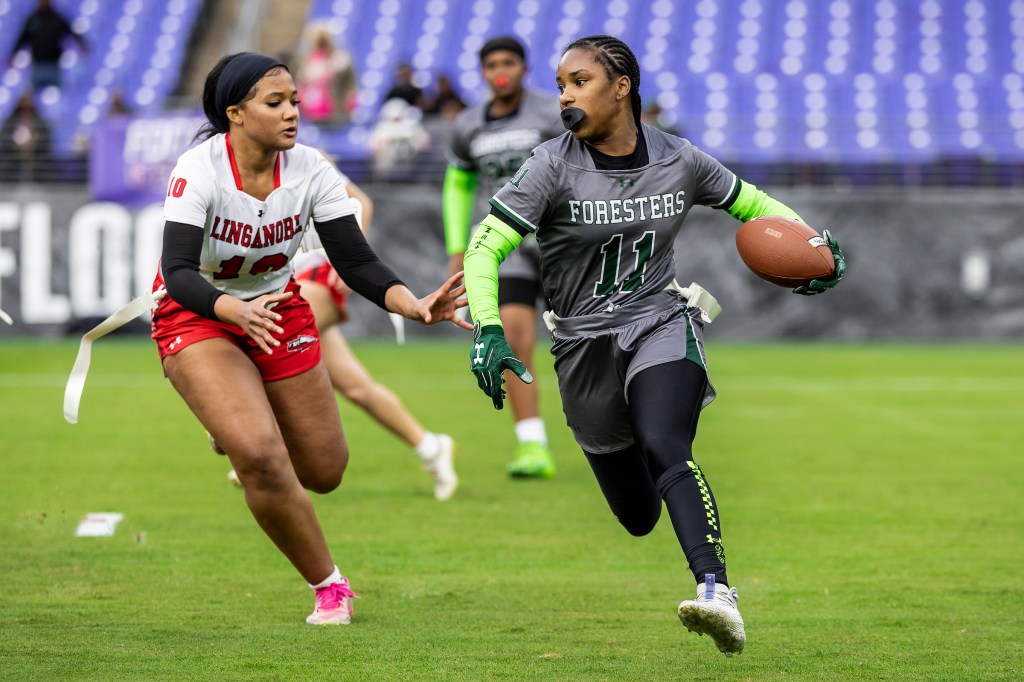
The Mid-Eastern Athletic Conference’s recent announcement that it would add women’s flag football to its stable of sports for the 2026-27 academic year was greeted with enthusiasm by its three member schools in Maryland, even though Baltimore’s two Historically Black Colleges and Universities said they won’t begin sponsoring teams until the following year.
Coppin State will look to launch a club team in a few months before promoting that squad to varsity status for 2027-28, athletic director Derek Carter said last week. Morgan State is planning to distribute a student interest survey this fall before deciding whether to start a team, athletic director Dena Freeman-Patton said last week.
Nonetheless, both Carter and Freeman-Patton said they are excited about the prospect of offering women’s flag football to their athletes.
“This has been brewing over the last few months,” Carter said. “Certainly, we’ve heard that the interest level is high. Once the final word came out, most of our students were gone, but this has been talked about. So clearly there’s an interest on our campus and on many campuses.”
At an administrative level, the MEAC schools must, among other priorities, hire coaches and staff, develop facilities for training and games, and begin recruiting prospects. But Carter said he was pleased to see the conference take charge.
“Many schools and conferences are bringing on flag football,” he said. “I think the MEAC is doing a good job of getting out on it quickly, but the interest is there nationally. So this is going to be a sport that’s going to grow quickly.”
The MEAC said that championship formats and additional operational details will be announced at a later date.
UMES, the third state-based member of the MEAC, announced last week that it would begin competing this upcoming year.
Mount St. Mary’s recently completed its inaugural season, going 9-16 and defeating Wagner in the first round of the Eastern Collegiate Athletic Conference playoffs before falling to Franciscan in the second round. On May 28, Washington College announced it would begin playing at the club level for the 2026-27 year and move to the varsity tier for the spring of 2028.
The NCAA Committee on Access, Opportunity and Impact recently voted to recommend that Divisions I, II, and III add a national collegiate flag football championship beginning as early as the spring of 2028. As of this summer, more than 75 colleges will compete in women’s flag football at the NCAA or club level, surpassing the NCAA’s 40-school requirement.
Women’s flag football is one of the fastest-growing sports in the athletic landscape. It topped 59 other disciplines at last year’s World Games in Chengdu, China, as the most-watched sport across streaming platforms, according to the International Federation of American Football.
In the United States, 68,847 girls played flag football for their high schools during the 2025-26 academic year, according to the National Federation of State High School Associations. Between the 2023-2024 and 2024-25 school years, 25,000 more girls signed up for high school flag football, which was offered in almost 1,000 more schools.
In April, the Maryland Public Secondary Schools Athletic Association sanctioned girls’ flag football as a varsity sport for the 2026-2027 academic year. A projected 132 high schools will compete for state championships in three classifications at M&T Bank Stadium in Baltimore in mid-November.
Freeman-Patton witnessed flag football’s popularity when Morgan State hosted the MEAC Girls on the Gridiron Flag Football Clinic, which attracted about 200 players to Hughes Stadium last July. The Bears will host their fourth consecutive clinic on July 19.
“I was blown away,” she said. “So I think it’s an awesome time for the MEAC to get involved and be on the ground floor by starting women’s flag football and being a part of the movement.”
Flag football got a significant boost when the 2028 Summer Olympics in Los Angeles will introduce the sport in both men’s and women’s formats. The NFL has agreed to allow its players to participate in the Olympics.
While acknowledging the power of the Olympics, Carter credits the sport’s popularity to a more fundamental rationale.
“I believe young ladies grow up watching football,” he said. “NFL and college football is the most popular sport in America, and it allows them the opportunity to participate in football, a game that they’ve grown up on and have been watching with their friends, families, dads. So it gives them an opportunity. I’m very excited about seeing just exactly where this is going to progress.”
Have a news tip? Contact Edward Lee at eklee@baltsun.com, 410-332-6200 and x.com/EdwardLeeSun.