
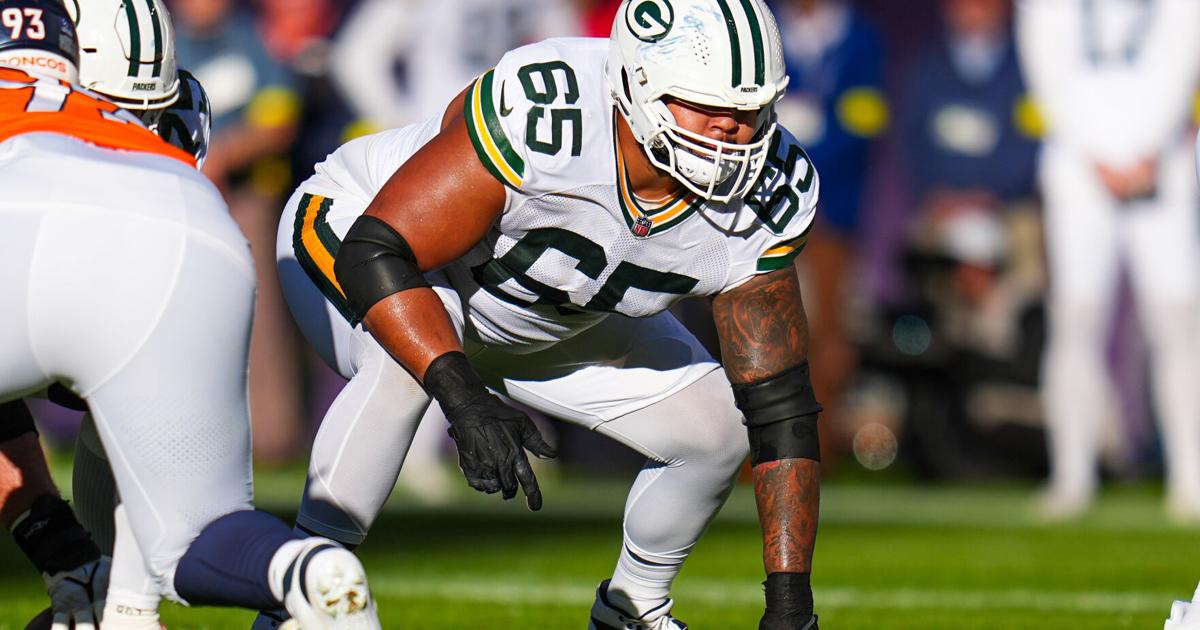
After injury-derailed first season in Green Bay, the veteran offensive lineman wants to take a more vocal leadership approach — and stay healthy — to help his younger teammates
GREEN BAY — Aaron Banks’ first season with the Green Bay Packers was a disappointment. Especially to Aaron Banks.
Coming over from the San Francisco 49ers on a four-year, $77 million free-agent deal that contained a $27 million signing bonus, Banks’ injury issues nagged him before the season even began, with back and knee issues limiting him throughout camp.
And although he only missed two games (one with an ankle injury, another with a groin injury), he missed parts of two others and played at less than 100% for most of the year, and his performance showed it. His overall grade of 53.5 from Pro Football Focus ranked him 64th out of 81 guards the site graded, and he played only 749 of the offense’s 1,051 regular-season snaps (71.3%).
“Yeah, there were a lot of frustrating moments,” Banks confessed during the team’s offseason program. “Some of which [was], just being frustrated at myself, just looking in the mirror like, ‘Man, just get healthy. We’ve got to go show them who you are and what you can do.’
“There’s frustration always when you deal with injuries. But I’m excited to come into this season and be healthy, have a year under my belt with the guys, have that camaraderie, build that togetherness amongst the O-line and just keep taking steps forward every day.”
The Packers appear convinced that that’s exactly what will happen with Banks, who’ll turn 29 on Sept. 3, 10 days before the season kicks off on Sept. 13 at Minnesota. The way his contract was structured, the team could have easily moved on from Banks after just one year, but instead restructured his contract to guarantee even more of the money in it.
Banks had a $9.5 million roster bonus due in March and was scheduled to be paid a $7.7 million base salary in 2026. Although releasing him would have left the Packers with more than $36 million in dead cap money, his nearly $25 million cap number would also have been wiped out — meaning it would have only cost them about $11 million in net cap room to move on.
Instead, the Packers converted most of that money into a signing bonus, allowing them to spread out the salary-cap charge and lower Banks’ cap number. He got nearly $16 million in guaranteed money — meaning he’d gotten roughly $44.5 million from the team in a 12-month span — and sending a very clear signal that they want him to be a stalwart on their line.
“I mean, [we saw] flashes, and I think he’ll tell you the same,” offensive line coach Luke Butkus said. “He will never make an excuse — I’m not making an excuse for him either — [but] he was banged up, he was in a new system, but he’ll be the first one to tell you, it doesn’t matter.
“He’s going to come to work. Did we see some really good things? Absolutely. And then there’s some things we need to clean up, and that’s our job as coaches [and] his as a player — to have a vision of what he needs to do to get better. But coming back for the second year, I think he’s a guy that’s going to be really good for us, and really good for the younger guys in the room.”
That’s Banks’ goal, too — to play better, and be a better leader after the team released Elgton Jenkins, a former Pro Bowl left guard who moved to center after Banks’ signing and was the unquestioned leader in the room before his season-ending leg injury last year.
“I’ve never been like a super rah-rah type of guy. I’m more of a lead-by-hard-work, lead-by-example guy,” Banks said. “But being the oldest guy in the room now, I don’t have a choice. Me doing those things and stepping out of my comfort zone will help everybody else maybe step out of their comfort zone and just put it all out there.
“We’re all moving forward. Not leaving anybody behind. Everybody gets better, everybody eats, everybody works. It’s newer, but I’m accepting it. I’m taking it as I go.”
About our “Most Important Packers of 2026” Series: When the Packers kick off their eighth training camp under head coach Matt LaFleur on July 29, they’ll do so with a host of players facing pivotal seasons. LaFleur clearly believes he has ample talent to be a Super Bowl contender — and felt that way about last year’s team until an avalanche of injuries to key players ultimately took its toll — but turning that belief into reality will require a host of players to elevate their games (and stay healthy).
This series, which began in 2010 on ESPNWisconsin.com, examines each of those players and how the team’s success hinges on their contributions. It factors in not only their individual importance but also the innate importance of the position and the depth the team has — or lacks — at the position they play. The list is compiled with input from team observers, former players and NFL sources.
COPYRIGHT 2026 BY CHANNEL 3000. ALL RIGHTS RESERVED. THIS MATERIAL MAY NOT BE PUBLISHED, BROADCAST, REWRITTEN OR REDISTRIBUTED.