
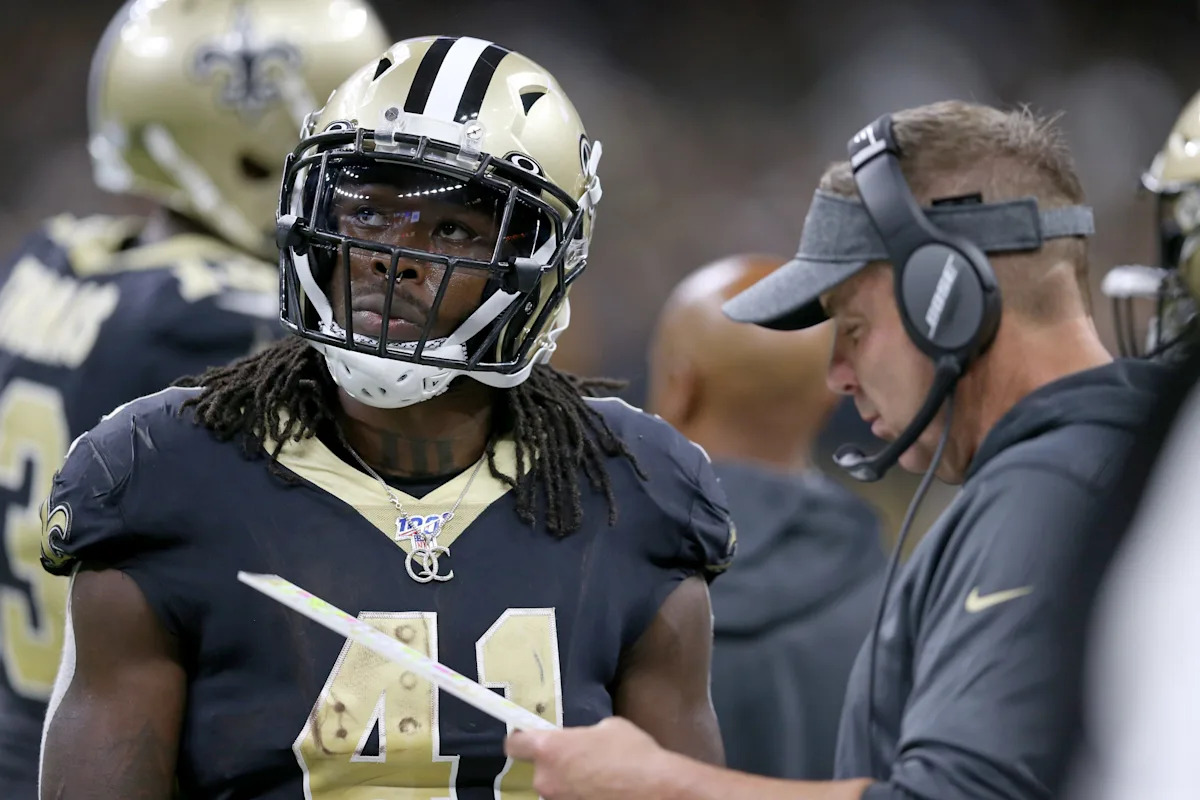
We’re entering the part of the offseason where we start to get kind of wistful. A little nostalgic. Introspective, maybe. Look back on years past, and consider how comments made before look with the benefit of hindsight.
Back when he was leading the New Orleans Saints as their Super Bowl-winning head coach, Sean Payton had a blunt reaction to being asked about comments he’d made comparing rookie draft pick Alvin Kamara to Pro Football Hall of Fame running back Marshall Faulk, who he had coached in college at San Diego State. Payton had complimented how quick a learner and adept a receiver both players had been (similar body types helped; Faulk played at 5-foot-10 and 211 pounds, while the Saints list Kamara at 5-foot-10 and 215), but that’s where the comparison stopped.
Advertisement
“Stop,” Payton told reporters back in 2017. “Marshall Faulk’s a first ballot Hall of Famer. We’re not doing that to a rookie running back. This kid has got really, really good football intelligence. He has good transitional speed. But even when I made the comparison back in training camp it was prefaced with, hey, not making a comparison to Marshall, I’m just saying he’s a guy that learns very quickly and that’s how Marshall was. I just don’t want to see Marshall Faulk headlined with Alvin Kamara, that’s all.”
But you can’t put the toothpaste back in the tube, and Payton’s comparison has only looked more apt with time. He’s right that Faulk was a different caliber of player than Kamara, but he was also right to compare the two in the first place.
At this stage in his career, Faulk had appeared in 121 games, totaling 2,155 carries (17.8 per game) with 548 receptions (4.5 per game), amassing 14,889 yards from scrimmage with 79 touchdown runs and 31 touchdown catches. He had also been selected for six Pro Bowls, was a six-time All-Pro, had won league MVP, and was named Offensive Player of the Year three times.
Kamara doesn’t have as many accolades, but his five Pro Bowls and two All-Pro appearances are nothing to sneeze at. Through his first eight years he’s appeared in 115 games, recording 1,543 rushing attempts (13.4 per game) and catching 573 passes (4.9 per game). He’s gained 11,541 yards from scrimmage. So while they have averaged the same number of yards per carry (4.4), the four extra rushes per game that Faulk got made a very big difference.
Advertisement
And now Kamara is on the verge of doing something special. He’s 238 receiving yards away from joining Faulk, Marcus Allen, and Tiki Barber to become the fourth running back in NFL history to gain at least 5,000 yards as both a rusher and receiver. Look at the numbers:
Marshall Faulk: 12,279 rushing yards, 6,875 receiving yards
Marcus Allen: 12,243 rushing yards, 5,411 receiving yards
Tiki Barber: 10,449 rushing yards, 5,183 receiving yards
Alvin Kamara: 6,779 rushing yards, 4,762 receiving yards
It feels like a safe assumption that Kamara will go the distance and join those great players in the 5,000-yard (10,000?) club, but just how far can he go? Kamara’s contract is set to run out after the 2026 season, so he has at least two more years to keep building on his legacy. He’s talked before about not wanting to play football until his body breaks down, and his abundance of interests away from the field gives him options. If he decides to keep playing after this contract runs out, he might close the gap with Faulk in the end. Maybe.
And here’s one more stat for the road. Since the two-point conversion was adopted in 1994, just two players have successfully converted it seven times. Those two players? Marshall Faulk, and Alvin Kamara.
This article originally appeared on Saints Wire: Sean Payton’s Alvin Kamara-Marshall Faulk comp was right on the money