
Baltimore Beatdown is proud to introduce this four-part series on Lamar Jackson from former Ravens running back Femi Ayanbadejo! He is a member of the 2000 Super Bowl championship team and an 11-year NFL veteran. He also holds an MBA from Johns Hopkins, with executive credentials from Harvard and Wharton, and has worked in sports media as an NFL analyst since 2013. Ayanbadejo is currently part of the radio team at 105.7 The Fan Baltimore.
Lamar Jackson trades like a meme stock in the marketplace of media and executive opinion. His perceived value surges after an MVP season, crashes after a playoff loss, and resets with almost no institutional memory of the underlying fundamentals. The film, the production, and the total body of work change gradually. The narrative price moves overnight.
Jackson is judged differently than any quarterback in recent memory. His accolades take the stairs up while his critics put him on the elevator down. Every achievement is earned slowly, scrutinized at every floor, and met at the top with a new reason it was not enough. Every criticism arrives instantly and is amplified before anyone checks whether it is true. Old narratives are zombie-like in their refusal to die. Evidence of underperformance is weighted against his entire body of work, while evidence of growth is often treated as temporary. When the facts change, the framing simply finds a new form.
That narrative volatility is visible right now. In the player-voted NFL Top 100, Jackson fell 67 places—from No. 2 to No. 69—after an injury-disrupted season in which he still finished fourth in passer rating at 103.8. Trevor Lawrence ranked 62nd and Bo Nix 59th, while ESPN’s survey of more than 70 executives, coaches, and scouts placed Jackson fifth among quarterbacks. Colin Cowherd’s movement was even more revealing: he ranked Jackson seventh in May, then 11th in July, choosing the “ascending” Drake Maye over an “expensive, declining” Jackson and announcing that he was “selling his stock.” Skepticism about Jackson in major postseason moments is fair; declaring him a depreciating asset after one injury-marred season is not. He is 29. Matthew Stafford just won MVP at 37, Aaron Rodgers and Peyton Manning won at 37 or older, and Tom Brady won at 40. Meanwhile, Baltimore’s supporting cast was ranked 22nd. When Jackson produces an MVP-caliber season, critics say he is loaded with talent. When preseason rankings arrive, that same supporting cast is considered below average while Jackson’s individual value collapses. This is not consistent evaluation. It is narrative volatility. If every NFL player were available in a franchise draft today and the objective were to win now, I do not believe five players would be selected before Lamar Jackson.
People underestimating Jackson is not an occasional occurrence. It is his norm. The hyperbole surrounding him since before the draft has helped create a man largely impervious to nonsensical commentary. He rarely responds to it. I will.
I write from the intersection of athlete, analyst, admiration, and accountability. Not all criticism of Jackson is invalid. His decision-making in several playoff losses, his postseason ball security, and a 3-5 playoff record are fair subjects for scrutiny. This series addresses them directly. What is not fair is the pattern of unverified character attacks, manufactured destination narratives, and lazy analysis that presents subjective opinion with the authority of sourced fact.
Over the past year, the pile-on has been particularly pointed. Emmanuel Acho called Jackson the “common denominator” in Baltimore’s postseason failures and expressed no confidence that he would ever win a Super Bowl. Eric Mangini questioned his maturity and loyalty. Greg Cote invoked Dan Marino as a cautionary comparison. Mike Preston published a commentary containing character allegations and destination speculation without disclosing a verifiable source. These claims do not all belong in the same category. Some are legitimate opinions. Some contain valid questions. Others are unsupported assertions. Responsible analysis requires us to distinguish among them.
Before He Ever Took a Snap
The underestimation of Lamar Jackson did not begin in the NFL. It began before he was drafted, in one of the most polarizing quarterback evaluations of the modern era.
During the 2018 pre-draft cycle, scouts and media figures questioned whether Jackson’s college game at Louisville could translate to the NFL. Former Indianapolis Colts general manager Bill Polian publicly argued that Jackson lacked the size and accuracy to remain at quarterback and should move to wide receiver. Multiple teams asked Jackson to go through receiver drills at the Scouting Combine. He refused, participating only as a quarterback. Critics emphasized his sub-60 percent college completion rate, called him raw, and questioned whether his rushing style could survive professional football.
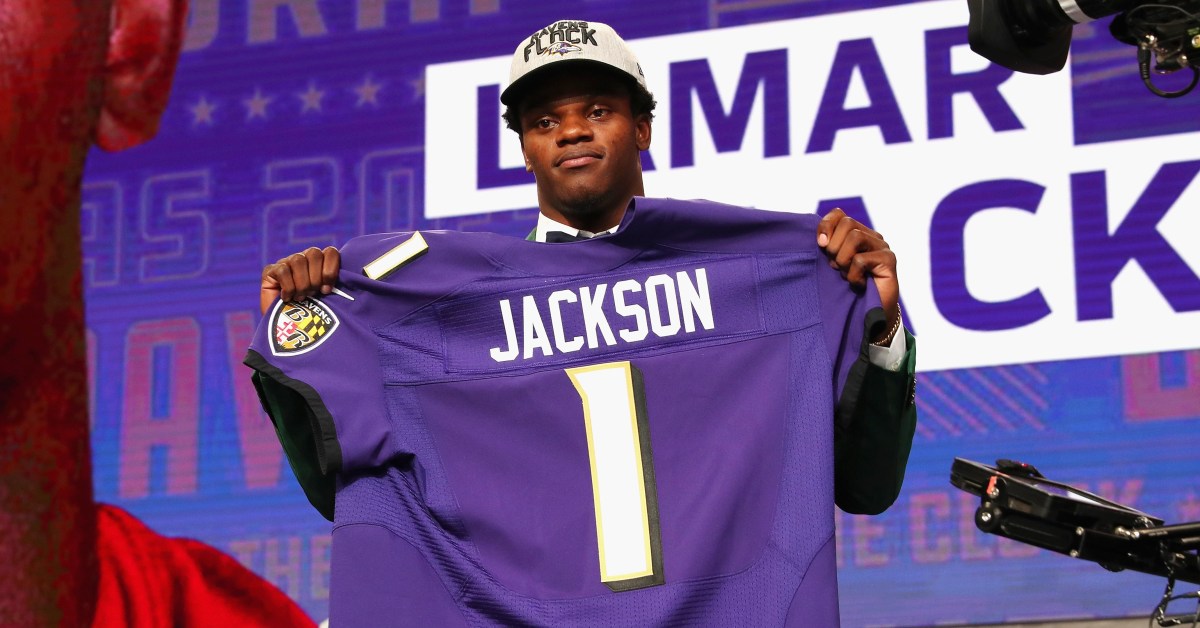
Ozzie Newsome evaluated the same player differently. In his final draft as Ravens general manager, Newsome traded back into the first round and selected Jackson 32nd overall. He did not know precisely what Jackson would become. He recognized that the prevailing evaluation placed too much weight on convention and too little on exceptional ability: rare acceleration, arm strength, a quick release, spatial awareness, and the capacity to stress every defender on the field.
No one could know that Jackson would become a multiple-time MVP and redefine the geometry of the position. Newsome simply gave an unconventional quarterback the opportunity to be evaluated as a quarterback. That decision became one of the defining selections in franchise history.
The doubt did not stop when Jackson entered the league. It evolved whenever the evidence defeated its previous form.
First, he could not play quarterback in the NFL. Then he could win only with his legs and was not a “real passer.” Next, he could succeed only in a specialized offense with simplified reads. Then he won MVP awards in two distinct offensive structures: Greg Roman’s zone-read-heavy, historically productive rushing system in 2019 and Todd Monken’s more expansive passing structure in 2023.
From Marty Mornhinweg to Roman to Monken, the coordinator changed. The system changed. The personnel changed. Jackson kept winning and developing. He has answered nearly every threshold placed in front of him. One remains unresolved: whether he can consistently protect the football and deliver his best football through a complete championship run.
At least now we are discussing something real.
Belief is subjective. Truth is not. A belief can be sincere and still be wrong. Quantitative claims require data. Qualitative claims require verification. Those who claim to know what a player thinks, feels, or intends while that player stays silent are not analyzing. They are guessing. This series does not argue that Lamar Jackson is beyond criticism. It argues that criticism should be specific, proportionate, and supported by evidence.
Part Two takes the conversation to the field and examines what the film and data actually establish, including the postseason criticism Jackson and the Ravens have earned. Part Three examines the off-field narratives: representation, contract leverage, character allegations, destination rumors, and the media ecosystem that converts speculation into received wisdom. Part Four considers what Jackson has already changed, what remains unfinished, and how his remaining career could reshape his legacy.
The standard will remain the same throughout: verified fact, supported inference, clearly identified opinion, and projection labeled as projection.