
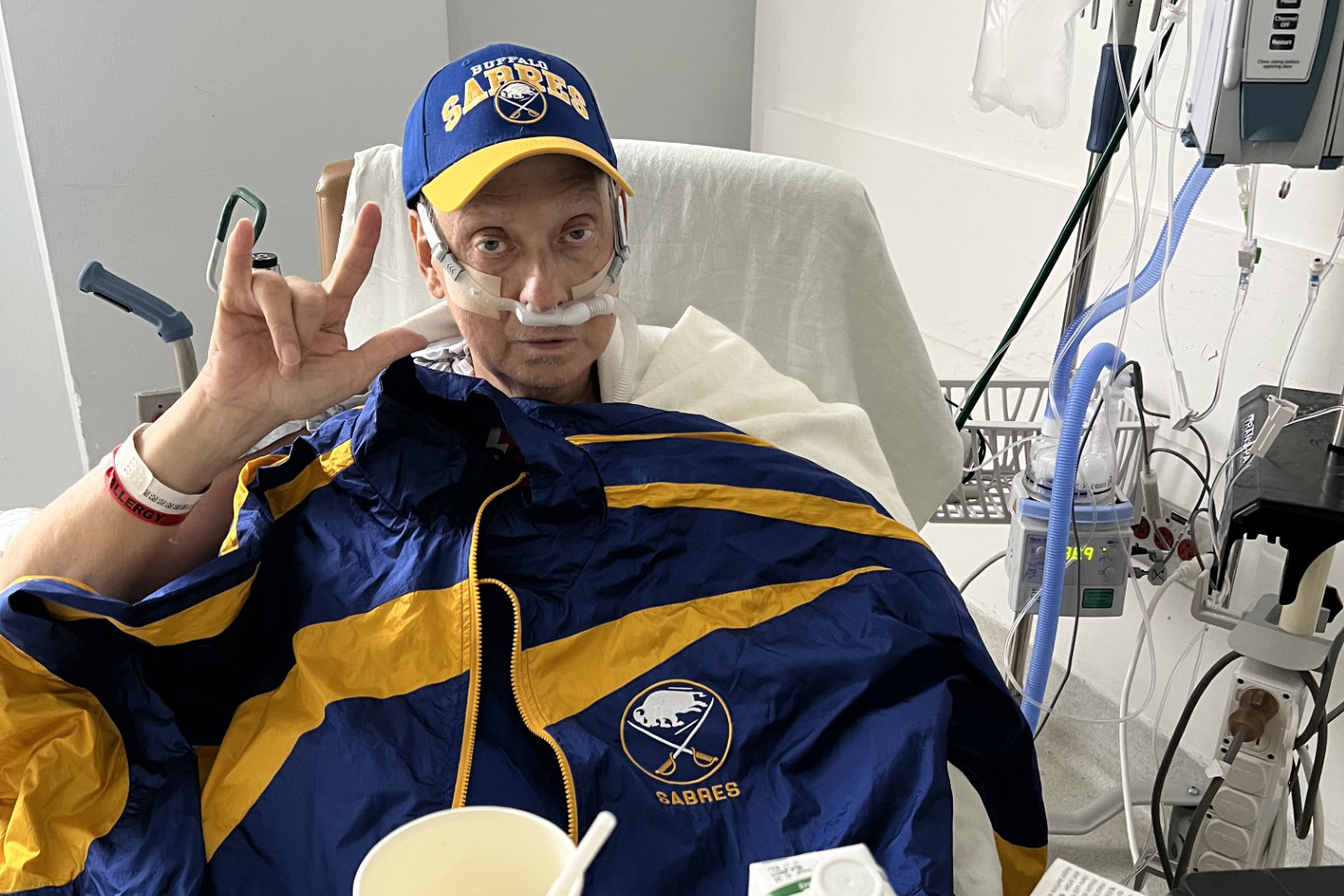
Niners radio announcer Greg Papa, a native of suburban Buffalo, wears Buffalo Sabres gear during one of the team’s recent playoff games.
Courtesy Greg Papa
Greg Papa sounded like Greg Papa.
During a recent two-hour phone interview from his East Bay home, the San Francisco 49ers radio announcer’s distinctive baritone was robust. He recalled dates and details with his usual precision and punctuated stories with trademark humor.
But every three seconds, there was a loud click.
Article continues below this ad
It came from a machine delivering supplemental oxygen through a nasal cannula. At one point, Papa paused to make the short walk to the bathroom. When he returned, he was winded.
“My 40 time,” he said, “was 40 feet in 4.2 seconds.”
Niners radio announcer Greg Papa does physical therapy with his brother Ron, right.
Courtesy Greg Papa
A year after he was diagnosed with leukemia and nearly five months after a successful bone marrow transplant, Papa, 63, is cancer-free. But post-transplant complications that nearly killed him may have left his lungs permanently scarred. After a 42-year career in which he has spent 53 seasons as the voice for Bay Area teams, he faces the possibility that he might never return to the booth.
Papa returned home July 11 after spending 78 days at UCSF Medical Center, most of them in intensive care. His ordeal included pneumonia and the collapse of both lungs. He needed two chest tubes, spent nearly a week on a ventilator, developed a hernia from violent coughing and developed four blood clots, including one that traveled to a lung. He was advised by doctors to get his affairs in order.
Article continues below this ad
“For many weeks, the situation was life-threatening,” Papa said. “Now it’s life-altering.”
Doctors don’t know how much lung capacity Papa can regain through pulmonary rehabilitation. He may require supplemental oxygen for the rest of his life. He has temporary diabetes from heavy doses of steroids. His mornings begin with insulin monitoring, two shots in his stomach for blood clots and 15 to 20 pills.
Radio announcer Greg Papa gets a visit from 49ers director of broadcasting Bob Sargent.
Courtesy Greg Papa
“Breakfast can take an hour,” he said.
Article continues below this ad
The David Benzer Strike Out Fear Foundation, a 501(c)(3)nonprofit, has established a GoFundMe campaign to help ease the financial burden of Greg Papa’s long recovery period. Funds will be used to assist with everyday living expenses while Papa is unable to work, and medical out-of-pocket expenses not fully covered by insurance including medical co-pays, uncovered medications, and home healthcare. Those wishing to support Greg can visit: support.strikeoutfear.org/helpgregpapabeatcancer
On July 20, nine days after leaving the hospital, Papa’s blood pressure plummeted, sending him back to an emergency room. He was discharged the next day. The issue was related to a change in his medication.
Papa has quietly worked through serious health problems before. After being diagnosed in 2023 with cardiomyopathy, a hereditary heart condition, he often stood in front of a bathroom mirror before 49ers games and told himself: “Just get through this. You’ll figure it out.” During broadcasts, he would mute his microphone and let analyst Tim Ryan talk while he collected himself.
“That was a challenge, but it was nothing like this,” Papa said. “No one knows what my future is.”
Four months ago, Papa was optimistic in the aftermath of his bone marrow transplant. His younger sister, Judy, had been a perfect match. There were no complications after 5 million of Judy’s harvested cells were infused through a Hickman line in Papa’s chest, a process that took an hour.
Article continues below this ad
Papa was expected to spend a month at UCSF, but he returned home in two weeks. He was hopeful he could attend training-camp practices this summer and call the 49ers’ season opener in Melbourne, Australia, on Sept. 10. A text that he sent on March 6, two days after his transplant, captured his monthlong mood: “TD on opening drive,” he wrote.
The post-transplant stretch was a rare ray of sunshine during a journey that began on July 16, 2025. Papa was diagnosed last summer with acute lymphoblastic leukemia that was discovered in his brain and spinal column. He became ill when he was vacationing in France. The news was delivered by a doctor who spoke limited English.
“I understood one of every five words, but he said ‘leukemia,’” Papa said. “That was crystal clear.”
Papa was hospitalized for 23 days, the first 11 in France, and lost 20 pounds over one three-day stretch. A hematologist told him 12 days after he was diagnosed that it would be a challenge to keep him alive for three years. That ominous timeline sounded optimistic on the nights Papa drifted asleep wondering whether he’d ever wake up.
But Papa returned home. He had two rounds of chemotherapy. He went into remission. He called the 49ers’ regular-season finale, a loss to the Seahawks at Levi’s Stadium on Jan. 3, with a catheter in his arm that provided an uninterrupted stream of immunotherapy drugs.
Article continues below this ad
Niners radio announcer Greg Papa on the sidelines before the regular season finale against the Seattle Seahawks at Levi’s Stadium on Jan. 3. It was Papa’s first game back after undergoing treatment for acute lymphoblastic leukemia, which was diagnosed before the season.
Carlos Avila Gonzalez/S.F. Chronicle
“That took a lot out of me,” Papa said. “Afterward, I thought: ‘Why did you do that?’”
This spring, nearly a month after his transplant, the four-time California Sportscaster of the Year was excitedly asking himself whether he could comfortably return for the 2026 season.
Then he was leveled by a cascade of health crises.
On April 4, Papa was rushed to a Marin County emergency room and spent two days in ICU after he collapsed and began vomiting profusely. It was discovered during his 10-day hospitalization that he’d developed an infection associated with the Hickman line that had been inserted in his chest.
On April 24, 10 days after he was discharged, Papa went to UCSF for routine blood work. And he didn’t leave for 11 weeks and one day. When Papa’s vitals were checked, his blood oxygen level was 87%. A reading below 92% is concerning. Papa wasn’t initially struggling to breathe, but his condition quickly deteriorated.
He was given a nasal cannula, but he quickly needed high-flow oxygen. Then Papa needed more liters of oxygen than he could receive in his regular hospital room. He asked, gasping, to be taken to ICU, “I said, ‘I can’t breathe here.’”
A CT scan revealed that Papa’s right lung had collapsed and twisted, cutting off blood flow and oxygen. The medical term is torsion. Papa said doctors told him only 24 comparable cases had been documented.
“They were greatly concerned,” he said.
On May 1, as doctors worked to determine the source of his lung issues, Papa’s oxygen needs skyrocketed and he underwent an emergency procedure to insert a chest tube on his right side. The first attempt to lift and stabilize his lung failed.
“The surgeon came back and said, ‘I’m going to try one more time,’” Papa said. “Meanwhile, another doctor was in my ear saying, ‘If this does not work, we’re putting you on the ventilator immediately.’ I was thinking, ‘I’m going to die.’ I couldn’t talk. Every breath was a struggle, like I was drowning.”
The second attempt was successful. But there was no reprieve. His left lung collapsed two weeks later. Another chest tube. Then his right lung began bleeding. Papa said it looked like he’d been shot in the chest one day during physical therapy. Blood pooled on the floor.
On June 1, another oxygen crisis forced doctors to place Papa on a ventilator.
A month earlier, when doctors had considered intubating him to perform a bronchoscopy, Papa resisted for two days. He had been told there was a 15% chance the tube could cause irreparable damage to his vocal cords — a bleak prospect for a man who made his living with his voice. The emergency procedure on his right lung had ended that discussion.
A month later, there was no conversation.
“I understood,” Papa said. “They had to save my life.”
The ventilator lessened his oxygen requirements, but his condition remained dire. He was told his lungs were dying. The outcome might be inevitable. He recalls a nurse asking: “How long do you want to keep fighting like this?”
Did he mean he should give up? Papa was indignant.
Niners radio announcer Greg Papa in his hospital bed.
Courtesy Greg Papa
Before his transplant, a friend had noted that the date of the procedure was the only one on the calendar that doubled as an instruction: March forth. Papa remained committed to doing just that. His brushes with death had loosened fear’s hold on him.
“It’s like someone broke into your house with a gun and threatened to shoot you,” Papa said. “After staring at him long enough, you say: ‘Are you going to do it or not?’ I’m not afraid of you anymore, Boogeyman. You charge at it. I may be surrounded — cancer, lungs, heart — but I’m still going to fight.”
By mid-June, around the 100-day mark after his transplant, Papa began to rally. His oxygen requirements steadily decreased, allowing him to move to a lower-flow device. His chest tubes were removed. Doctors told him they had prevented the death of the healthy portions of his lungs. He was transferred from intensive care to a regular cancer floor.
“The ICU is a terrible place to live,” Papa said. “I heard a 30-year-old man die of cancer in the room next to me. The mental battle was, ‘This is hard. I have to get out of here.’”
On July 11, after 78 days, he did.
Back at home, Papa has two oxygen systems. A portable unit allows him to travel to medical appointments. A larger unit, attached to a 50-foot hose, supplies oxygen when he sleeps and moves around his house. When he’s sitting, Papa usually requires one liter of oxygen through a cannula. He often needs five liters when he stands or walks. He needed nearly 100 liters during the worst of his lung calamities.
Papa weighed 173 pounds after losing 36 pounds in the months after his transplant. He’s gaining it back gradually; he’s up to 184, because doctors don’t want him to stress his heart by adding weight too quickly. He also lost his hair when he underwent intense chemotherapy before his transplant. The radio man who also did plenty of television work laughed.
“It is ironic — I made my living with great lung capacity and a nice head of hair,” Papa said. “And those are the two things that were hit.”
Papa tested his lung capacity by trying to deliver his signature call — “Touchdoooown, San-Fran-ciscoooo!” — during his hospitalization. During World Cup matches: “Goooooal!”
But it’s more than projecting into a microphone. Papa’s maniacal pregame preparation has been key to his success. He wonders whether he can regain the necessary energy and focus. Whether he can travel. And, after chronicling countless games over 42 years, how much he needs to call another one.
“I don’t have to prove anything — to anyone or to myself,” Papa said. “This is not what motivates me. Part of the motivation is that I want to decide when I stop. I want to plot the course of my own life.”
Papa thinks he could return to his midday KNBR talk show, working from his remote studio as he did last year, when he was undergoing chemotherapy. That would allow him to reclaim a piece of his professional life.
Returning to the booth presents a far greater challenge.
But long odds do not carry the same weight after Papa became cancer-free, stood face-to-face with the Boogeyman and, as he put it, “got out of that f—ing hospital.”
Papa sounded like Papa. But the past year has changed his body and his relationship with fear. It also has changed his outlook on his limits. The improbable, he believes, is achievable.
“My doctors told me that 95% of people would have died from what I went through,” Papa said. “They looked me in the eye and said, ‘We don’t know whether you will ever get out of here.’ My recovery was remarkable. So I will not say I cannot do it.”