
3. Second/Third Quarterback
This has become a much more interesting competition than seemed likely when training camp began. The play of undrafted rookie Jalon Daniels in the first two preseason games, in which he has led a pair of game-winning rallies and a total of five scoring drives, has led to questions of not only whether he makes the 53-man roster but if he could actually challenge veteran Jake Browning for the primary backup spot when the real games begin.
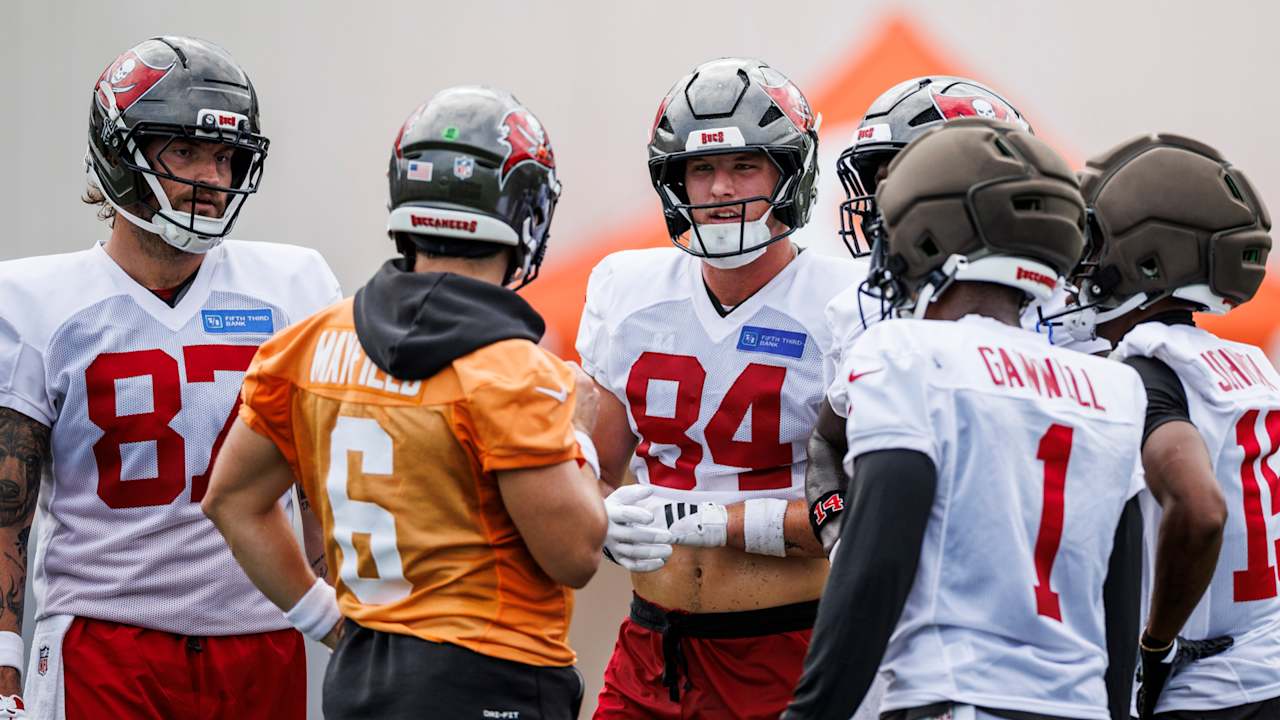
The first and most fundamental question is, how many quarterbacks will the Bucs keep on the 53-man roster. They started last season with only two, with then-rookie Connor Bazelak on the practice squad as a third option. Later in the season, when Baker Mayfield was dealing with a myriad of injuries that occasional put his ability to play in question, Bazelak was promoted and the Bucs carried three passers for the last six weeks. Choosing to carry three quarterbacks on the active roster reduces flexibility at other spots but might be necessary if the Buccaneers are concerned about losing any of their passers during the waiver process.
Browning, who has 10 career regular season starts and notably kept the Bengals afloat during a seven-game Joe Burrow absence in 2023, was obviously signed in large part due to that starting experience. The Bucs had none of that behind Mayfield prior to his signing. Will the Buccaneers stick with that plan and make Browning active on game days, or is it possible that the rookie Daniels has shown enough to press him for that spot. Bowles recently said that competition has been and remains open.
Here the assumptions are that the Bucs will keep six receivers on the 53-man roster and that five of them will be Chris Godwin Jr., Emeka Egbuka, Jalen McMillan, Tez Johnson and Ted Hurst III. Last year, the Bucs actually started the season with seven receivers on the roster because Godwin was not ready to play for the first few weeks. With other injuries at the position cropping up throughout the year, they carried seven receivers instead of six for 12 of the 18 regular-season weeks overall.
Given that both Egbuka and McMillan have been dealing with injuries and that Bowles chose not to say that Egbuka will definitely be ready for Week One due to his toe ailment, it’s certainly possible that the Bucs will once again start the year with seven receivers. However, that would become very difficult if they want to keep three quarterbacks, four running backs and four tight ends. For the purposes of this discussion will predict a six-receiver unit.
If we are right in both assumptions, then there are ___ candidates for the sixth spot: Kameron Johnson, David Sills V, Garrett Greene, Dean Patterson IV, Eric Rivers Jr., Matthew Henry and Jha’Quan Jackson. Since they just joined the team this week and will only have a couple days on the roster before the cutdown to 53, it seems unlikely that Henry or Jackson will capture that sixth spot. (The practice squad could be another matter.)
Kameron Johnson has the distinct advantage of being the team’s incumbent return man and it’s worth noting that when the Bucs rested their starters in preseason Week One he was held out, too. Sills’ advantage would be that he played for Zac Robinson in Atlanta last year and had a relatively productive season, with 18 catches for 191 yards and two touchdowns. Patterson is the team’s leading receiver through two preseason games and Rivers was one of the team’s top targets in the undrafted free agency period. This is likely to be a difficult decision for Bucs coaches and a good number of these candidates could also stick around on the practice squad.
The Buccaneers actually started last season with 11 defensive backs on the 53-man roster and eventually toggled between 10 and 11 during the duration of the campaign. But that was with only four off-ball linebackers and five outside linebackers, and the Bucs may want to go deeper at those spots this year. For the purposes of this discussion, let’s set the DB target at 10 spots.
We are considering the corners and safeties together as one group because several players in that group are very position versatile. Most notably, rookie Keionte Scott is listed as a DB on the Bucs’ roster rather than CB or S and how you count the numbers at each spot depends on how you classify his position. Right now, he is listed as a cornerback behind Jacob Parrish and is definitely in the running for the starting slot corner spot.
We will start by freezing Scott, Parrish, Zyon McCollum, Antoine Winfield Jr., Tykee Smith, and Benjamin Morrison for our first six. We’ll add veteran Miles Killebrew as we expect him to be a key leader on special teams, and we’ll guess that the recent return of safety J.J. Roberts to practice will put him back on track to make the roster like he was expected to do last summer before suffering a season-ending injury. If those assumptions are all correct that would leave two spots to be contested between Josh Hayes, Damarion Williams, Rashad Wisdom, Ifeatu Melifonwu, Ayden Garnes, Roman Parodie, Robert McDaniel and Xavier Williams.
Hayes and Wisdom were both on the active roster last season, so that is obviously a good starting advantage, and Hayes has been one of the Bucs’ best and most active special teams players for the past three seasons. That kind of output in the third phase of the game is often a tiebreaker when final roster spots are being contested. Garnes has consistently made big plays throughout training camp and the preseason games and at some point his output may become too significant to ignore. Parodie has lodged an interception for the Bucs in each of the last two preseasons. Melifonwu is the most experienced of the bunch, with 53 games played and 22 starts for the Lions and Dolphins.