
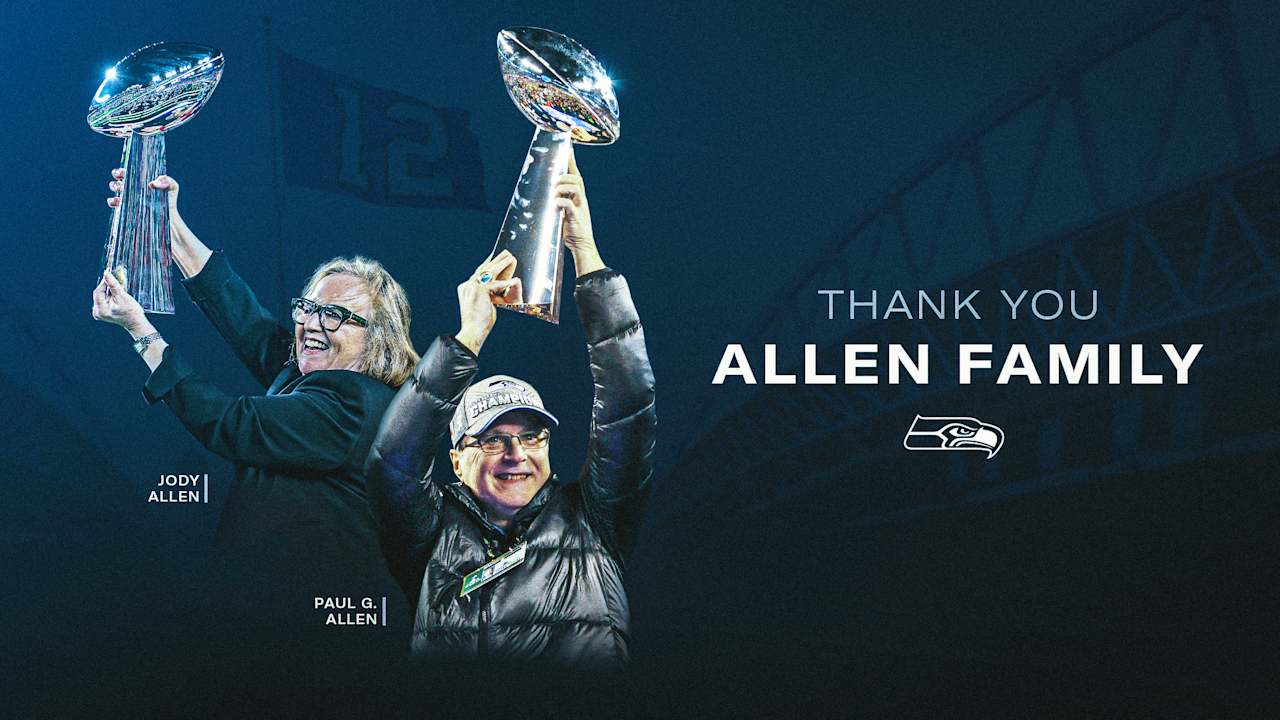
While Allen might have been hesitant to purchase an NFL franchise, once he agreed to buy the Seahawks, he was fully committed to making them the best team in the NFL.
In 1997, the Seahawks headed into the draft holding two first-round picks, No. 3 and No. 11 overall. The Seahawks took cornerback Shawn Springs at No. 3, and Randy Mueller, the team’s vice president of operations, wanted to trade up into the top 10 to also land tackle Walter Jones. Behring, who was in the process of selling the team, didn’t want to make the financial commitment that would come with selecting two players in the top 10, and preferred the Seahawks trade back. Enter Allen, who at that point still didn’t actually own the team. Knowing it wasn’t even a certainty that he would buy the team—the agreement to purchase the Seahawks was contingent on a referendum passing later that year that would fund a new stadium—Allen still agreed to be on the hook for Springs’ and Jones’ signing bonuses. This was after Allen had also signed off on a big free-agent contract for Chad Brown, one of the first big signings Seattle had made since the start of free agency a few years earlier. With that hurdle out of the way, the Seahawks were able to trade up and select Jones, who went on to become a Hall of Famer and one of the best tackles in NFL history.
Two years later, Allen made another big swing, hiring Super Bowl-winning coach Mike Holmgren away from the Green Bay Packers. Under Holmgren, a franchise that had been to the playoffs only four times in its first 23 seasons earned six postseason berths in 10 seasons, winning five division titles and the first conference championship in team history. In 2010, Allen once again made a big hire, two of them actually, convincing Pete Carroll to finally leave USC, then pairing him with John Schneider to form a partnership that would take the Seahawks to even greater heights. Under Carroll and Schneider, the Seahawks reached the postseason 10 times in a 14-year span, winning five division titles, two NFC championships, and most notably, the first Super Bowl title in team history.
From the time he purchased the Seahawks until his death in 2018, Paul Allen operated behind the scenes, making important big hires, then empowering the likes of Holmgren, Carroll and Schneider to run the team, signing off on big decisions or contracts when necessary.
“The way that Paul has established a championship culture is just that curiosity and the constant striving like there’s no finish line,” Schneider said in 2017. “We talk about that all the time here, how are we going to do it better than anybody’s ever done it before? I mean look at what they did with Microsoft, right? How are we going to take that attitude of never thinking that we’re satisfied or never thinking that everything is good enough?
“Then we’re constantly trying to improve in every area that we possibly can in this organization. And when you read his book, you read everything about the risks they took early on starting Microsoft and everything, and again, everything that he has overcome individually. He’s a fighter, so that’s what we’re all about. We’re all about fighting, competing, and being curious and trying to stay ahead of the curve in every aspect we possibly can.”
After Paul Allen’s death from complications of non-Hodgkin’s lymphoma during the 2018 season, Jody Allen took over and, along with Seahawks vice chair Bert Kolde, continued his legacy. Jody Allen wasn’t in the public eye, nor did she meddle in day-to-day football decisions, but she was demanding and decisive when the role required it. It was Jody Allen who signed off on the monumental decision to trade Russell Wilson, which felt like a risky move at the time, but ended up setting the Seahawks up for future success thanks to a huge haul of draft picks Schneider was able to secure in the trade. She also made the difficult decision to move on from Carroll, the most accomplished coach in franchise history, paving the way for Schneider to hire Mike Macdonald, who led the Seahawks to another Super Bowl title in his second season as head coach.
“Jody has been phenomenal since the day I interviewed for the job,” Macdonald said following his team’s Super Bowl win. “I think vividly of our conversation we had in Baltimore, and I just loved hearing her vision for the team and what she wanted to create for our team and for our city and our community and our franchise and our football team, and that was really inspiring, because I thought it was aligned with what we wanted to create and how we wanted to build our program. And when you’re aligned in that vision, it’s a fun ride. Especially last year, as we’re kind of going through the fog of some things, she had such great perspective on everything. She kept us together, always backed John and I on some of the tough decisions we had to make, and that lets you make those decisions when you know she’s in your corner.”
A few days later as the Seahawks stood on a stage at Lumen Field prior to their Super Bowl parade, Schneider addressed Jody Allen directly during his remarks to the crowd, saying, “Jody, Paul would be so proud of you the way you’ve led this organization and allowed us to be where we are.”
And of course, the Allens’ ownership of the team went beyond just the wins or championships or big decisions like coaching hires. As Seattle natives, the Allen family understood the connection between the team and its fans, a bond that began in those early days in the Kingdome, and grew as the team kept winning under Holmgren, Carroll and Macdonald. Lumen Field was designed to help capture crowd noise, an idea Allen championed, and the organization continued to find unique ways to connect with fans year after year.
Philanthropy has also been at the core of both Paul and Jody Allen’s beliefs, with Paul Allen, and later, Jody and the Paul G. Allen Estate, giving billions to philanthropic causes, money that will include the proceeds from the sale of the Seahawks, Trail Blazers and the rest of Allen’s estate. Paul Allen, who in 2015 was awarded the Carnegie Medal of Philanthropy, championed various causes ranging from climate change to ocean health to wildlife preservation to brain research to homelessness to the arts, making a difference both locally and globally. And since 2018, Jody Allen has continued that work.
“From the time that Paul and I were kids, we were raised in an environment where to have a healthy community means you participate in your community,” Jody Allen said in 2017. “And this was something that we were in a unique position to do.”
The Seahawks are about to enter an exciting new era under the leadership of the Khosla family, but before looking forward to that bright future, it’s important to look back and say thank you to the family that saved football in Seattle, the family that turned the Seahawks into one of the best sports franchises on the planet, the family that made the city and the world a better place through their philanthropy, and the family that turned the Seahawks into Super Bowl champions. Twice.