

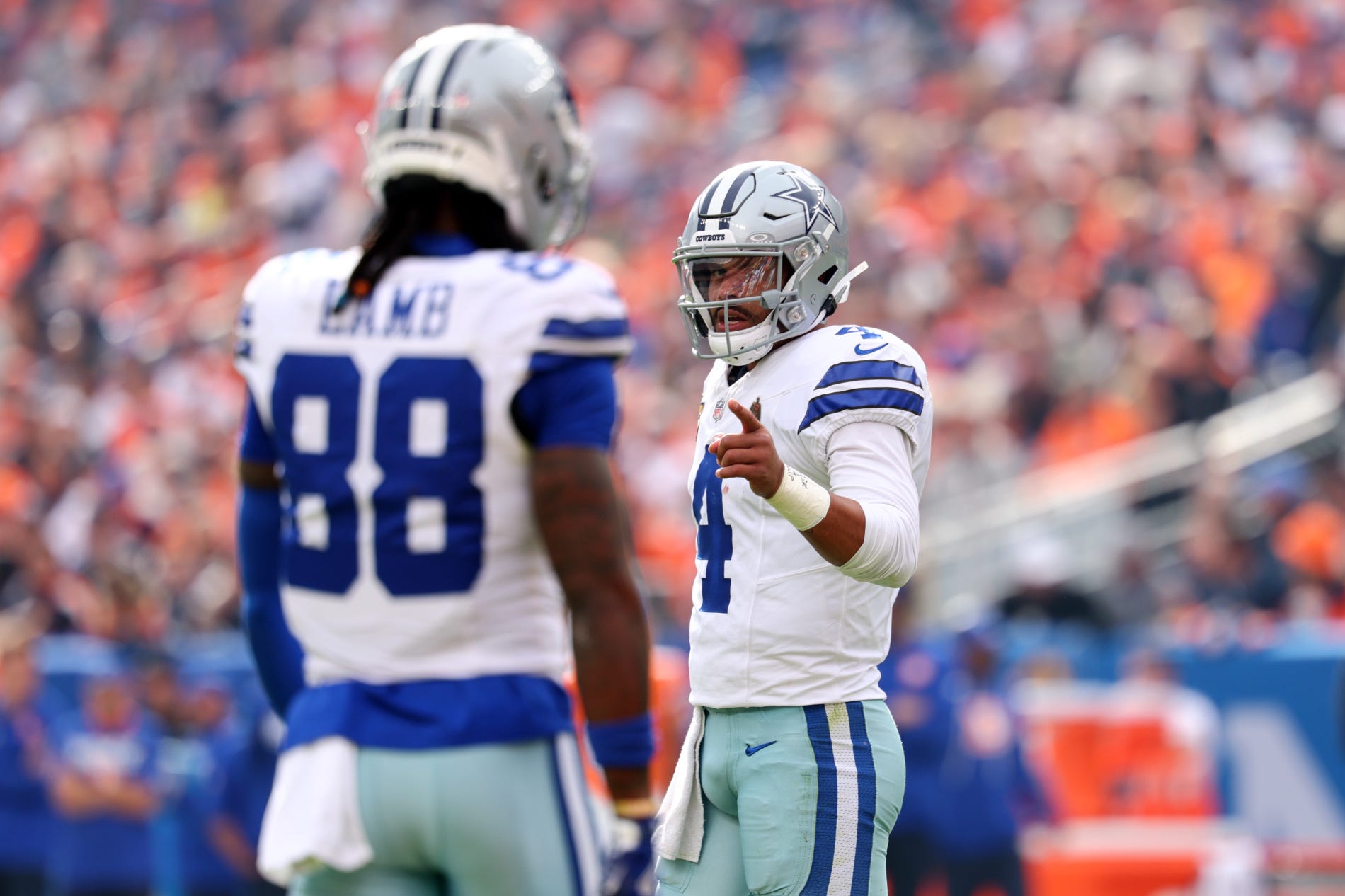
 Dak Prescott signals to CeeDee Lamb of the Dallas Cowboys during the first quarter in the game against the Denver Broncos at Empower Field At Mile High on October 26, 2025. (Jamie Schwaberow/Getty Images)
The Dallas Cowboys can never be accused of flying under the radar. As I wrote here, the franchise seems to exist in a permanent state of championship-or-bust, with every season made to feel more consequential league-wide than it probably is:
But on the eve of the 2026 season, it’s tough to know quite what to make of this year’s version of the Cowboys.
From 2021-23, Dallas went exactly 12-5 for three consecutive seasons, making the playoffs three years in a row for the first time since 1996. Though that team bowed out before making the NFC title game all three years — what else is new? — it wasn’t hard to project that regular-season success into a deep playoff run sooner or later. After back-to-back seven-win campaigns, though — each of which happened for differently confounding reasons — the Cowboys have landed in a place that’s even harder to pin down.
The 2024 Cowboys could reasonably blame their collapse on an injury to Dak Prescott… except that they were already 3-5 by the time Prescott was lost for the season. And the 2025 version didn’t even offer that much in the way of explanations. Prescott returned to lead one of the NFL’s elite passing attacks — it was an off-numbered year, after all — starting all 17 games and producing Top-5 QB EPA stats. But Dallas’ defense was so bad that they still went just 7-9-1, with a three-game winning streak at midseason representing the only time they won consecutive games at all.
And yet, that same imbalance may actually be Dallas’ best reason for optimism in 2026.
According to NFLverse’s Expected Points Added (EPA) metrics, last year’s Cowboys ranked No. 7 in offensive EPA per game above average (+5.3) and No. 5 in passing particularly (+5.7). But at the same time, they not only had the worst EPA-per-game defense relative to average (-11.3) in the league last season, but the worst in any season since at least 2003 — as far back as my complete dataset went — and the third-worst relative passing defense (-8.5) over that span as well:
That was down from a defense that was merely normal-bad (27th with -3.0 EPA per game vs. average) in 2024, though no one especially batted an eye at a defensive collapse for Dallas — not after they dealt Micah Parsons to Green Bay on the eve of the seasons. But that might just be our star-bias speaking: As friend of the Substack Ethan Strauss argued recently, non-QB NFL players don’t impact team success as much as the media hype suggests. (And it’s not like Parsons helped the Packers defense avoid slipping from sixth to 22nd, anyway.)
This resulted in Dallas having the seventh-biggest split between their opponent-adjusted EPA per game on offense and on defense since 2003. And because of their extreme mismatch between offense and defense, the 2025 Cowboys had one of the most unhinged week-to-week profiles of any team: Never once did they post an above-average EPA performance on both sides of the ball at the same time.
Compounding their one-dimensionality, Dak and the passing attack — specifically throwing to WR George Pickens and, to a lesser extent, WR CeeDee Lamb, TE Jake Ferguson and WR Ryan Flournoy — were far more efficient relative to league average than RB Javonte Williams and the rushing attack, which ranked 19th in EPA per game. There’s a reason why Dallas went 4-2-1 when their passing EPA was at least +6.0 points per game above average, 3-3 when it was between +0.6 and +6.0, and 0-4 when it was worse than that: If Prescott wasn’t producing big efficiency numbers through the air, the Cowboys stood little chance of competing for wins. (And even then, sometimes they would still lose — or maybe just tie.)
That’s a lot of pressure to put on one unit, especially when Prescott has a mixed record of staying healthy for full seasons. Yes, he suited up for all 17 games in 2025, but the year before that he played just 8 games. Not to read too much into this, but in odd-numbered years since 2019, Dak has played 66 of a possible 67 games; in even-numbered years over that span, he’s played just 25 of a possible 50 games.
So in light of all this, why would I argue that Cowboy fans ought to actually feel better than expected about this upcoming season? Well, the good news in Dallas is that all of the things the Cowboys were historically bad (or even just mediocre) at in 2025 regress back to the mean between seasons much harder than the things they were good at.
To illustrate this, let’s look at 704 adjacent-season team pairs from 2003-04 through 2024-25, using a few measures comparing the year-to-year “stickiness” of a team’s performance from one season to the following season:
While no metric has especially great carryover from year to year — the NFL is notoriously unpredictable — the single most persistent aspect in our data year-over-year for the typical team is its passing offense. (Intuitively, his makes sense: QB is usually the most important position on the field, and teams with continuity under center tend to retain more of their offensive performance from one season to the next.) Offense in general is nearly as consistent, with net EPA performance wedged between the two. (Again, not surprising, since passing offense drives so much of overall offensive performance.)
What’s much less predictive year-over-year? Defense — specifically passing defense — and rushing offense. In terms of share of next season’s variance explained by the previous one, passing offense was nearly three times as predictive as passing defense!
A consequence of this is that, when projecting the Cowboys’ 2026 performance, we must “shrink” their bad defense — an outlier in recent history — and their mediocre rushing offense back toward something less terrible than we need to pull Dak and the passing offense back toward the mean. Putting aside what Dallas did in their personnel moves — and who can even say there; NFL.com’s Matt Okada gave their offseason an A- grade, but ESPN’s Seth Walder only gave them a C+ — the Cowboys simply gain through the mathematics of regression alone.
Will that be enough for them to return to the playoffs? Maybe. My market-based forecast aggregator has Dallas at 9.9 wins and a 52 percent chance to get in. And the (admittedly sparse) history of similarly all-offense/no-defense teams offers further hope: Of the seven previous teams in my data who had an offense at least +4.0 EPA per game above average paired with a defense at least -7.0 points below it, six of them improved their net efficiency the following year, by an average of 3.8 EPA per game, while gaining 1.3 wins.
And more than the usual hype, that’s ultimately the strange case for believing in these Cowboys. They don’t need the defense to suddenly become good, nor do they need Prescott to perfectly repeat one of his best seasons. (Though they do need him to stay intact.) What Dallas mostly needs is for the things that went catastrophically wrong in 2025 to become merely mediocre. After going an entire season without a single above-average game on both sides of the ball, even a handful of “complete” performances could make the Cowboys look dramatically different — and more relevant — in 2026.
Filed under: NFL