

College football has spent the past five years tearing down nearly every tradition it once insisted was sacred. Players can transfer freely, earn money from their names and receive direct payments from their schools. Conferences have swallowed schools from three time zones away. The playoff expanded. Corporate logos have reached the uniforms.
Yet one ritual remains as dependable as a halftime marching band: A small school will accept a large check to visit a powerhouse and get the hell beaten out of it.
Ohio State will pay Ball State $1.9 million to come to Columbus on Saturday. The Buckeyes are favored by more than 50 points. The payment and the point spread are essentially two sides of the same transaction. Ohio State is purchasing a seventh home game and something approaching certainty. Ball State is selling its Saturday afternoon and accepting a few bruises for nearly $2 million.
The Cardinals are hardly alone. Kent State will collect $1.3 million to play at South Carolina, $1.9 million to visit Ohio State and $1.2 million for a trip to South Florida. That’s $4.4 million for three games in which the Golden Flashes will almost certainly be significant underdogs, but those three guarantees will generate roughly 13 percent of the athletic department’s annual operating budget.
This is not scheduling. It’s fundraising with shoulder pads.
9.5 wins for Ohio State in 2026?
Ralph D. Russo and Stewart Mandel
The modern term is a guarantee game. The honest term is a purchased beating. The elite programs get another Saturday of tickets, parking, concessions and television inventory without surrendering a future home date. The smaller program gets money it could not realistically generate on its own. Everyone understands the arrangement before the contract is signed.
What makes it uncomfortable is that the people signing the contracts are not the people absorbing the hits. The athletic director receives the check. The football players receive 60 minutes against a roster that is usually bigger, faster, stronger and assembled with exponentially more money.
If the result becomes 56-3, the small-school coach must explain the embarrassment. The players become a social media punchline. The institution deposits the money and uses it to help pay for scholarships, travel, facilities, salaries and sports that might produce little revenue of their own.
The football team is not merely representing the university. For one afternoon, it is financing it.
That’s the part of the guarantee-game economy that deserves more attention now. College sports finally acknowledged that athletes produce economic value. The revenue-sharing limit for participating schools is about $21.3 million this academic year. The old defense, that a scholarship alone was sufficient compensation for labor that generates millions, has collapsed.
But the guarantee game preserves a smaller version of the same arrangement. The players at the less wealthy school create revenue by agreeing to place themselves in a competitive mismatch. Some might receive direct payments or name, image and likeness money, but the guarantee check goes to the athletic department, not to the players who take the field.
The easy response is to call the arrangement exploitation and demand that it end. That would ignore why the schools keep agreeing to it.
The arithmetic becomes even more severe one level down. The median Football Championship Subdivision athletic department recently reported about $25.5 million in annual expenses while generating only about $6.1 million itself. The median gap was roughly $16.8 million. Against that reality, a $1.5 million guarantee is not incidental income. It can represent nearly one-quarter of what the typical FCS department generates in an entire year.
Only 1 FCS football program in America generated more revenue than it spent in 2024.
One. Out of 129+ schools playing FCS football, one broke even on its own.
The rest were subsidized.
Every single one.
North Carolina has seven of them — Campbell, Davidson, Elon,… pic.twitter.com/FmGA5POE5n
— NORTH CAROLINA SPORTS NETWORK (@TheNCSportsNet) April 11, 2026
Eliminate these games, and the richest programs would survive without noticing. The smaller schools might cut operating budgets, reduce travel, eliminate teams or place more of the burden on students and the university. The beating can look degrading, but the check might protect opportunities for hundreds of athletes who never appear in the game.
There is also the stubborn possibility the victim refuses to cooperate. Northern Illinois accepted $1.4 million from Notre Dame in 2024 and left with one of the biggest victories in school history. Memphis took $1.3 million from Florida State that same season and beat the Seminoles. Appalachian State received $400,000 to visit Michigan in 2007 and delivered the most famous upset the sport has seen.
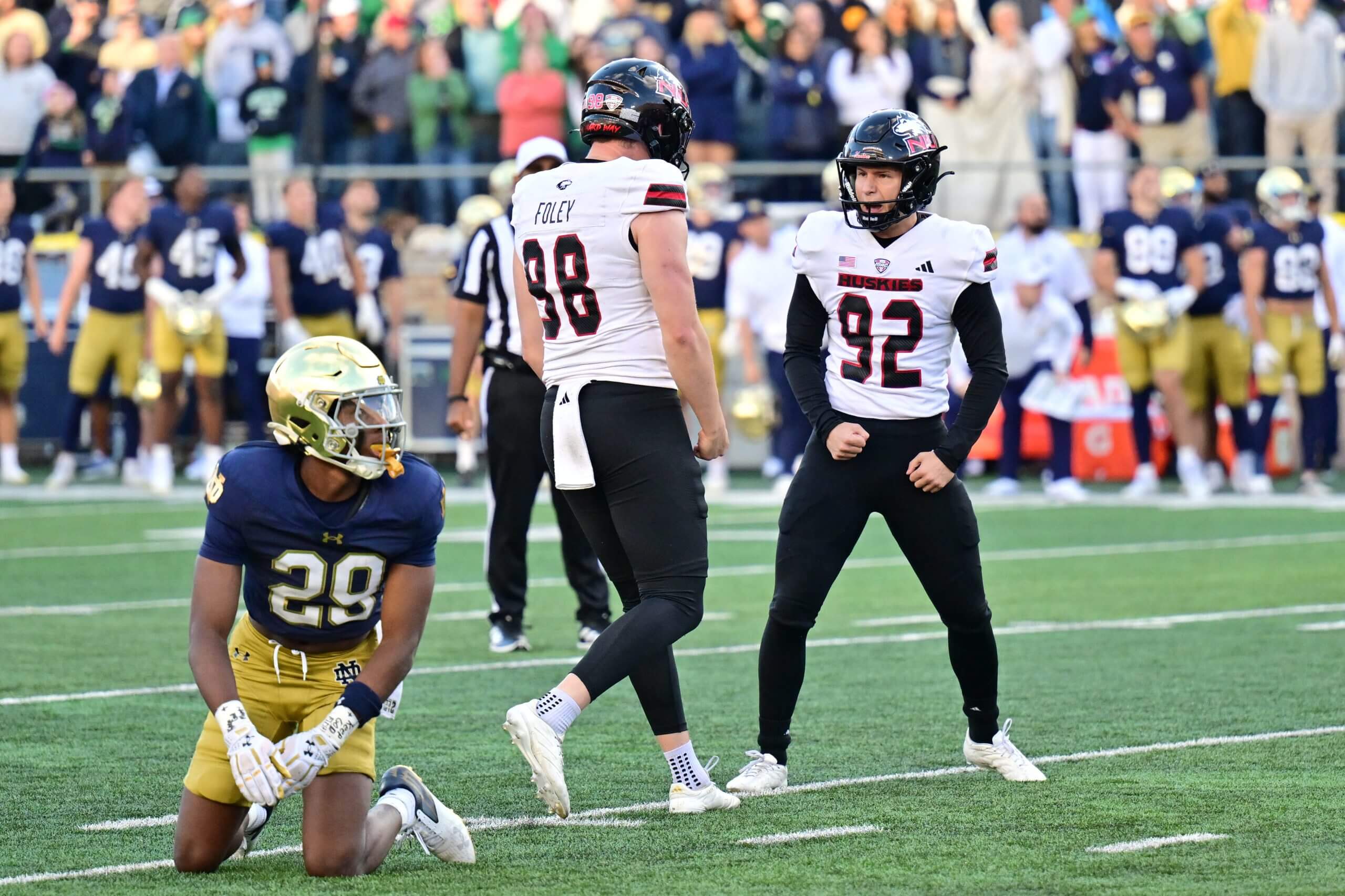
Kanon Woodill, right, celebrates after kicking the winning field goal against Notre Dame to give Northern Illinois a stunning 16-14 victory in 2024. (Matt Cashore / Imagn Images)
On Thursday night, UMass made the most of its opportunity, stunning Rutgers 37-21 in Piscataway, N.J. The Minutemen, who were 29.5-point underdogs, received $1.55 million and 500 complimentary tickets to ruin the Scarlet Knights’ season opener.
Those results are why players embrace the stage rather than view themselves as burnt offerings. They get to enter a stadium they watched on television, test themselves against future NFL players and occasionally change their program forever. Nobody boards the bus expecting to become an accounting entry.
The upsets, however, are memorable because they are rare. Most of these games end exactly as the contracts anticipate: The large school keeps its crowd happy, the small school keeps the check and everyone moves on before asking too many questions about who benefited most.
That market might become even harsher now. Power conferences are adding league games. Playoff selection increasingly rewards schedule strength. Athletic departments have to reserve more money for player payments. The largest schools might eventually decide buying a mismatch is not as valuable as it once was, reducing the number of available paydays and giving them even more leverage over programs that need the revenue.
College football can pretend it is becoming a professional sport, and in many ways, it already has. It has contracts, free agency, revenue sharing, salary structures and increasingly obvious divisions between the wealthy and everyone else.
The guarantee game might be the most professional transaction of all. Nobody pretends the participants are equal. Nobody hides the money. One side buys the likely outcome. The other sells the risk because it needs the cash.
The final score will say one school lost. The ledger will say it won. That contradiction isn’t a flaw in the guarantee game. It’s the entire point.