
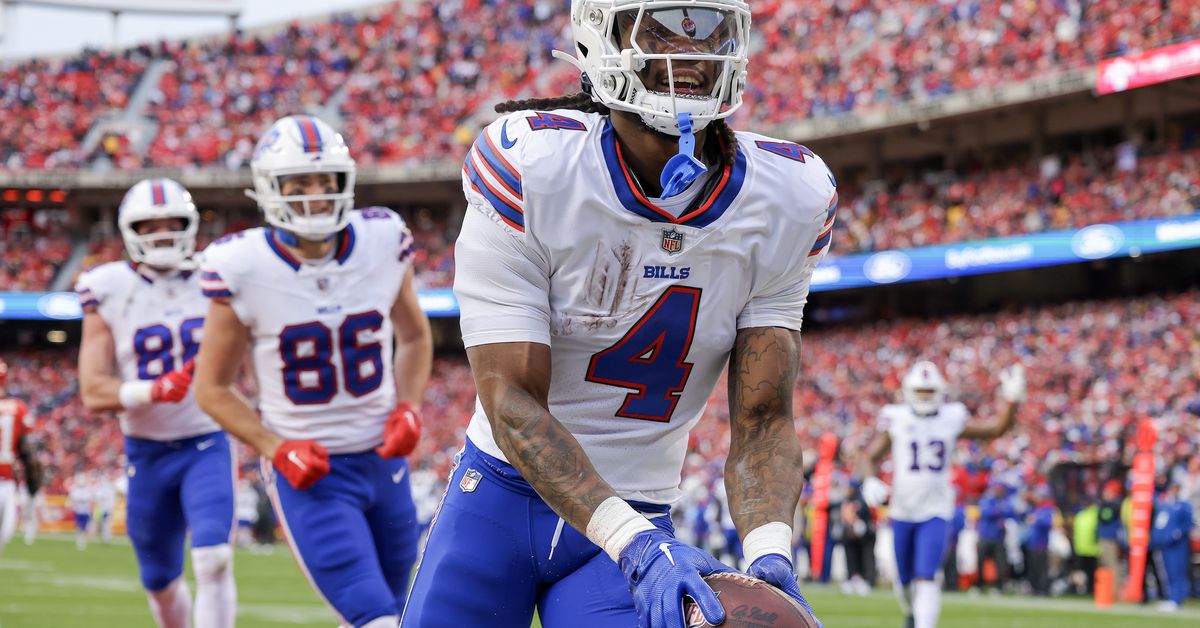
The 2025 NFL Draft came and went this past weekend without the Buffalo Bills adding a single running back to their roster. It’s a move that surprised many given the uncertainty surrounding James Cook’s future with the team.
Cook, who is entering the final year of his rookie contract, is scheduled to earn $5.271 million in base salary this season, along with a $75,000 workout bonus. The 2022 second-round pick has developed into Buffalo’s lead back over the past two seasons, posting career highs in rushing yards and total touchdowns in 2024. However, despite his growing role in the offense, questions remain about the Bills’ long-term plans at the position — and at what cost.
The Bills’ decision not to draft a running back this year surprised many, especially considering Cook’s recent absence from voluntary offseason workouts. His no-show at OTAs has fueled more speculation that he’s unhappy with his contract and wants and extension secured prior to heading into the 2025 NFL season. Bills general manager Brandon Beane has publicly downplayed any concerns.
“I mean, it’s voluntary,” [Beane said when asked about Cook’s absence.] “We could all assume he’s not here because he’s unhappy with his contract or whatever, but that’s not fair. He hasn’t told me that. No one has told me that he said that. It doesn’t mean he’s not here next week or the week after. He’ll be ready to go though.”
Beane has remained consistent throughout the offseason when questioned about Cook. He also indicated there had been no trade inquiries regarding Cook prior to or during th 2025 NFL Draft, reinforcing that Buffalo intends to move forward with him as their starter in 2025.
Early on during the current offseason, Cook’s contract became an interesting topic of conversation when he and his older brother, running back Dalvin Cook, both used social media to suggest lofty contract expectations. Earlier this offseason, James retweeted a post referencing a $15 million annual salary, while Dalvin later retweeted a figure of $20 million per year after Saquon Barkley signed his new deal with the Philadelphia Eagles. Whether that was for his brother’s benefit or congratulating Saquon Barkley is speculative at best.
While the fanbase loves Cook, and confidence in him runs high, most league insiders peg James Cook’s true market value between $10 and $14 million average annual per year. Still putting him in the top 5-7 RBs in terms of AAV. But should he be paid in the same tier as Barkley or Christian McCaffrey? These guys are workhorses who are on the field for the majority of the offensive snaps. Saquon Barkley played 74% of the Philadelphia Eagles’ offensive snaps in the 2024 season while sitting the last game of the season. Christian McCaffrey played 76% of the snaps in 2023 season (injured for the majority of 2024). In comparison, James Cook played in approximately 48% of Buffalo’s offensive snaps.
Cook’s explosive playmaking ability has certainly made him a weapon within the Bills’ offense, but the position’s overall market makes it unlikely he will reach the top of the running back pay scale — at least not in Buffalo. Cook will also turn 26 years old by the start of the 2025 season, and while he has limited tread compared to backs with heavier early career usage, running back production often declines sharply after 28. Committing long-term dollars —would require careful consideration and some additional risk.
For now, the Bills appear content to let Cook play out the final year of his rookie deal, keeping the door open for either an extension later this offseason or a possible franchise tag decision in 2026 if he has another breakout season. The question is whether Cook will let his contractÿ concerns get in the way of his 2025 season. If so, Buffalo has a capable backup in Ty Johnson and second-year RB Ray Davis — but no one is pretending that either of them are in the same tier as Cook.
With the draft complete and Cook still very much part of the roster, attention now turns to whether he’ll report for mandatory minicamp in June or if he will hold out. His attendance — or lack thereof — could give a clearer signal of where negotiations stand heading into the summer months. Either way, it’s clear the Bills aren’t rushing to make a move.