
8 Things Malik Willis Must Fix to Save His Dolphins Season
The Miami Dolphins entered the 2026 NFL season hoping Malik Willis could become the franchise’s quarterback of the future.
Five games later, that hope is fading.
With Miami at 0-5, Willis has become one of the organization’s biggest storylines. His inconsistent performances, costly turnovers, and inability to consistently move the offense have raised legitimate questions about whether he can be the long-term answer at quarterback.
But here’s the reality: Willis still has time to change the narrative.
The Dolphins are coming off their bye week and preparing to face the New York Jets. Head coach Jeff Hafley can make adjustments, and Willis can show that the struggles of the first five games don’t have to define his season.
No one should expect Willis to suddenly become an elite NFL quarterback overnight.
But he can do several things immediately to improve his performance, help Miami become more competitive, and potentially convince the organization he deserves to remain part of its future.
The question is whether he can make those adjustments before the Dolphins decide it’s time to move in another direction.
The Numbers Show Just How Much Willis Needs to Improve
Before discussing what Willis must do differently, it’s important to understand how poorly he’s done through his first five starts.
MALIK WILLIS — 2026 SEASON THROUGH FIVE GAMES
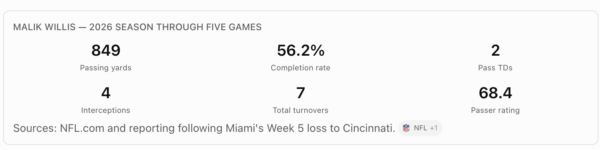
Those aren’t numbers that inspire confidence in a starting NFL quarterback.
Willis has thrown twice as many interceptions as touchdown passes, completed barely more than half his attempts, and repeatedly put the Dolphins in difficult turnover situations.
His performance against Cincinnati was especially troubling.
In Miami’s 31-24 loss, Willis completed 15 of 27 passes for just 137 yards, threw two interceptions, and lost a fumble. Although he contributed with his legs and helped lead a late rally, the damage had already been done.
So what needs to change?
1. Stop Turning the Football Over
This is Willis’s biggest issue, and it isn’t particularly complicated.
He must protect the football.
Seven turnovers in five games are unacceptable, especially for a quarterback leading an offense that already struggles to score consistently.
The Dolphins aren’t built to overcome multiple turnovers every Sunday.
When Willis throws an interception or loses a fumble, Miami’s young defense is forced back on the field, often with little time left.
Against Cincinnati, two interceptions on consecutive second-quarter possessions helped turn a competitive game into an uphill battle.
Willis needs to understand that not every play requires something spectacular.
Sometimes throwing the football away is the correct decision.
Sometimes a short completion is better than attempting a difficult downfield throw.
And sometimes accepting a modest gain is preferable to trying to extend a play and risking a fumble.
Willis has to become more disciplined with his decisions.
If he can eliminate the unnecessary turnovers, Miami’s offense will immediately become more competitive.
2. Improve His Accuracy on Routine Throws
Willis possesses impressive arm strength, but having a strong arm doesn’t automatically make someone an effective NFL quarterback.
Accuracy matters.
Over five games, his 56.2% completion percentage suggests he isn’t consistently delivering the football where it needs to go.
There have been too many missed opportunities on relatively simple throws.
Short passes to running backs, quick routes to receivers, and intermediate throws that should move the chains have become more difficult than necessary.
For an offense featuring several inexperienced skill-position players, the quarterback needs to make their jobs easier.
That means placing the football where receivers can catch it in stride rather than forcing them to adjust to poorly located passes.
It also means improving his timing.
Willis cannot consistently wait until a receiver is completely open before releasing the football.
He needs to anticipate routes and trust his receivers to get open.
The Dolphins don’t need Willis to make highlight-reel throws every series. They need him to consistently complete the throws that NFL starting quarterbacks are expected to make.
3. Make Quicker Decisions and Trust What He Sees
One of Willis’ biggest problems has been hesitation.
At times, he appears uncomfortable making decisions from the pocket, leading to unnecessary sacks, hurried throws, or broken plays.
The NFL moves too quickly for a quarterback to consistently hold the football while waiting for the perfect opportunity.
Willis needs to improve his pre-snap recognition and understand where his answers are when opposing defenses bring pressure.
If the defense is blitzing, he must identify his hot receiver.
If the coverage takes away his first read, he needs to progress to his second or third option without hesitation.
And if nothing is available, he needs to know when to escape the pocket or throw the ball away.
This is where Hafley and the offensive coaching staff also have a responsibility.
The Dolphins need to give Willis a passing game with defined reads that lets him play decisively.
Quick throws, play-action passes, and designed outside-the-pocket movement could help Willis get into a rhythm.
The more comfortable he becomes operating the offense, the better his decision-making should become.
But ultimately, Willis has to execute.
4. Use His Legs as a Weapon, Not a Crutch
No one can question Willis’ athletic ability.
Against Cincinnati, he rushed for 74 yards, setting a Dolphins single-game rushing record for a quarterback.
He also broke off a 39-yard run, showing how dangerous he can be in open space.
That ability should be an important part of Miami’s offense.
Designed quarterback runs, read-option plays, and bootlegs can create problems for opposing defenses.
But there’s a difference between using mobility to create opportunities and relying on it because the passing game isn’t functioning.
Willis cannot abandon the pocket every time his first read isn’t available.
He needs to learn when to trust his protection, step up, and deliver the football.
At the same time, Miami’s coaching staff should continue finding creative ways to utilize his athleticism.
A quarterback who can threaten defenses with both arm and legs creates extra challenges for opposing defensive coordinators.
Willis has that potential.
The challenge is becoming a more complete quarterback, not just an athletic player who occasionally throws the football.
5. Get the Offense Moving Earlier in Games
The Dolphins have spent too much of this season playing from behind.
While the entire team shares responsibility, Willis must do a better job getting the offense into a rhythm early.
Against Cincinnati, Miami’s passing game was virtually nonexistent during stretches of the first half.
Willis failed to complete a pass until the second quarter, and the Dolphins found themselves trying to overcome another significant deficit.
That simply cannot continue.
Miami needs to script early offensive plays that give Willis confidence.
Short completions, quick throws to the outside, and a productive running game could help establish momentum.
The Dolphins should also consider getting Willis outside the pocket early, where his mobility can threaten defenses.
The goal should be to avoid the repeated three-and-outs and turnovers that have forced Miami to chase games.
A productive opening drive could change the entire tone of a contest.
With the Jets up next, this is an excellent time to finally start fast.
6. Develop Better Chemistry With His Young Receivers
One issue that shouldn’t be overlooked is Willis’s lack of experience.
Miami’s receiving corps is young, and several players are still learning to perform consistently at the NFL level.
Malik Washington, Chris Bell, and other young receivers have shown flashes, but the passing game hasn’t consistently operated with the timing and precision necessary to succeed.
That chemistry takes time.
However, five games into the season, Willis and his receivers need to begin demonstrating noticeable improvement.
Routes must be run at the proper depth.
Receivers need to understand how to adjust against different coverages.
And Willis needs to trust that his targets will be where they are supposed to be.
Hafley has acknowledged that the passing game’s problems extend beyond the quarterback, pointing to receiver execution, pass protection, and coaching as areas that must improve.
He’s correct.
But as the starting quarterback, Willis is responsible for helping bring those pieces together.
He must communicate better with his receivers, build trust through repetition in practice, and take command of the offense.
The Dolphins won’t suddenly acquire an entirely new receiving corps.
Willis has to find a way to succeed with the players currently on the roster.
7. Become a Better Leader When Things Go Wrong
Leadership is about more than giving speeches or encouraging teammates on the sideline.
It’s about accountability.
Willis has been willing to acknowledge his mistakes, which is encouraging.
Following the Cincinnati loss, he spoke about the need to correct repeated execution problems and avoid turning ordinary mistakes into disastrous plays.
That’s the right message.
But words only carry so much weight.
Willis needs to demonstrate that accountability through improved performances.
When a drive stalls, he needs to respond positively.
When he makes a mistake, he can’t let it affect the next possession.
When the Dolphins face adversity, he needs to provide the steady leadership expected of a starting quarterback.
The young players surrounding Willis will look to him for direction.
If he appears uncertain or frustrated, that can spread throughout the offense.
If he stays composed and executes the next play, he can help build confidence.
To become Miami’s long-term quarterback, Willis must prove he can lead the offense through difficult moments.
8. Prove He Can Win Games, Not Just Make Exciting Plays
This may be the most important point.
Willis has shown flashes of talent.
He can make impressive throws, escape pressure, and run for explosive gains.
But those individual moments matter little if the Dolphins keep losing football games.
At some point, Willis has to demonstrate that he can consistently put his team in position to win.
That means converting important third downs.
It means finishing drives in the red zone.
It means avoiding costly mistakes late in close games.
And it means making the right decisions when the game is on the line.
The Dolphins have been competitive in stretches against quality opponents, but they haven’t been able to finish.
Willis needs to become part of the solution, not one of the reasons Miami keeps falling short.
How Much Time Does Willis Really Have?
Hafley has publicly backed Willis coming out of the bye week.
When asked whether he was considering starting Kyle McCord against the Jets, Hafley rejected the idea and reaffirmed Willis as the starter.
That’s an important vote of confidence.
But it shouldn’t be interpreted as an unlimited commitment.
The Dolphins are rebuilding, and part of that process is deciding which players deserve a role in the organization’s future.
If Willis continues struggling, Miami will eventually need to evaluate whether McCord deserves an opportunity.
The Dolphins also must consider selecting a quarterback in the 2027 NFL Draft.
That puts additional pressure on Willis to demonstrate progress.
He doesn’t necessarily need to lead Miami to eight or nine victories over the remainder of the season.
But he does need to show that he can operate the offense effectively, protect the football, and consistently make NFL-caliber throws.
If the Dolphins finish the season with only a handful of wins but Willis shows significant improvement, the organization could still have reason to believe in his future.
However, if the same problems continue week after week, Sullivan and Hafley will struggle to justify another season with Willis as the unquestioned starter.
The Jets Game Is a Perfect Opportunity to Start Turning Things Around
Miami’s next opponent is the New York Jets, and the matchup gives Willis a chance to start changing the narrative.
The Jets have their own problems, and Miami shouldn’t need its quarterback to throw for 350 yards and four touchdowns.
Instead, Willis should focus on playing clean, efficient football.
A performance featuring 200 to 225 passing yards, two touchdowns, no turnovers, and several productive runs would represent a meaningful step forward.
More importantly, it could help the Dolphins earn their first victory of the season.
One strong performance wouldn’t erase five weeks of struggles.
But it would provide evidence that Willis is learning from his mistakes.
And that’s what Miami needs to see.
Final Thoughts: The Rest of the Season Will Define Malik Willis’ Future
The Dolphins invested in Willis because they believed his athleticism, arm talent, and potential made him worth developing.
That belief hasn’t paid off in the first five games.
But the season isn’t over.
Willis still has opportunities to prove that he can become a productive NFL starting quarterback.
The path forward isn’t particularly complicated.
Protect the football. Improve accuracy. Make faster decisions. Trust his receivers. Use his mobility intelligently. And, most importantly, help the Dolphins win games.
The challenge is actually doing those things consistently on Sundays.
Miami doesn’t need Willis to become Patrick Mahomes or Josh Allen overnight.
It needs him to become a reliable quarterback who gives his team a legitimate chance to win.
If Willis can make those improvements, he may still have a future as the Dolphins’ starting quarterback.
If he can’t, Miami may have no choice but to begin looking elsewhere.
The bye week gave Willis an opportunity to reset.
Now comes the hard part.
He has to prove the first five games were growing pains, not a preview of what the Dolphins can expect for the rest of the season.
And with the Jets waiting on Sunday, there is no better time to start.