
Big Ten Catches SEC in Race for College Football Superiority originally appeared on Athlon Sports.
[Editor’s note: This article is from Athlon Sports’ 2025 College Football Preview print magazine. Order your copy online today, or pick one up at retail racks and newsstands nationwide.]
Advertisement
Remember “SEC Speed?”
Just weeks after then-No. 1 Ohio State won college football’s latest “Game of the Century” against then-No. 2 Michigan to end the 2006 regular season, the favored Buckeyes were blown out by a Florida Gators team that seemed faster, more physical and meaner at every position.
While the entire college football world spent that November fixated on the marquee Midwest matchup — and a potential second encounter in the BCS National Championship Game — the Gators of the SEC suddenly grabbed the attention of the nation by running around, past and oftentimes right through the Buckeyes in a 41-14 rout to claim the national title.
For almost the next two decades, the SEC would tower over college football. Head coach Urban Meyer would win multiple national titles at Florida, and Nick Saban would turn Alabama into the greatest dynasty in the sport’s history. And when those two names weren’t hoisting trophies, a rotation of SEC programs (LSU, Auburn, Georgia) and other schools south of the Mason-Dixon Line (Florida State, Clemson) were trading national championships, often facing off against one another.
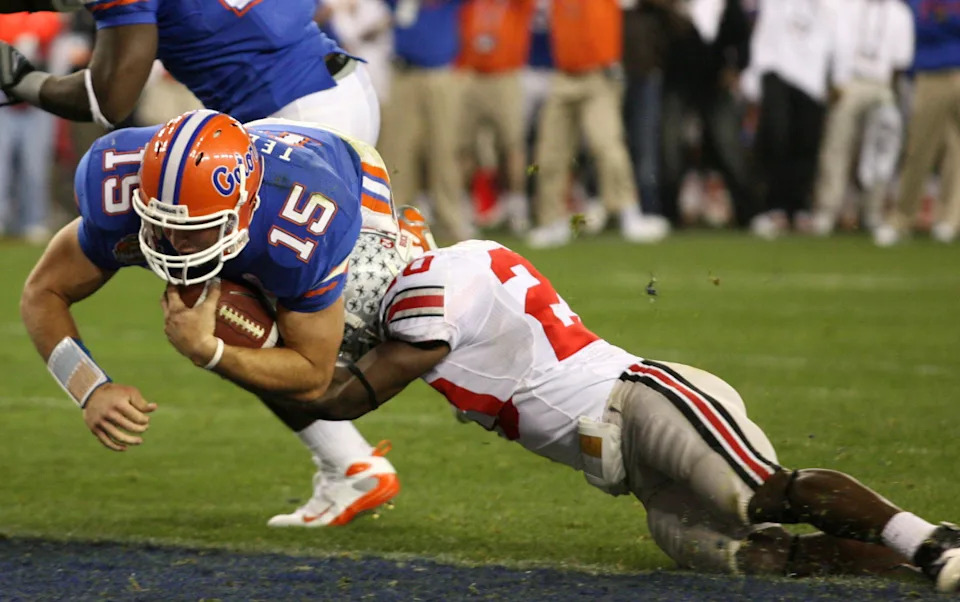
Florida Gators quarterback Tim Tebow scores a touchdown as Ohio State Buckeyes defensive back Donald Washington attempts a tackle in the BCS National Championship Game in Glendale, Arizona, on Jan. 8, 2007.Matthew Emmons-Imagn Images
The only reprieve for the Big Ten came when the Buckeyes lured Meyer, an Ohio native, out of a feigned retirement and back home to Columbus, where he promptly discarded the league’s antiquated, unwritten rules of gentlemanly recruiting and built a national champion in 2014.
Advertisement
But even with Big Ten programs attempting to modernize their personnel, the South still ruled. Following Ohio State’s 2014 title at the beginning of the College Football Playoff era, an SEC and/or Southern school won every national championship for the next eight seasons. Only once, when Alabama beat Ohio State 52-24 in 2020, did a Big Ten school even make the CFP final.
So why is a guy like Doug Lesmerises so confident?
“We’ll look back at this era of SEC and Southern dominance as a blip,” says Lesmerises, a longtime sportswriter covering the Big Ten and Ohio State. “Before the BCS, college football success was geographically balanced. And now it will be again. Michigan and Ohio State winning the last two national titles isn’t a fluke. This is the new normal.”
Lesmerises hosts “Kings of the North,” a show dedicated to firing back at a generation of Southern dominance in college football and the associated narrative. “It doesn’t necessarily mean the North and the Big Ten will dominate. It just means the playing field has been leveled, and it’s never going back to the way it was,” he says. “The South better suck it up and get used to it.”
Advertisement
In the past two national championship games, Michigan and Ohio State defeated Washington and Notre Dame, respectively, boxing out the SEC. Add in the unavoidable context of how college football is changing off the field, and suddenly the Big Ten looks a lot more formidable entering the next era of the sport.
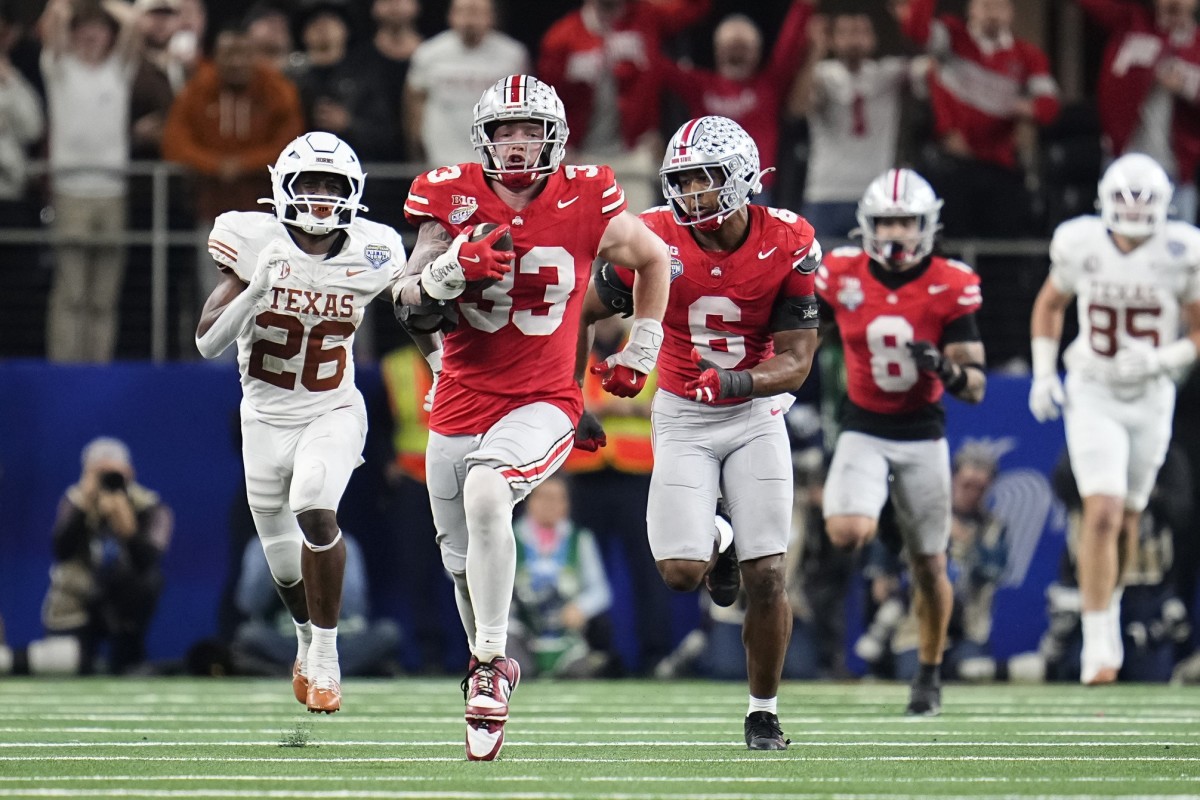
To see it on the field, take a look at how Ohio State’s defenders blew up Texas’ goal-to-go drive in the Cotton Bowl/CFP semifinal last year. Ohio State safety Caleb Downs, a former Alabama player, sniffed out a simple toss play to Texas running back Quintrevion Wisner on second-and-goal. The lost yardage helped set up a fourth-and-goal on which Ohio State’s Jack Sawyer forced a fumble and returned it for a touchdown (above, left), helping seal the win for the Buckeyes and blocking the SEC from the title game again.
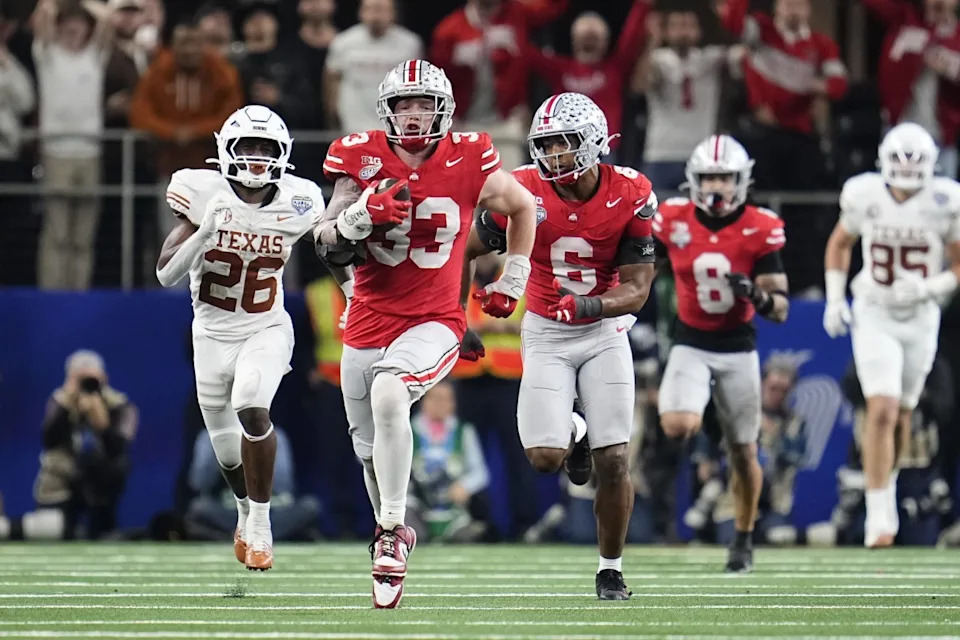
Ohio State Buckeyes defensive end Jack Sawyer returns a fumble recovery for a touchdown against the Texas Longhorns during their Cotton Bowl playoff game on Jan. 10.Adam Cairns / Columbus Dispatch / USA TODAY Network via Imagn Images
Downs’ play — and the fact that he did it in a scarlet and grey uniform — illustrates the impossible-to-ignore change that the transfer portal and Name, Image and Likeness rights have caused. During any of the Saban title seasons at Bama, Downs would’ve been in Tuscaloosa, but the new market of unrestricted “free agency” let him leave Bama for a better payday at Ohio State. The hundreds of players like Downs moving between the SEC and Big Ten, as well as the rest of the FBS, is creating a newfound parity in the sport.
Advertisement
If there’s a short and quick explanation for the South’s dominant run for two decades, it’s basic geography. More elite players hail from warm-weather states like Florida, Texas and Georgia than anywhere in the traditional Big Ten footprint. Accordingly, the “old ways” of acquiring personnel via non-compensated scholarships and active penalties against transferring meant that the South could enjoy a stocked pond, and keep every fish it caught. But the old ways are no longer applicable.
One way to overcome a geographic disadvantage is to simply outbid your competitors, which an increasing number of Big Ten programs have started doing via NIL. College football’s black market of “bag men” is defunct, and now that it’s out in the open, schools whose boosters might’ve been unwilling to spend large amounts of untraceable cash have a legitimate means of fundraising to attract talent.
“Now that things are above board, there’s no question that Michigan, Ohio State, Notre Dame, Oregon and even USC are financially strong enough to have one of the highest-paid rosters in college football,” says Steve Wiltfong, On3’s vice president of national recruiting. “And they’re doing it. Michigan, they didn’t fool around at quarterback this year. They went into the portal and paid a lot of money for the best player in the country.”
That player — 5-star quarterback Bryce Underwood — flipped to the Wolverines from LSU.
Advertisement
“That doesn’t happen five years ago or maybe even three years ago,” Wiltfong says. “The above-board paying of players certainly has benefited the Big Ten compared to the past, where we know it wasn’t a fair game.”
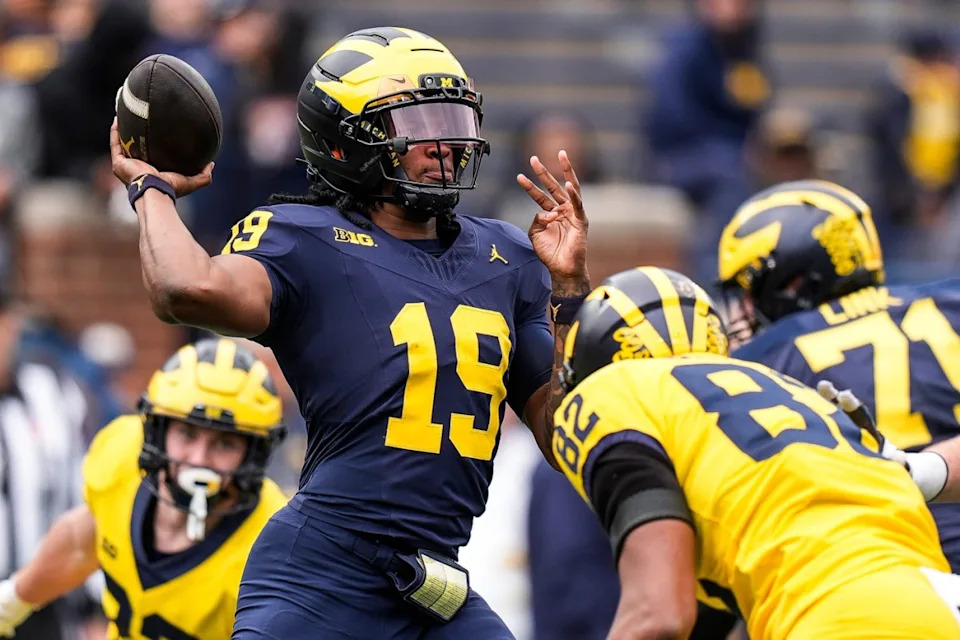
Michigan quarterback Bryce Underwood throws a pass in the Wolverines’ spring intrasquad game in Ann Arbor on April 19.Junfu Han / USA TODAY Network via Imagn Images
For Lesmerises, it feels like a sea change. “Of course the SEC is closer to more great high school talent. Beyond that, every advantage has evaporated in this new era of permissibly paying players and the transfer portal,” he says. “NIL has activated the donor class in the Big Ten, which has bigger cities and more than enough money to compete.”
According to analyst Parker Fleming of CFB Graphs, recent data shows that other leagues are catching up. In 2019, the SEC enjoyed a non-conference winning percentage of 69.6% and an average margin of victory of 8.43 points. In the past two seasons, the SEC has won just 54.5% of non-conference games by an average of 4.13 points per game.
Advertisement
Does that mean the SEC is doomed? The SEC certainly doesn’t believe so. “Ohio State was the best team in the country last year when it mattered most, no doubt. Best players in the best position to win,” one SEC assistant says. “Michigan was a different situation. A lot of coaches think that [Rose Bowl] was one of the worst-coached games of Saban’s career, and that if Bama calls a better game, they crush Washington in that title game.
“This idea that the SEC can’t win in the portal era is ridiculous. The schools in this league invented aggressive recruiting.”
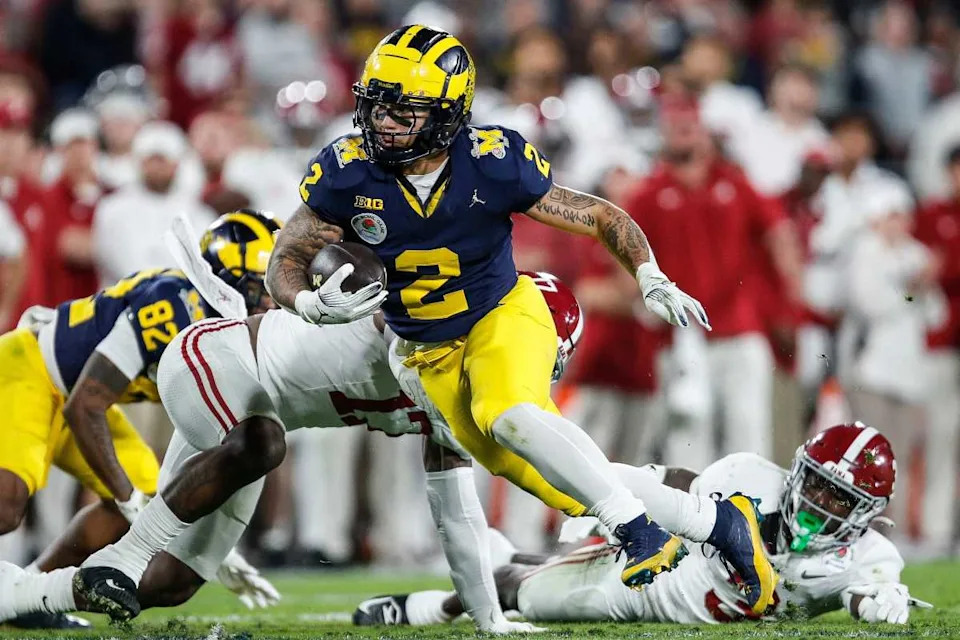
Michigan running back Blake Corum runs the ball against Alabama in their College Football Playoff semifinal game at the Rose Bowl in Pasadena, California, on Jan. 1, 2024.Junfu Han / USA TODAY Network
But they’re not the only ones using it. “I think it’s a hell of a lot easier to convince boosters to throw money into NIL,” a Big Ten assistant says. “I think Indiana’s success last season woke everyone up in this league. … A lot of coaches in this league think Illinois could’ve won a game in the playoff last year.”
Advertisement
“I wouldn’t rush to judgment after one playoff selection,” one SEC coordinator says. “But if you look at their league and our league, and take the best, most complete roster leaving the spring, it’s probably Texas against Penn State. A few years ago, that would’ve been a Saban or [Kirby] Smart team with a significant advantage. I think Penn State and Texas, right now, would be a pretty close game. And that’s saying something.”
Related: Athlon Sports 2025 College Football Preview Magazine Available Now
Related: SEC Coaches Talk Anonymously About Conference Foes for 2025
Related: Big Ten Coaches Talk Anonymously About Conference Foes for 2025
This story was originally reported by Athlon Sports on Jun 11, 2025, where it first appeared.