
With the recent conference expansion, the Big Ten is now home to some of the oldest and most famous football stadiums in the world.
Those are, in no particular order, Wisconsin’s Camp Randall Stadium, Michigan Stadium, Ohio Stadium, Penn State’s Beaver Stadium, UCLA’s Rose Bowl, USC’s L.A. Memorial Stadium, Nebraska’s Memorial Stadium, Iowa’s Kinnick Stadium, and so on.
Related: Ranking all 18 Big Ten football stadiums from smallest to largest
When non-Big Ten football history is also considered, such as the L.A. Memorial Coliseum’s Olympic events, Super Bowl and World Series, plus the Rose Bowl’s annual Rose Bowl Game, the conference’s repertoire is further bolstered. If one were to rank the college football conferences by the history of their members’ stadiums, the Big Ten would boast the prohibitive No. 1 slot.
For a look at that history, which in many cases is more than 100 years old, here is every Big Ten football stadium ranked from youngest to oldest.
18. Lanny and Sharon Martin Stadium (Northwestern)
Capacity: 12,023
Opened: 2024 (temporary)
Northwestern demolished old Ryan Field before the 2024 season. It currently plays in this temporary lakefront stadium, at least until the weather starts to turn in November, when it moves to the Chicago Cubs’ Wrigley Field. The new Ryan Field is set to open in 2026. It will have little trouble besting the old version.
17. Huntington Bank Stadium (Minnesota)
Capacity: 50,805
Opened: 2009
Minnesota’s stadium is on the newer side. The Gophers played at their own Memorial Stadium from 1924 to 1981, when they moved to the nearby Metrodome. Huntington Bank Stadium, an on-campus venue, also hosted the Minnesota Vikings for two years.
16. SHI Stadium (Rutgers)
Capacity: 52,454
Opened: 1994
Rutgers’ campus has plenty of history — it hosted the first recorded intercollegiate football game, between then-Rutgers College (Rutgers) and the College of New Jersey (Princeton). The site of that game is not where modern-day Rutgers plays football, however. The 30-year-old SHI Stadium doesn’t have much history.
15. Autzen Stadium (Oregon)
Capacity: 54,000
Opened: 1967
Autzen is one of the most beautiful college football stadiums. Its atmosphere also swings above its weight with only a 54,000-seat capacity. This venue should be one of the Big Ten’s toughest to win at for as long as Dan Lanning is leading the Ducks.
Get more (Oregon) news, analysis, and opinions on Ducks Wire
14. Memorial Stadium (Indiana)
Capacity: 52,626
Opened: 1960 (Oct. 8)
Memorial Stadium saw the best season in its 65-year history in 2024, as the Hoosiers went 11-1 during the regular season (8-0 at home) and reached the College Football Playoff. Its opening year is tied with one other stadium, the two separated by only a month.
13. Beaver Stadium (Penn State)
Capacity: 106,572
Opened: 1960 (September 17)
Beaver Stadium may hold the crown for the best stadium atmosphere in college football. For those skeptical of the stadium’s impact, find the highlights of its 2024 CFP game against SMU. At 106,572, it is also the second-largest stadium in the sport.
Get more (Penn State) news, analysis, and opinions on Nittany Lions Wire
12. SECU Stadium (Maryland)
Capacity: 51,802
Opened: 1950
2025 will be the 75th year for Maryland at SECU Stadium. In addition to Maryland football, the stadium hosted the USFL’s Baltimore Stars in 1985, plus 10 Division I NCAA Men’s Lacrosse Championships.
11. Kinnick Stadium (Iowa)
Capacity: 69,250
Opened: 1929
Kinnick Stadium is one of the Big Ten’s better venues. It is one of an incredible total of 11 Big Ten stadiums built before 1930. Thanks to Iowa’s classic identity and dominant defense, it is one of the toughest places to play, especially at night.
Get more (Iowa) news, analysis, and opinions on Hawkeyes Wire
10. Michigan Stadium (Michigan)
Capacity: 107,601
Opened: 1927
There is an argument for Michigan Stadium as one of the more overrated venues in the Big Ten. It is more than 107,000 seats that span further and further away from the field itself, where the top row may find itself in another zip code. That aside, the venue’s history is second-to-none. Remarkably, the conference’s 10th-oldest stadium is nearly 100 years old.
Get more (Michigan) news, analysis, and opinions on Wolverines Wire
9. Ross-Ade Stadium (Purdue)
Capacity: 57,236
Opened: 1924
Ross Ade Stadium was a dangerous place for top-ranked teams for a few years during the Jeff Brohm era. The nearly 60,000-seat venue helped the ‘Spoilermakers’ develop their name. New coach Barry Odom is tasked with returning the program to that form after it experienced two poor years under Ryan Walters.
8. Memorial Stadium (Illinois)
Capacity: 60,670
Opened: 1923 (Nov. 3)
Illinois’ Memorial Stadium is one of four venues that opened in 1923. It’s also one of three stadiums with its name in the conference. In all likelihood, the 2025 season could see Illinois’ best results in the venue since its undefeated seasons in 1923 and 1927.
7. Memorial Stadium (Nebraska)
Capacity: 85,458
Opened: 1923 (Oct. 20)
Here is the third Big Ten stadium to open in 1923, plus the conference’s third ‘Memorial Stadium.’ The program has sold out 403 consecutive home games dating back to 1962, the longest sellout streak in NCAA history for any sport. As seen above, those sellouts are still far from full capacity.
Get more (Nebraska) news, analysis, and opinions on Cornhuskers Wire
6. Spartan Stadium (Michigan State)
Capacity: 75,005
Opened: 1923 (Oct. 6)
Spartan Stadium edged Nebraska and Illinois’ Memorial Stadiums by just a few weeks. The venue was one of the toughest places to play in the Big Ten for several years during the Mark Dantonio era. Spartan fans hope that Jonathan Smith is close to bringing the program back to that level.
Get more (Michigan State) news, analysis, and opinions on Spartans Wire
5. L.A Memorial Coliseum (USC)
Capacity: 77,500
Opened: 1923 (May 1)
While the L.A. Memorial Coliseum technically opened on May 1, 1923, it did not host a game until Oct. 6 of that year. In addition to USC football, it has hosted two Summer Olympics (1932 and 1984 — plus another upcoming in 2028), the Los Angeles Rams (1946-79, 2016-19), the Los Angeles Dodgers (1958-61), a Super Bowl (I) and more. It is by far the conference’s most historic venue.
Get more (USC) news, analysis, and opinions on Trojans Wire
4. Rose Bowl Stadium (UCLA)
Capacity: 89,702
Opened: 1922 (October 28)
When only college football is considered, the Rose Bowl’s history is second-to-none. It hosted four BCS National Championship Games (2001, 2005, 2009 and 2013 seasons), four CFP semifinals (2014, 2017, 2020 and 2023 seasons and one quarterfinal (2024 season). In addition, it also hosted the 1994 FIFA World Cup final, which Brazil won over Italy in penalty kicks.
Get more (UCLA) news, analysis, and opinions on UCLA Wire
3. Ohio Stadium (Ohio State)
Capacity: 102,780
Opened: 1922 (October 7)
Ohio Stadium is synonymous with Big Ten football. Part of that is the strength of the Buckeyes’ program, which has won nine national titles (1942, 1954, 1957, 1961, 1968, 1970, 2002, 2014 and 2024). Another is the venue’s history, which is older than just two in the Big Ten.
Get more (Ohio State) news, analysis, and opinions on Buckeyes Wire
2. Husky Stadium (Washington)
Capacity: 70,138
Opened: 1920
This inclusion is a bit surprising, given Washington’s recent move to the conference. Husky Stadium is known as one of the most beautiful venues in the sport. It is not synonymous with the other 100-year-old-plus stadiums in the conference. But the numbers don’t lie.
Get more (Washington) news, analysis, and opinions on Huskies Wire
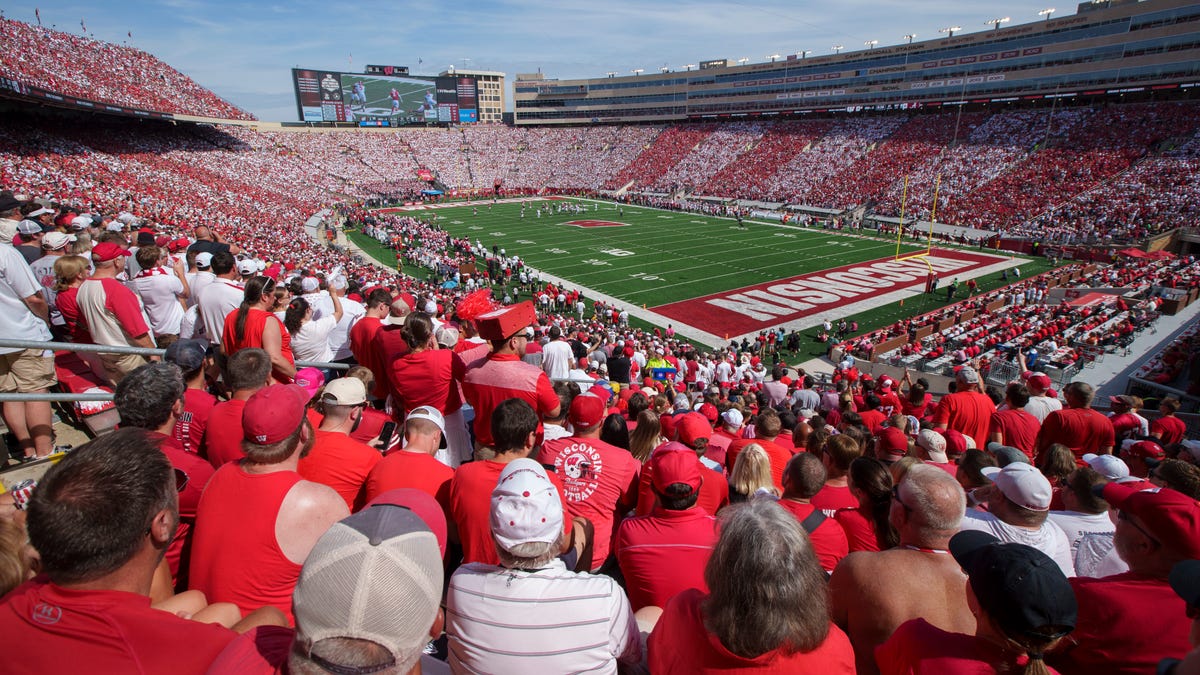
1. Camp Randall Stadium (Wisconsin)
Capacity: 80,321
Opened: 1917
Wisconsin’s Camp Randall Stadium claims the crown as the oldest venue in the Big Ten. The name comes from the history of the ground on which it stands, which was a Union Army training camp during the Civil War. Of course, its ‘Jump Around’ tradition has become one of the sport’s best.
Contact/Follow @TheBadgersWire on X (formerly Twitter) and like our page on Facebook to follow ongoing coverage of Wisconsin Badgers news, notes and opinion