
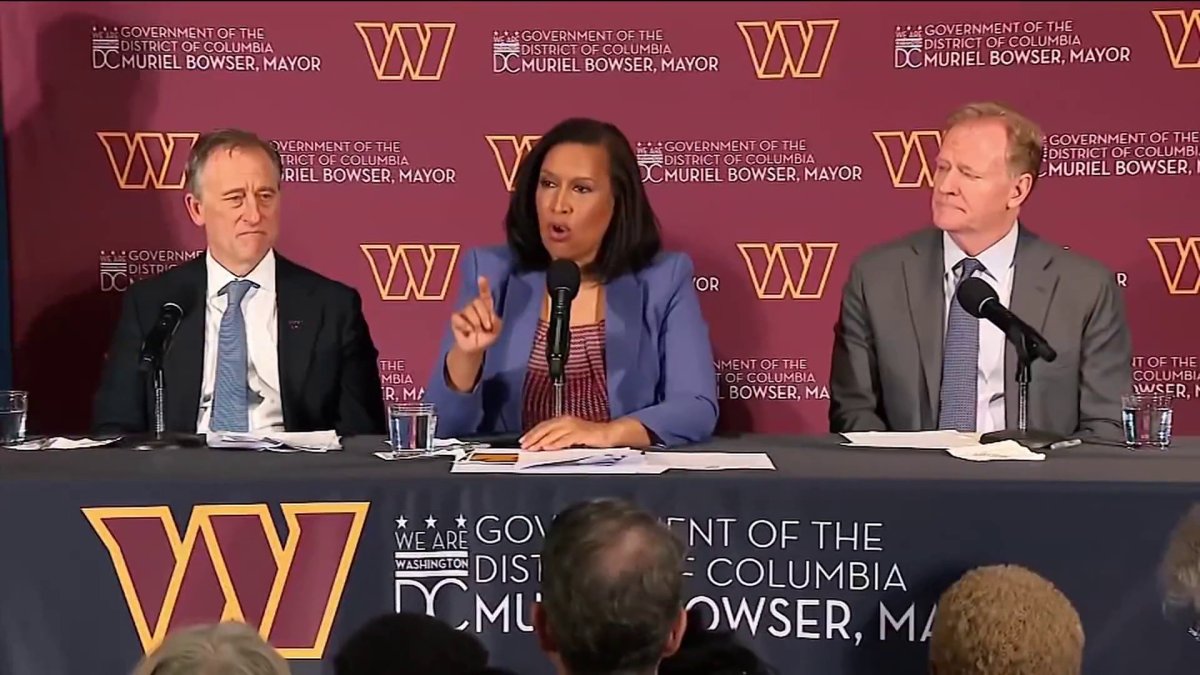
At a splashy announcement in late April, D.C. Mayor Muriel Bowser assured taxpayers their $1.1 billion investment in a new football stadium and entertainment complex would be money well spent — pledging that over 30 years the deal would bring in $4 billion in tax revenue.
A month later, her administration released a report from private consultants that upped that figure to $5.1 billion in tax revenue over a 30-year period.
But the News4 I-Team’s review of that new fiscal impact shows at least a third of those tax dollars will remain at the proposed Washington Commanders stadium site — a significant portion of the return promised to taxpayers.
Of the $5.1 billion private consultant CSL predicts the stadium and surrounding district will generate in tax dollars over 30-plus years, the I-Team found $1.7 billion will be spent running the stadium, maintaining the stadium and paying off the money D.C. borrows to build the stadium.
“Some of the tax revenue that’s generating that will stay on the campus is really meant to be able to maintain the quality of what’s there so it doesn’t degrade over time,” said D.C. City Administrator Kevin Donahue, adding those dollars would offset annual operating costs from public safety and civil enforcement associated with game days.
Donahue explained all sales taxes, food and beverage taxes, and ticket taxes generated at the stadium would stay in a fund used solely for the stadium expenses and upkeep.
It’s just one aspect of the $3.7 billion stadium complex deal now under consideration by the D.C. Council, which has discussed delaying a vote on the package Bowser proposed as part of the Council’s annual budget process.
Under the deal, the Commanders pledge to invest $2.7 billion of private money with more than $1 billion in D.C. taxpayer funds to revamp the RFK Stadium site in Ward 7.
The deal has come under fire, however, from taxpayer watchdogs who say District dollars would be better invested in District residents’ more urgent needs.
“This is really an investment in billionaire sports team owners. And what it is going to do is grow their profits while D.C. bears the cost,” Shira Markoff of the DC Fiscal Policy Institute told News4.
Markoff said that, at a time when necessities such as D.C. Medicaid and other safety nets face dramatic cuts, District residents deserve to know the full cost of the deal.
“This is D.C.’s money,” Markoff said. “We want to see it invested on behalf of D.C. residents to really grow our economy, you know, in ways that benefit D.C. workers and our most vulnerable population.”
But proponents of the deal, including Bowser, have argued there are few realistic alternatives for the RFK site, with estimates showing the Commanders complex would generate about 30,000 construction jobs and $4.2 billion in pay for those workers over three decades.
She has defended the multibillion-dollar tax revenue estimates as conservative, saying in early June: “When we look at the number of jobs created, tax revenue generated, the adjacent economic activity that is created, we think it could be even bigger.”
The I-Team asked for clarity on how the anticipated tax revenue changed from $4 billion over three decades to more than $5 billion in the private consultants’ report. The I-Team was told the private consultants aren’t available for media questions, but Donahue said the increase was a result of speeding up the projected opening of restaurants, shops and apartments surrounding the stadium.
“The bigger difference really was in the economic activity that’s happening outside the stadium,” Donahue told News4.
The I-Team wanted to see those dates and details and filed open records requests for the documents showing the initial projections and discussions around them.
The District provided the report breaking down the $5 billion figure but said neither the mayor, deputy mayor for economic development nor about a half dozen of their senior staffers had a copy of the first draft — which included the $4 billion figure — before reporting its promises in the stadium announcement.
The I-Team also was told the District could not locate a single email, text or voice message about it in its records.
The deal also projects as many as 6,477 multi-family residences around the stadium. That is almost five times as many residences in the District’s Wharf neighborhood, according to The Wharf’s website.
Under the deal, the Commanders have the right to develop the residences, but it’s unclear how many District dollars could go to that effort. The District already requires a portion of housing units to be designated as affordable and, according to Donahue, hasn’t ruled out providing additional funds for that purpose.
Donahue said District leaders arrived at the 6,477 number based off a master plan it has for the RFK site. But when the I-Team asked for a copy of that plan, which they said was prepared by outside consultants, they declined to release it.
Meanwhile, the D.C. Council hired an outside consultant to review the terms of the deal, which Bowser said must be approved by July 15 under its agreement with the Commanders. If that date passes, the Commanders could start negotiating again with Maryland or Virginia.
The team has said it hopes to open the new stadium by 2030.
Investigative producer Katie Leslie and photojournalist Derrick Cheston contributed to this report.
Sign up for our free deep-dive newsletter, The 4Front, to get standout News4 stories sent right to your inbox. Subscribe here.