
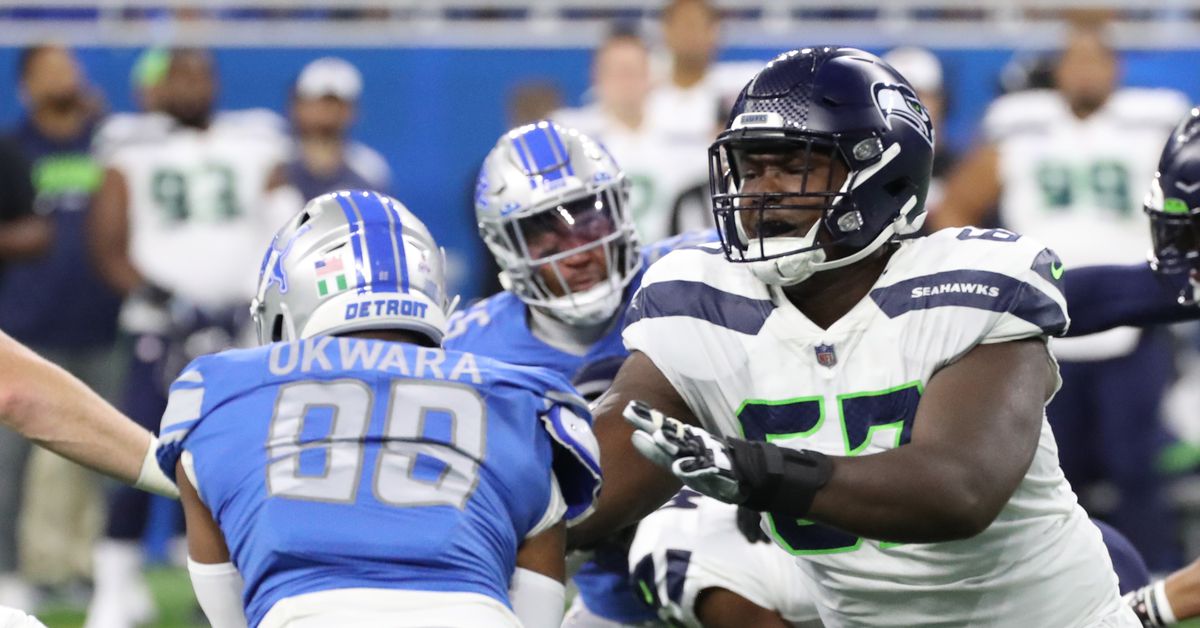
After two promising seasons, Charles Cross has established himself in 2024 as one of the pillars of the Seahawks’ offensive line. The left tackle, chosen ninth overall in the 2022 NFL Draft, has made a notable technical leap, especially in pass protection, demonstrating improvements in both efficiency and consistency.
As he approaches the end of his rookie contract, has he shown enough to believe he can become elite?
Contract extension?
Reaching an extension this offseason could represent an even greater salary cap savings than exercising the fifth-year option, while waiting another year until Cross is in the final year of his contract could burn more salary cap than the team saved by exercising the option.
With his performance in 2024, Charles Cross strengthens his case for a future contract extension. Given the recent offensive tackle market — where names like Penei Sewell (5 years, $112M) and Jordan Mailata (3 years, $66M) have signed extensions — it’s reasonable to project that Cross could fetch somewhere in the $22–25 million per year range, making him one of the highest-paid LTs in the NFL.
If that sounds like a lot, consider these “absurd” numbers:
Walker Little, Jacksonville Jaguars (26): $40.5M, $13.5M per year;
Jaylon Moore, Kansas City Chiefs (27): $30M, $15M per year;
Alaric Jackson, Los Angeles Rams (27): $57.75M, $19.25M per year;
Dan Moore Jr., Tennessee Titans (27): 4 years, $82M, $20.5M per year;
Andrew Thomas, New York Giants (26): 5 years, $117.5M, $23.5M per year;
Christian Darrisaw, Minnesota Vikings (26): 4 years, $104M, $26M per year;
Stats and performance (PFF)
Overall Grade: 82.5 — 10th among 140 NFL tackles .
Pass Block Grade: 81.3 (15th in the league) .
Run Block Grade: 77.9 (16th in the league) .
Snaps played: 1,094 (7th among 140 tackles), 724 snaps as a pass-blocker (2nd) .
Penalties: 8 (110th/140)
Sacks allowed: 6 (120th/140)
Pressures allowed: 47 .
These numbers show a clear jump: he went from middling grades in 2022/23 to being in the top 10 in 2024 . Ranked among the 101 best players by PFF (ranked No. 89), the only OL for Seattle recognized this year .
Early in the season, he stood out as the best OT in the league in the first few weeks, with zero pressures allowed and a 90.2 grade from PFF . In Week 1, opponents like the Denver Broncos were unable to pressure him, and he had a 96.1 grade in run blocking.
Pass Protection: Charles Cross stands out among the elite
In 2024, Charles Cross allowed just 23 total pressures, including 4 sacks, over 17 starts. His pass-blocking efficiency was 96.9%, according to PFF data, which put him in the top 10 in the league among LTs with at least 500 passing snaps.
Comparing to the elite:
Player (LT) Pressures Given Sacks Given Efficiency (PFF):
Trent Williams (SF) 16 3 97.4%;
Charles Cross (SEA) 23 4 96.9%;
Andrew Thomas (NYG) 21 5 96.8%;
Rashawn Slater (LAC) 25 5 96.3%;
Laremy Tunsil (HOU) 29 6 96.1%
Cross not only maintained consistency, but he also demonstrated maturity when facing the league’s top edge rushers. Against the likes of Micah Parsons, Nick Bosa and Aidan Hutchinson, he had a solid performance, allowing no more than three pressures in any of those games — none of which resulted in a sack.
In terms of pass protection, Cross showed greater consistency in 2024. His ability to position himself quickly after the snap and his use of his hands were areas that improved, especially when working against bull rushers. Cross began to use his “independent hand usage” better, alternating his hands instead of committing both simultaneously, which gave him more room to react to secondary movements from edge rushers.
Handwork was Cross’ best attribute coming out of college. He didn’t show this characteristic consistently in his first year, but it improved as the games went on.
This is an example of him showing this quality during his time at Mississippi State.
This snap is very impressive. Cross misses the first contact, with the defender showing his hands and quickly recovering. This could result in a loss of balance, but he is able to stay in front of the EDGE and protect the QB.
He excelled especially against speed rushers with less anchoring power, being able to maintain good depth and angle on his kick slide. His more controlled base reduced the number of times he was beaten inside – a notable vulnerability in 2022 and partially in 2023.
His anchoring also fails punctually against bull rushers who align with a narrow angle and gain low leverage.
One way he has learned to deal with stronger defenders is with this leverage contact. He positions his hands well and tries to push the defender up, reducing contact with the ground. If he can do this consistently, it could be excellent for him in the future, since dealing with these power moves is clearly his biggest weakness.
Feet “glued” after first contact: This leaves him vulnerable to quick counters.
Late hands in quick set situations: Sometimes he waits too long for contact, allowing the defender to dictate the pace.
Leaning forward against more explosive rushers: When he tries to compensate for strength with aggression, he ends up losing balance and being punished by swim moves or arm-overs. When facing rushers with good hand swiping and inside counter moves, he tends to open his hips too much, losing the ability to react laterally with explosion.
Run Blocking: Good foundation, but still room for improvement
In the running game, Charles Cross showed improvement, but his impact is still lower than that of other elite OTs. According to PFF, his run-block grade was 68.5, a number that places him in the top half of the league, but far from the leaders at the position.
Player (LT) Run Block Grade (PFF)
Trent Williams (SF) 90.2;
Christian Darrisaw (MIN) 83.7;
Jordan Mailata (PHI) 74.3;
Kolton Miller (LV) 71.9;
Charles Cross (SEA) 68.5
Cross continued to be most effective in zone blocking schemes, where his mobility is highlighted. He can reach the second level efficiently, using good angle and light feet to reposition himself and seal linebackers off the play. His reach block technique has also improved, as he is able to maintain control of the defender’s shoulder and hip more often.
Athletic ability, controlled and with good angles to reach the next level.
He needs to be used more in open space.
A snap that shows great improvement from Cross. There is still a lot of work to do, but he makes a key block to allow Sataoa Laumea’s pull to work.
Again, a key block. He can’t push the defender back many yards, but he can get between him and the runner and open the gap for the run to work.
Cross’s performance in gap/power schemes has left something to be desired. His difficulty lies in generating vertical push on drive blocks, especially against DLs with lower bases and higher torque. He has also shown technical limitations on down blocks, with failures to anchor and maintain prolonged contact. Against defensive ends with good hands, he often gives up space after the first contact, compromising the flow of the play.
✅Final Thoughts
Charles Cross took a major step forward in his third season in the NFL. With a pass protection game that is among the best in the league and a solid performance in the running game, he joins the group of tackles that offer security and reliability to the offense. If he continues on this trajectory, he will not only be the anchor of Seattle’s offensive line for years, but he will also establish himself as one of the elite names in the position in the league.
Charles Cross had a transformative year in 2024: he definitely entered the top 10 at tackle level in the NFL, assumed the role of technical and mental reference on the offensive line, and gained internal and external recognition as a key player. The work with the coaching staff, combined with physical and mental gains, projects more leadership and sustainable performance in 2025.