
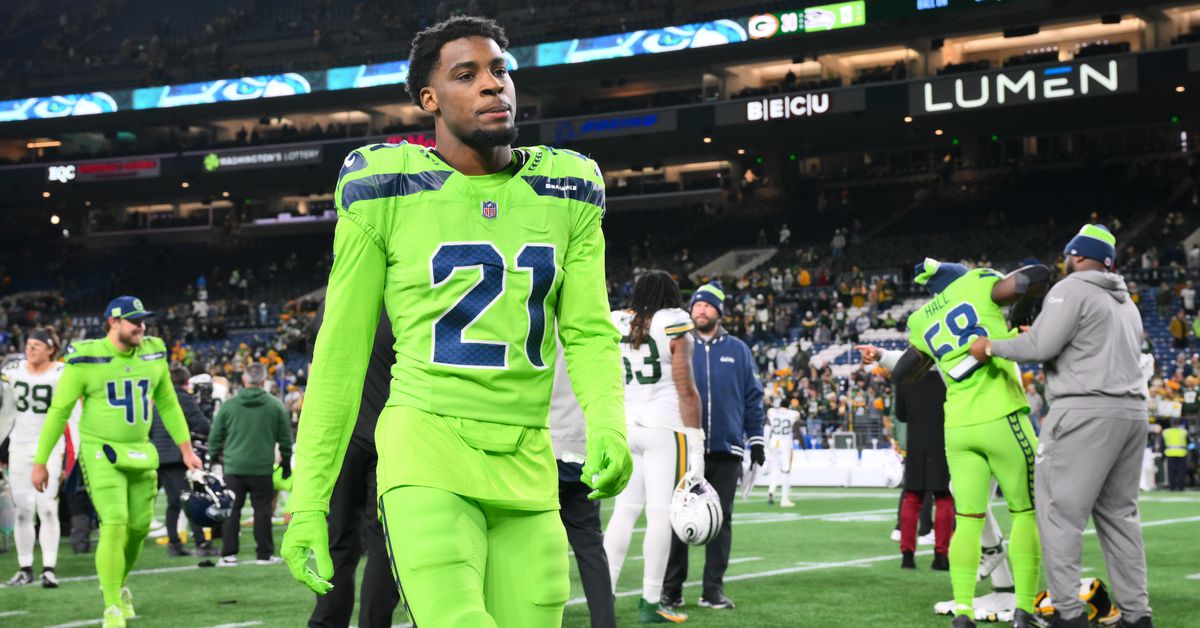
In his second season, Witherspoon reaffirmed his position as the heart and soul of the Seattle Seahawks secondary. With Mike Macdonald at the helm, he was a key player in transforming Seattle’s defensive style: aggressive, versatile, and physical.
If 2023 was Devon Witherspoon’s breakthrough in the NFL, 2024 was the confirmation that the first-round cornerback is not just a momentary playmaker — he is a central piece of a modern defense, with the ability to line up in different roles and impact the game in different ways. Last season, Witherspoon was used as an outside corner, slot and even rotational safety in disguised formations, which put his intelligence and technique on constant display.
In this text, we analyze the strengths and technical limitations of the number 21, and his performance in 2024.
Data and Evaluation – PFF
Overall grade 76.1 — 20th among 222 CBs
Pass rush grade 78.3 — 14th best
Run defense grade 90.0 — 3rd best among CBs
Solo tackles 80 — 1st among CBs
Total pressures 8 — 6th among CBs
Run stops 39 — 1st among CBs
Witherspoon was top 10 among all NFL cornerbacks according to PFF, and led the Seahawks in defensive stops on third downs. His impact goes beyond statistics — he changes the behavior of opposing QBs.
Alignment Versatility
With Mike Macdonald, Witherspoon was the defense’s wild card. Lined up:
53% as a slot corner;
28% as a boundary corner (outside);
14% as a safety in disguised rotations;
5% as a blitzer in Nickel/Big Dime packages
His ability to disguise coverages and attack blitzes without compromising the system made him the most versatile defender in the unit.
Normally nickel blitzes come from the EDGE. Mike Macdonald calls a blitz with the Mug Front (two LBs in the A gaps) and this ends up putting the center against two players, the pressure comes and Sam Darnold basically throws the ball away.
He didn’t get impressive sack or interception numbers, but sometimes he created plays. That’s where the term “force multiplier” came from. On this play, if he can’t pressure Brock Purdy, he would probably have three targets behind the Seahawks defense. In a hurry, the QB couldn’t complete the pass.
Run Defense
His presence in the front of the defense was impressive:
Referred to by PFF as the CB with the most solo tackles (80), SI additionally highlighted that Spoon was the CB most present in run support, with an average tackle of 3.8% of snaps.
Spoon is a torment for blocking schemes. He is quick to try to escape from TEs and OLs and can be physical to tackle heavier RBs, like Javonte Williams in this play, in the open field in 1v1.
He quickly identifies the play, and goes to the backfield where he gets another tackle for loss.
Sometimes the price is exacted. He prepares to defend the run and the second it takes him to realize it would be a pass seems like an eternity, giving the TE space to score the TD.
Aggressive Mentality
Everyone knows that Spoon is a bit of an undersized CB. But, his mentality is similar to that of a big guy like Kam Chancellor.
He processes the play well, tries to make an aggressive tackle against the RB, misses the tackle against a nice stiff-arm. The analysis of the play could end there, but not with Spoon. After the mistake, Spoon doesn’t slow down, on the contrary, he keeps fighting and takes a good angle to avoid even more damage.
Boye Mafe misses a seemingly easy TFL. Seattle’s defense misses tackles and angles and the RB has a clear path in front of him. Spoon, who was lining up on the other side, manages to get there and make the tackle. It’s worth remembering that in this game we went to OT and the Pats had the advantage at that moment. A TD here and the result could have been a loss.
Perhaps no play better expresses what Spoon is (and how his season went) like this one. Coby Bryant’s pick six was fantastic, but it only happened because of Spoon. The Cardinals are on a 4th & 1 and have James Conner in the backfield to try to convert. Maybe running up the middle would really be the best solution here.
However, Kyler Murray gets the ball. Spoon had come aggressively to try to help stop Conner, in what would be a favorable situation for the Cards’ attack. He realizes that Murray has the ball and manages to quickly change direction, preventing the QB from running for the first down. But he does more.
He pressures Kyler, who throws a bad pass that is intercepted. In his best style, he provokes the opponent, realizes that he needs to help with the blocks, sacrifices himself against a guy much bigger than him and, after getting the block, provokes again.
Coverage
If he gets the interception here it would be one of the plays of the year. He tracks his receiver and passes him to the safety, turns his eyes to the QB and changes direction to deflect the pass.
The Lions attack with a three-tier threat: short, intermediate and long routes. Spoon can’t bite quickly on any of them. He stays patient against Sail, reads the QB’s eyes, gets in position to defend the play and goes to make the tackle.
Spoon covers the curl zone and keeps his eyes on the QB. Only when the pass is thrown does he leave his zone to make the tackle. A concept called CoF, Curl over Flat.
Excellent understanding of the play. He covers his WR, but keeps his eyes on the offense. He sees George Kittle’s cross-field route, passes his receiver to the safety, and drops down to make a strong tackle against a much heavier player.
One of his favorite techniques is the “catch-man” technique, which he uses to read the receiver’s hips. It is typically used in off-coverage, but he employs some of its principles here and successfully deflects the pass.
The “catch man” technique in football is a defensive strategy in which a defensive back (DB) plays off-man coverage, allowing the receiver to get close to him before engaging and breaking the route. It is a technique used to “catch” the receiver as he approaches, rather than aggressively pressuring him at the line of scrimmage. It is often used when the defense is playing off-man coverage and wants to avoid being beaten deep. It can also be effective against receivers who are known for their quick releases or underneath routes. Therefore, in addition to aggressiveness in contact, it requires a good knowledge of offensive patterns and routes.
Here is a breakdown of the technique:
1. Initial Positioning:
The DB usually lines up a few feet from the receiver, not in a press position, but in off coverage. This allows the DB to read the receiver’s initial movement and react accordingly.
2. “Catching” the Receiver:
The goal is to attack the hip of the receiver closest to the DB, while maintaining leverage and control. The DB will use his hands to disrupt the receiver’s timing and trajectory, “catching” the receiver as he moves.
This was a “concept” often used by Mike Macdonald on defense. The secondary rushes to defend the first down line and on the front-seven he creates creative pressure. The QB has no choice but to find a quick, short pass. Spoon is alert and flies to make the tackle.
The Rams are on a 3rd & 3. They try to connect with Cooper Kupp (now a Seattle player) on a quick cross-field route. The idea is to create congestion and prevent any defender from getting there in time. Spoon manages to defend masterfully.
The Seahawks send five on the pressure, have a safety deep down the field and the rest of the team man-to-man. CMC in the slot runs a pivot/whip route, but Spoon is with him. Brock Purdy, feeling the pressure, still passes on what he thinks would be his checkdown. Devon Witherspoon attacks the ball that is left hanging and falls into the lap of NT Johnathan Hankins for his first career interception.
What can still be improved
Still no interceptions in 2024, lower turnover production, and the allowed rating went up slightly.
The secondary unit gave up some long plays — sabotaged by good, if not perfect, coverage.
1. Penalties and overly aggressive play:
Sometimes, his quality can become a defect. What makes Spoon a different player is his aggressive mindset, but at times it will take its toll. Here, he tries to make the play by taking the ball away from the RB, but ends up losing the tackle.
His aggressiveness can be a problem. Witherspoon gave up six penalties in 2024 (four for illegal contact or holding), mainly when lined up as an outside corner.
In addition, especially at the beginning of the year, Spoon committed some completely unnecessary fouls, like the one in the play above.
2. Double moves:
When he plays on the boundary, he shows vulnerability to double moves, especially against fast receivers. He tends to bite the first cut and relies too much on recovery. This cost him two touchdowns on deep balls during the season.
3. Pad level on untimed blitzes:
On some plays, his blitzes arrived late or without a defined angle, which left him exposed in the backfield or caused mismatches in the coverage rotation.
Conclusion
Devon Witherspoon has become the backbone of Mike Macdonald’s defense. He brought physicality, energy, versatility, blitzing ability, and dominance against the run game. Despite his lack of turnovers, he was undoubtedly the Seahawks’ best cornerback, the only one in the Pro Bowl and a key part of a defense that is starting to find its identity in Seattle.
Devon Witherspoon in 2024 was not just an excellent cornerback — he was an elite tactical tool. With natural aggression, refined technique and above-average intelligence, he became the backbone of Seattle’s defense. If he corrects excessive contact and refines his discipline in marking out of the slot, he could become a regular All-Pro.
The Seahawks have on their hands one of the most complete defensive players in the modern NFL — and that will soon cost them dearly. But by all indications, it will be worth every penny.