
A new yet strangely familiar disturbance took place in college football last weekend.
Texas Tech celebrated Independence Day with one of the biggest recruiting wins in program history. Five-star offensive tackle Felix Ojo — No. 1 recruit in the state of Texas and top-10 national prospect in the 2026 class — committed to the Red Raiders. Ojo chose Tech over Texas, Ohio State and just about every other power conference school, a coup for the program.
Just as startling was the financial news that soon followed. As college sports embark on a new revenue-sharing voyage under the House settlement, it was reported that Ojo would be going to Tech on a three-year, $5.1 million revenue-share agreement, setting the market just days after the new system went into effect July 1. Or maybe it’s three years, $2.3 million. Depending on the source.
Either way, the dollar figure itself isn’t a new thing. Since name, image and likeness compensation was introduced in 2021, money has become an increasingly standard part of the recruiting conversation. And within the rules. But this situation was different. The timing of Ojo’s decision makes him the highest-profile recruiting commitment of the rev-share era, when the dollar figure attached to him will be coming fully and directly from the university as part of a capped annual revenue-sharing pool.
Within this fledgling framework of college sports, the money is now more relevant than ever. As conflicting reports on Ojo’s revenue-share agreement trickled in over the weekend, distracting fans from their star-spangled revelry, social media buzzed with folks marveling at the price tag while also debating whether it’s a wise investment.
This is new territory for college football. But it feels a lot like the NFL.
A blue-chip five-star such as Ojo is a boon for any college program, but especially Texas Tech, which beat out the in-state Longhorns and a slew of elite programs. Tech emerged as a legit recruiting force in recent years thanks to its oil-dipped resources, led by billionaire boosters Cody Campbell and John Sellers. The alums and self-made oil magnates led the charge on funding Tech’s big-money NIL efforts, but the House settlement and revenue-sharing system alter that calculus.
The settlement aims to rein in an unregulated NIL landscape and put some guardrails in place with direct revenue sharing capped at $20.5 million per school in Year 1 and roughly 75 percent of that going to football at most power conference programs. Jury’s still out on whether it works as intended, but Ojo’s commitment — and contract — is an early indication the Red Raiders will remain a force to be reckoned with.
And yet, the bigger-picture takeaway from a blockbuster recruiting weekend was how college football is speeding faster and faster toward an inevitably NFL-ized future.
ESPN first reported the $5.1 million deal via Ojo’s agent, Derrick Shelby of Prestige Management. Shelby confirmed those details to The Athletic on Saturday, and that the entirety of the deal would be from Tech’s direct revenue share. However, multiple Texas Tech sources rebutted the specifics, telling The Athletic the agreement is for $2.3 million, with a verbal agreement that the total value could be renegotiated into the $5 million range depending on future circumstances.
A lack of clarity on contract details isn’t uncommon. NIL deals were not required to be made public under the old way, and there was plenty of incentive for agents to inflate the dollars on behalf of their athletes and for booster-led NIL collectives to keep their budgets confidential. (And for the schools to feign ignorance.) It’s long been similar in the NFL with free agency and re-signings. Agents leak the highest feasible dollar figure to media insiders; fans celebrate, opposing fans chirp back that the player is overpaid, and the salary-cap wonks implore those on both sides to “wait until we find out about the guarantees.” There’s no requirement for NFL contracts to be made public either, but eventually, the details usually come to light, offering a fair amount of transparency to the process.
That hasn’t been the case in college football. To this point. With no “salary” cap — no NIL guardrails at all, really — there was little impetus for transparency. Most insight was either dodgy or surprisingly voluntary, such as Ohio State athletic director Ross Bjork’s publicly stating that the Buckeyes, who went on to win the national title, had a $20 million roster in 2024. A willingness and ability to shell out NIL dollars gave a sense of which schools were contenders, but so much of it was (and still is) half-truths and whispers. And like the good ole days of the bag man, it was largely unregulated.
Now the stakes have changed. There’s a revenue-share cap and reporting requirements, with a new enforcement arm in place to oversee it. It’s not entirely clear how the various details and clauses of these rev share agreements will hold up if challenged in court (along with other aspects of the settlement), but the universities seem to be taking them seriously until convinced otherwise.
The public still won’t be afforded that transparency — the revenue-share agreements will be kept behind the curtain — but how schools and their individual programs build out and balance rosters within the cap will be crucial to success. Much like it is in the NFL.
Yes, there will still be over-the-cap NIL deals for the elite programs, and maybe even some loopholes. But cap management and roster building are the next frontier. Which teams are most efficient with their rev-share money? Who has to overpay for big names and premium positions? How will position, recruiting rank and experience shape the compensation ranges? Who tries the “Moneyball” route? Who tries to develop and retain a young roster? Who opts for signing the established, veteran mercenaries out of the transfer portal?
Who will be the Philadelphia Eagles, and who will be the Cleveland Browns?
This is not exactly music to the ears of college football fans. Many dread the sport’s becoming a Diet NFL. And it’s not simply about the money; most operating in good faith believe, or at least concede, that college athletes should get paid. It’s more about how the money has gradually stripped the sport of its tradition and regionality — of its soul — realigning the college football map into bloated power conferences and super conferences. The House settlement only perpetuates that shift into a smaller-tent professional model.
You could feel it Friday in the wake of Ojo’s commitment. Texas Tech celebrated accordingly, and rightfully so. But even beating out Texas was a little less sweet with the Longhorns no longer a conference foe, and so much of the broader coverage was about a multiyear contract, disputed dollars and guarantees and cap considerations — all for a soon-to-be high school senior. It was a Saturday-afternoon moment dressed up in Sunday-morning discourse.
How this rev-share era unfolds is still to be determined, but it won’t slow college football’s inescapable drift. Fans can rage against it, but the fact the NFL is America’s most popular and lucrative sport won’t help in that fight.
The truth is, college football has been on this NFL trajectory for a while. Last weekend’s biggest recruiting headline was just a brand-new reminder.
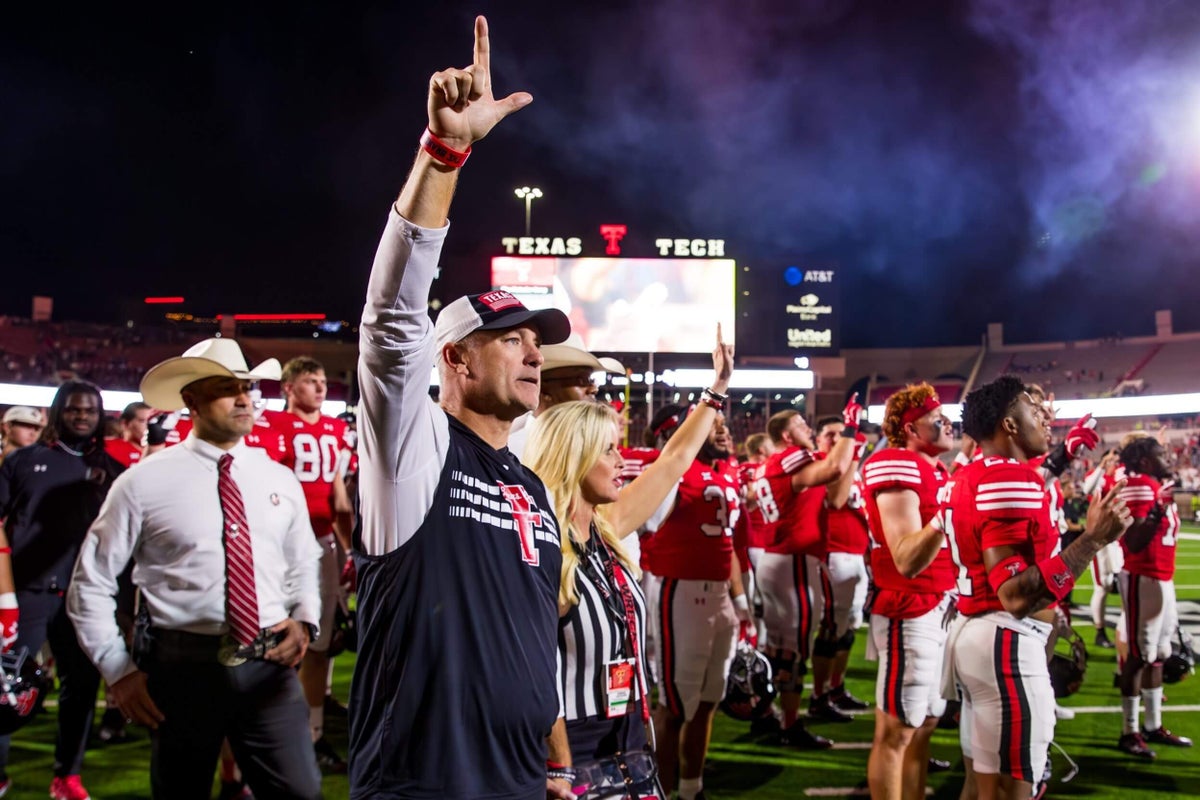
(Photo of Texas Tech coach Joey McGuire: John E. Moore III / Getty Images)