
The Cleveland Browns made an interesting decision during the 2025 NFL Draft weekend when they selected two quarterbacks. When the Browns followed up selecting Oregon’s Dillon Gabriel in the third round by tabbing Colorado’s Shedeur Sanders in the fifth, the Browns joined a relatively small group of teams who doubled up at quarterback in the same draft.
Since the NFL Draft shortened to seven rounds in 1994, 10 teams had drafted multiple QBs in the same class. The Browns became No. 11. Cleveland also (briefly) set the record for the fewest picks between the two quarterbacks. Gabriel was No. 94, while Sanders came to Cleveland 50 picks later at No. 144.
The history of taking two QBs in the same seven-round draft began in 1994 with Washington taking Heath Shuler at No. 5 overall and Gus Frerotte at No. 197. Their fates didn’t turn out as Washington expected; Shuler quickly fizzled out of the league while Frerotte started over 90 games in 15 NFL seasons, including all 16 games for Washington in their second seasons with the club.
With many pundits predicting a similar fate for the Browns tandem of QB draftees, it’s worth investigating how those quarterback pairs have fared over the years.
Washington, 1994
Heath Shuler No. 3: The 1993 Heisman runner-up (to Charlie Ward) at Tennessee, Shuler struggled through his rookie year, completing just 45 percent of his passes and throwing more INTs (12) than TDs (10). Frerotte beat him out after Shuler struggled in the ’95 season opener and Frerotte played well in a win over Arizona. Shuler was traded to the Saints after the 1996 season, when he suffered a serious foot injury that ended his career. He’s better known in many circles now for being a Congressman from North Carolina from 2007-2012.
Gus Frerotte No.197: Frerotte, from Tulsa, quickly took over for Shuler and proved to be a capable NFL starter and exceptional backup QB. He made one Pro Bowl in Washington (1996) and started 93 career games across 15 NFL seasons with seven NFL teams, going 8-3 with the 2008 Vikings to end his career with a 45-47-1 record. Younger fans might know Frerotte from his infamous in-game celebratory head-butt of a wall, which led to a neck injury.
Carolina, 1995
Kerry Collins, No. 5: Collins was the first-ever draft pick for the Panthers franchise, which began play in 1995. Coming from Penn State, the big-armed Collins was an immediate starter for the expansion team. He made the Pro Bowl in his second season, leading the upstart team to an NFC West (yes, West) division title. After a substance abuse struggle, he bounced to New Orleans and then the New York Giants, where he was the primary starter for five seasons (1999-2003). Collins finished his career beating every NFL team but one (Miami) and is currently 23rd in career passing yards with over 40,000. His career record is just 81-99, but he led the 2000 Giants to a Super Bowl and also guided the Titans to a 12-3 record in a brilliant late-career renaissance in 2008.
Jerry Colquitt, No. 191: After taking over for Shuler at Tennessee, Colquitt quickly got injured. The Panthers took a chance on his potential, but he never made the Carolina roster. Or any NFL roster, for that matter.
Cincinnati, 1999
Akili Smith, No. 3: Smith came out of Oregon after one brilliant college season, where his impressive arm and derring-do catapulted him into consideration for the No. 1 overall pick. The Bengals pounced on Smith at No. 3 but almost instantly regretted the pick. He held out as a rookie and never fit in with the more complex NFL offenses. He went 3-14 in four seasons in Cincinnati, throwing 13 INTs to just 5 TDs in 22 career NFL games. Smith is often cited as one of the NFL’s biggest draft busts.
Scott Covington, No. 239: Covington stuck with the Bengals as a reserve QB for three seasons after a lengthy backup career with the Miami Hurricanes. He eked out one NFL start, an injury-induced emergency with the Rams in 2002. Covington completed 6 of his 10 NFL pass attempts, netting 30 yards while being sacked twice.
San Francisco, 2000
Giovanni Carmazzi, No. 65: Despite being the No. 65 overall pick, Carmazzi was the second QB selected in the 2000 draft. After starring at Hofstra and an impressive Senior Bowl, Carmazzi is now known as perhaps the most infamous of the “Brady Six”, the QBs taken ahead of Tom Brady in that draft class. Carmazzi never appeared in an NFL game, struggling with a nerve condition in his shoulder.
Tim Rattay, No 212: One of the most prolific passers in NCAA history at Louisiana Tech, Rattay stuck around as a backup for the 49ers for five seasons. He did start nine games for San Francisco in 2004, going 1-8 on a team that finished 30th in offense and 32nd in defense. Rattay was a backup for Tampa Bay and Arizona in subsequent seasons, finishing his seven-year career with a 5-13 record as a starter and a QB Rating of 81.9 with just over 700 passing attempts.
Houston, 2003
Dave Ragone, No. 88: The lefty from Louisville joined the Texans after their first season as an expansion franchise. He earned the No. 3 QB role behind David Carr and Tony Banks. Ragone got the starting nod (due to injuries) in Weeks 14 and 15, completing 20 of his 40 pass attempts for 135 yards and one INT. He never played in the NFL again but did stick on rosters through 2006.
Drew Henson, No. 192: Henson was a dart throw by the Texans, who sought to control his football rights while the Michigan quarterback explored his baseball career with the New York Yankees. When Henson returned to football, he was but a blip in the NFL. The Texans traded him to the Cowboys, where he made his only career start in 2004. Henson attempted 20 career passes, including two in a 2008 cup of coffee with the winless Detroit Lions.
Green Bay, 2008
Brian Brohm, No. 56: The Packers were transitioning from Brett Favre to Aaron Rodgers in 2008, and they needed a fresh backup. Brohm was a prolific pocket passer from Louisville. He lasted one year in Green Bay, being claimed off waivers by Buffalo in 2009. Brohm started two games in two seasons with the Bills. His career stat line: 27-of-52 for 252 yards, 0 TDs, 5 INTs. Brohm went on to play in the original UFL and the CFL.
Matt Flynn, No. 209: A plucky late-round flyer from LSU, Flynn beat out the more celebrated Brohm for the No. 2 job as a rookie. He played sparingly in his four years in Green Bay behind Rodgers, but Flynn parlayed an epic performance in a spot start against Detroit in 2011 into a free-agent contract with the Seahawks. After losing the QB battle to rookie Russell Wilson, Flynn got traded to the Raiders before circling back to Green Bay to finish his eight-year NFL career. Flynn completed 61 percent of his passes, throwing for over 2,200 yards with 17 TDs and 11 INTs as a well-regarded backup.
Carolina, 2010
Jimmy Clausen, No. 48: One of the most-hyped high school QB recruits ever, Clausen came out of Notre Dame as an expected first-round pick. His celebrated slide in the draft proved that the NFL was right about his cocksure persona and underwhelming arm talent. Clausen went 1-9 as the Panthers starter as a rookie, throwing just three touchdowns against nine INTs. Carolina drafted Cam Newton No. 1 overall the following year and also brought in Derek Anderson. Clausen got spot starts in Chicago and Baltimore as their backups in 2014-15, never winning a game.
Tony Pike, No. 204: A tall pocket passer who thrived at Cincinnati, Pike turned a strong Senior Bowl into being drafted by the Panthers. He played in one game as a rookie, taking over for a benched Clausen. A recurring elbow injury effectively ended Pike’s NFL career the following offseason.
Washington, 2012
Probably the most famous of the two-QB drafts, though probably not for the reason Washington hoped for back in 2012…
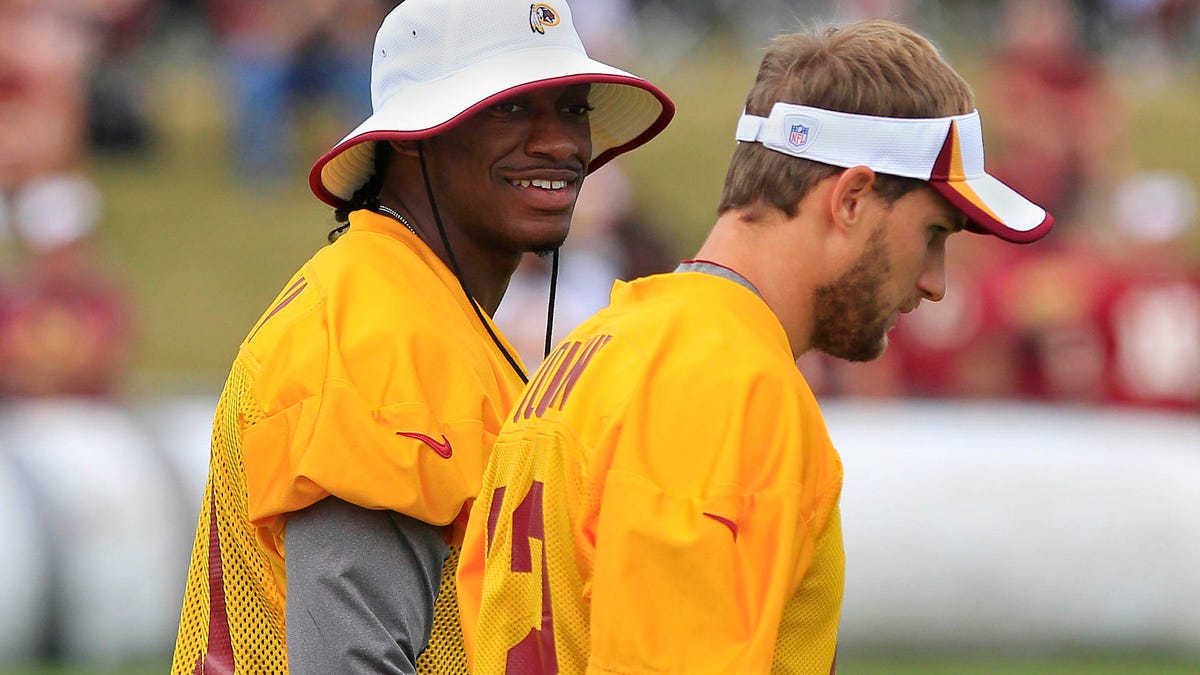
Robert Griffin III, No. 2: One of the most exciting collegians of the modern era, Griffin won the Heisman at Baylor and landed as the No. 2 pick behind Andrew Luck. Griffin’s NFL career started off outstandingly, with RGIII winning the Rookie of the Year honor and setting the record for the highest QB Rating by a rookie. Griffin suffered a devastating knee injury in Washington’s playoff loss, and his career never recovered. A subsequent injury in 2014 led Washington to pull the plug on Griffin. He tried but failed to regain any success in later stops in Cleveland and Baltimore. Griffin has become one of the great NFL “what if” debates, with his injuries ruining such a dynamic start to his career.
Kirk Cousins, No. 102: Cousins was the antithesis of Griffin. The fourth-rounder from Michigan State was largely immobile and a consummate game manager–albeit one with a strong arm and accurate touch. After proving more than capable as an injury fill-in for Griffin, Cousins took over full-time in 2015 and led the NFL in completion percentage. After a celebrated free agent move to Minnesota, Cousins has become one of the NFL’s better QBs, earning four career Pro Bowl nods. He’s 21st in career passing yards, 18th in passing TDs and 11th in career QB Rating. Cousins is now entering his second season as the (probable) starter in Atlanta.
Pittsburgh, 2022
Kenny Pickett, No. 20: Pickett played collegiately at Pittsburgh, making him a familiar presence for the Steelers in the first round. He was a divisive prospect due to his small hands and underwhelming arm strength, but the Steelers like his outstanding accuracy, underrated agility and great leadership skills. They have yet to translate well to the NFL. Pickett had two seasons as Pittsburgh’s primary starter, going 14-10 but throwing just 13 TDs (and 13 INTs) and struggling to push the ball down the field. He was Philadelphia’s backup in 2024 and is now competing with Gabriel and Sanders, as well as Joe Flacco, in Cleveland in 2025.
Chris Oladukon, No. 242: Oladokun was a late-round shot after a great final season at South Dakota State. He failed to make the Steelers as a rookie, though Oladokun bounced to a deep reserve role with the Chiefs and has a Super Bowl ring to his credit. He’s still never played in an NFL game and will be competing to stick for another season with the Chiefs in 2025.
New England, 2024
Drake Maye, No. 3: The Patriots selected Maye from North Carolina with the third pick in a QB-heavy draft. After sitting behind vet Jacoby Brissett for the first few games, the dual-threat Maye took over as New England’s starter for 12 games. The impressive arm strength and powerful running worked well enough that Maye enters 2025 as the unquestioned starter. He completed 66 percent of his passes for 15 TDs and 10 INTs as a rookie while also rushing for over 200 yards.
Joe Milton, No. 193: Milton brought a rocket right arm and LB size to the Patriots as a sixth-round pick out of Tennessee. An impressive start against Buffalo in the 2024 finale raised Milton’s profile, but the presence of Maye as the promising young QB in New England led the Patriots to trade Milton to Dallas this offseason. Milton enters training camp as the Cowboys’ backup behind Dak Prescott.
Technically, the Las Vegas Raiders also drafted two quarterbacks in 2025. However, the first of their two collegiate QBs, Tommy Mellott from Montana State, was quickly transitioned into playing wide receiver. Mellott and Cam Miller from North Dakota State were selected just two picks apart in the sixth round by the Raiders.