
Second in a series.
GREEN BAY — Josh Jacobs knew the stat. And he couldn’t believe it, either.
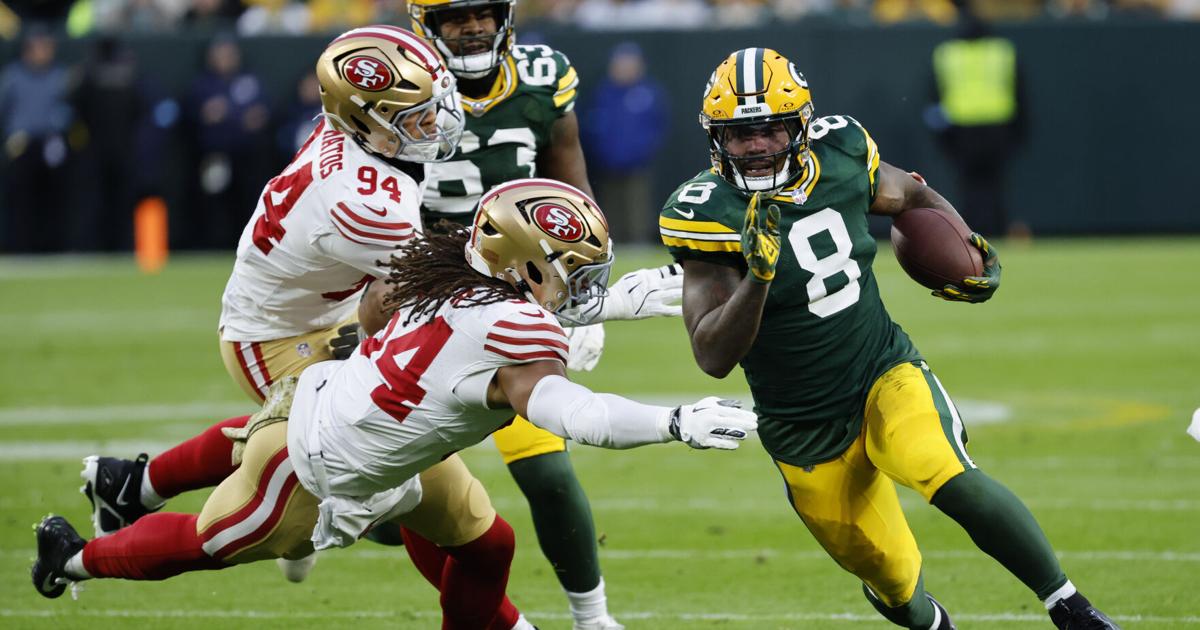
The veteran running back’s first season with the Green Bay Packers had been a tremendous success. He’d run for 1,329 yards (the fifth-most in a season in franchise history) and 15 touchdowns (tied for third-most in a season in the club’s record book) and clearly had been the engine that made the Packers’ offense go.
But while Jacobs finished sixth in the league in yards, he was well behind Philadelphia’s Saquon Barkley, whose 2,005 rushing yards not only led the NFL but also made him the ninth player in league history to surpass the 2,000-yard barrier.
A deeper look into their comparative numbers, though, showed just how much tougher sledding Jacobs had faced.
Of Barkley’s 2,005 total rushing yards, a whopping 1,328 had come BEFORE contact — meaning Barkley had 1 fewer yard before contact than Jacobs had gained in total. In terms of percentages, 66.2% of Barkley’s yards had come before contact, while 33.8% had come after the initial hit by a defender.
Then, there were Jacobs’ numbers.
Of his 1,329 yards, 737 had come AFTER contact — meaning he gained 55.5% of his yards after contact, and only 44.5% of them before contact.
“Yeah!” Jacobs exclaimed when the stat was presented to him, interjecting before it had fully been explained. “I seen that!”
What would Jacobs, head coach Matt LaFleur and the offensive coaching staff love to see this season? Larger holes for him to run through, better movement at the point of attack against would-be tacklers, and the running back getting farther downfield before taking his first hit.
To that end, the Packers went out and signed left guard Aaron Banks to a four-year, $77 million free-agent deal, moved Pro Bowl left guard Elgton Jenkins to center after not re-signing Josh Myers, and put the left tackle job up for grabs between incumbent Rasheed Walker and 2024 first-round pick Jordan Morgan — all with an eye toward improving the team’s run-blocking.
So what could you do with a little more space?
“I don’t know exactly who’s going to be in [the starting offensive line lineup] right now. Obviously, we’re still working out the kinks,” Jacobs said during the offseason. “But I tell people all the time, if you take a good back and you give him space, that’s what separates a lot of people.
“Like, if I’m getting touched three yards [downfield] and I only have to worry about a linebacker or a safety, I’m going to win a lot more of those than I lose. So I think that’s the difference. Obviously Saquon, a special player like him with an elite line, it’s like, it’s just going to make you look crazy [great], you know?
“So obviously we’re chasing that right now and we’re going to see how it plays out.”
Although quarterback Jordan Love’s knee and groin injuries factored into Jacobs’ increased workload in the games Love missed, he still carried the offense more than any other Packers back in two decades.
The Packers finished the season having run the ball on 52.3% of their offensive plays, third-most in the league (behind Philadelphia and Baltimore) and the highest run percentage since 2003, when Ahman Green set the single-season rushing record (1,883 yards) and had 405 touches.
Asked if he could run the ball even more than he did last season, when he finished with 301 carries, Jacobs replied, “I’ll do whatever they need.”
LaFleur, though, thinks Jacobs can be even more dangerous in his second year in the offense because he’ll have an even greater grasp of what LaFleur is trying to do as the play-caller.
“I think his comfort within the system, I think he’ll be much [better],” LaFleur said. “There’s still a learning curve, even though he’s a veteran player, when you’re hearing all this new terminology We’ll see where it goes, but he was pretty damn good last year.”
Here’s a closer look at the running back position as the Packers prepare for training camp, which kicks off with its first practice on July 23:
Depth Chart
No.
Name
Pos.
Ht.
Wt.
Age
Exp.
College
8
Josh Jacobs
RB
5-10
223
27
7
Alabama
31
Emanuel Wilson
RB
5-10
226
26
3
Fort Valley State
32
MarShawn Lloyd
RB
5-9
220
24
2
USC
30
Chris Brooks
RB
6-1
219
25
3
BYU
46
Amar Johnson
RB
5-10
205
22
R
South Dakota St.
35
Jalen White
RB
6-0
205
23
R
Georgia Southern
Burning Question | Can Jacobs continue to be durable with a heavy workload and his bruising style?
Jacobs’ 301 rushing attempts were not a career high — he ran 340 times when he won the league rushing title in 2022 with 1,653 yards with the Las Vegas Raiders — but what might’ve been the most impressive was that his hard-charging, physical running style didn’t leave him much worse for wear after the season.
If he can carry a similar load and feel as good as he did at season’s end, the Packers offense will be awfully hard to defend down the stretch.
“My body felt great, man. I didn’t go into the offseason really battling anything, really,” Jacobs said. “I would say last year was probably the best I felt after a season. So I feel pretty good.”
On the rise | Wilson.
Whether it’s his small-school roots — Fort Valley State, located in Georgia, is a Division II school with an enrollment of 2,182 students — or his quiet demeanor, Wilson doesn’t get the credit he deserves for how effective of a No. 2 back he is.
He carried 103 times for 502 yards (a 4.9-yard average) and four touchdowns, and while he never had more than 14 carries in a single game, he proved more than capable of filling in for Jacobs if called upon.
“I had a lot of improvements from my rookie year, learning the offense and playing fast [and] also learning from Josh and the coaches,” Wilson said. “It gives me a lot of confidence because I know I could have done a lot more [things] better.”
Player to watch | Lloyd.
It’s hard to imagine a worse rookie season than what Lloyd, a third-round pick from USC, endured last year — an injury-riddled campaign that included an emergency appendectomy just as he was about to return to the lineup in November.
Now healthy, the shifty, explosive Lloyd could bring a vastly different dimension to the offense.
“Last year was a learning experience,” Lloyd said. “It definitely grew me up in a way. I’m very comfortable with everything I can do. I’m not really trying to prove anything to anybody. I know what I can do and if you’re watching, you’re watching.”
Key competition | For playing time.
With Jacobs, Wilson, Lloyd and Brooks, the Packers have four options at running back that they believe can be effective in a lead role. Brooks is intriguing because not only is he natural at catching the ball out of the backfield but he’s capable of doing some fullback-style lead blocking, too. Figuring out if there are roles and room on the 53-man roster for all of them remains to be seen.
“The running back room looks good. There’s competition,” Lloyd said. “We have a really good backfield. The more we all can do, the better the team is. So I’m excited for the whole group.”
Bold prediction | Jacobs will lead the NFL in rushing.
Maybe Barkley will go back-to-back with 2,000-yard seasons. The guess here is that he won’t. And maybe Derrick Henry, who eclipsed the 2,000-yard barrier himself in 2020, will keep chugging along at age 31.
But Jacobs has won one rushing crown already (in 2022), and perhaps the only thing that will keep him from doing so again are the host of wide receivers and tight ends LaFleur would like to spread the ball to in the passing game.
“Offensively, I feel like for our team, it’s kind of hard. Because we’ve got to find a balance because we have so many playmakers, you know?” Jacobs said. “We have playmakers at wide receiver. Obviously, playmakers at tight end. And obviously running backs, too.
“We’ve got to find a perfect balance of getting everybody the ball.”
Next: Wide receivers.
COPYRIGHT 2025 BY CHANNEL 3000. ALL RIGHTS RESERVED. THIS MATERIAL MAY NOT BE PUBLISHED, BROADCAST, REWRITTEN OR REDISTRIBUTED.