
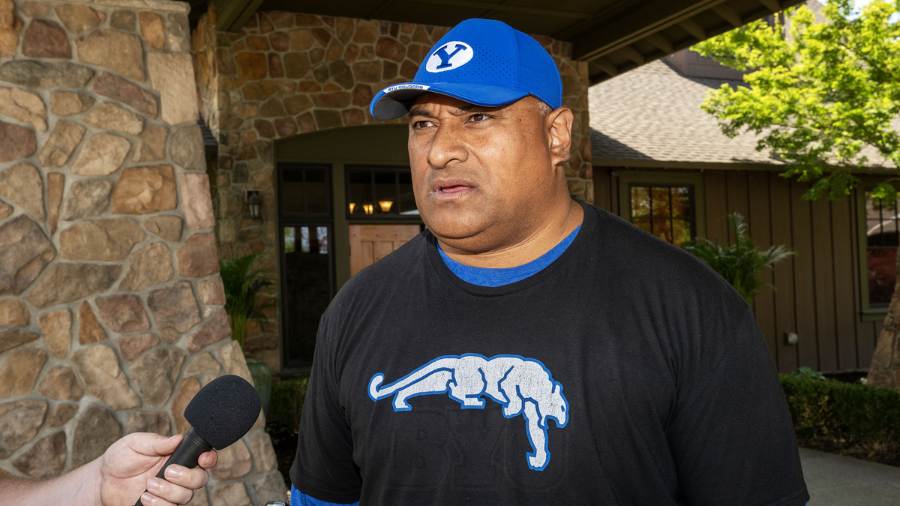
FRISCO, Texas – Kalani Sitake is entering his 10th season leading the BYU football program.
A lot has changed in his decade overseeing his alma mater.
When Sitake took over, the college football landscape featured a four-team College Football Playoff, and there was no transfer portal or NIL. A lot has changed.
Currently, the Playoff is a 12-team model, with the possibility of expanding to a 16-team format in 2026.
Whatever the next Playoff is going to be, many expect the strength of schedule data to play a significant role in determining the teams in the field.
That means lining up quality non-conference matchups, particularly against power conference programs, will be important in the future.
Currently, Big 12 teams are required to play one autonomous conference program in addition to Big 12 play. That gives each Big 12 team, when paired up with the league schedule, 10 games against power conference opponents.
“I think they’re critically important,” Big 12 Commissioner Brett Yormark said on high-profile non-conference matchups to the KSL Sports Zone. “It’s great for the fans to have big, meaningful games that are non-conference, but I also think it helps with the strength of schedule.
“As we think about the selection process for the CFP and what metrics are going to be used moving forward, and how those metrics are weighted, I think strength of schedule is going to really matter.”
BYU closes out a home-and-home series this year against Stanford from the ACC. Next year, BYU hosts Stanford’s Bay Area rival, California, before returning to Berkeley in 2027.
After that, the Cougars have agreements with Boston College and Virginia Tech, along with some carryover matchups with Big Ten and SEC programs that were canceled due to COVID-19 in the 2020 season.
But the matchups against fellow power conference teams outside of the Big 12 are limited. Aside from the games mentioned, the rest of BYU’s future non-conference schedules are filled with games against regional FCS opponents and Group of Six teams, mainly from the new-look Pac-12.
What would be the fix to get more high-profile non-conference games on future schedules?
Kalani Sitake has a compelling idea.
Kalani Sitake wants non-conference to feature matchups against Power Four leagues
“We play three non-conference games. I would love to play an ACC team, an SEC team, and a Big Ten team. Line them up. Let’s do this,” said Sitake. “Why can’t we do that?”
A simple idea. But who would argue against that?
In an era of revenue sharing where generating money is more important than ever for each university, you’d have to think season tickets would be a hot commodity at every institution, knowing that they will see power conference opponents outside of your league roll into home stadiums every year.
The problem with scheduling right now is that some leagues play eight conference games (ACC, SEC), while others play nine (Big 12, Big Ten). If there can be uniformity, a model like the one Sitake pitched makes a lot of sense.
“I think anything that we can get on the same page where everybody in college football is doing the same thing, I’m all for that,” Arizona head coach Brent Brennan said. “Whether that’s how we schedule, how we rev share, how we NIL, how we recruit, what the calendar is, what the rule is like, I’m all for that. Scheduling is done so far in advance, like I don’t get to weigh in on those things normally, you know what I mean?”
Mitch Harper is a BYU Insider for KSLsports.com and hosts the Cougar Tracks Podcast (SUBSCRIBE) and Cougar Sports Saturday (12–3 p.m.) on KSL Newsradio. Follow Mitch’s coverage of BYU in the Big 12 Conference on X: @Mitch_Harper.
Want more coverage of BYU sports? Take us with you wherever you go.