
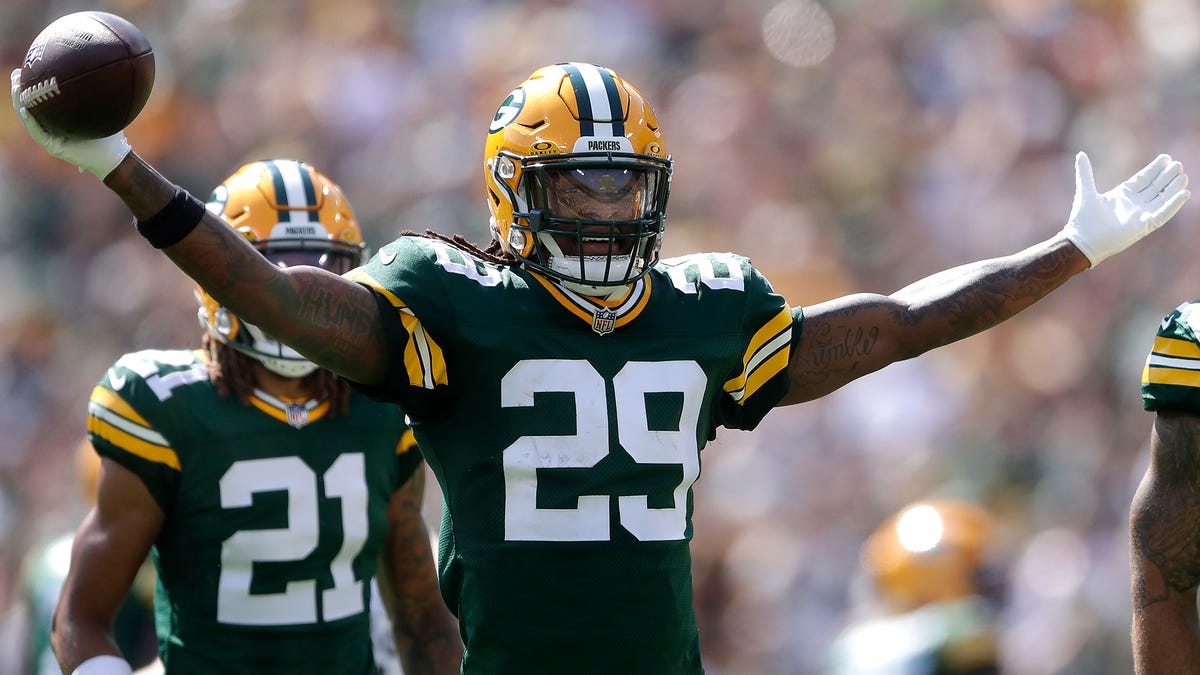
Xavier McKinney was everything the Green Bay Packers could have hoped for in his first season with the team. Leading Green Bay’s secondary by example, McKinney was arguably the best player on Jeff Hafley’s defense in 2024.
But just how good was he? And how did McKinney’s play in 2024 compare to the standards he set during his previous tenure with the Giants?
Here is the statistical profile McKinney compiled in his first year with the Packers:
Strengths
McKinney had a career year in coverage and was one of, if not the best safety in the league in defending the pass last year. He had already set a high bar based on his performance in New York in 2023 especially, but McKinney topped it.
Among qualified NFL safeties, McKinney ranked second in the league in interceptions per target (INT/TGT) behind only Kirby Joseph. McKinney picked off eight passes, only one less than he grabbed in the previous four years combined.
He did not allow a touchdown and has now not done so in the last two years. Only Tampa Bay’s Christian Izien was targeted more times without giving up a score last year.
McKinney allowed a passer rating of just 57.1 when targeted, good for fourth in the league, and compared to his peers, ranked in the 66th percentile in yards allowed per coverage snap (Y/SNAP), a career high ranking.
In terms of run defense, McKinney was a steady hand and put the ‘safe’ in ‘safety’, consistently getting ball carriers to the ground when called upon.
This is a skill McKinney had already established with the Giants, and there was no change in Green Bay. He ranked in the 89th percentile in missed tackle rate, whiffing on only 5.4% of his attempts, a career best mark after averaging 7.2% earlier in his previous three years as a starter.
Weaknesses
McKinney’s numbers in run defense are not as impressive as in coverage, and the stats indicate a career down year for him against the run.
He ranked in just the 39th percentile in solo tackles per snap in the run game, the 17th percentile in assisted tackles per snap, a career low, and run stops per game, which are tackles that result in a failure for the offense, another career low. His stop rate has declined each year since 2021.
McKinney was simply less active against the run than he had been previously, making only 65 solo tackles compared to 94 in 2023. He was safe and reliable, but was not a playmaker in that phase.
However, his apparent decline in the run game could be something of a red herring, and more a function of his role.
Many of the run game stats are somewhat circumstantial for safeties in particular, as the ones who play more of their snaps deeper as opposed to close to the line of scrimmage are going to get fewer opportunities to get involved.
This seems to be a factor for McKinney, who played 54.1% of his snaps at deep safety in 2024 compared to just 41.1% in 2023.
His career high rankings for assisted tackles and stop rate both came in seasons when he played the majority of his snaps at deep safety, so it does not completely excuse the lack of production, but shows how role and scheme can impact the numbers.
McKinney was not used enough as a blitzer in 2024 to qualify for ranking, having only been sent after the quarterback 15 times, and this is not a particular strength of his game.
When he did have enough snaps to qualify, McKinney was a just above average blitzer compared to his fellow safeties in 2022, but was arguably the least effective at his position in 2023. The Packers are not missing out on an untapped skill set by using McKinney in other ways.
Overall, McKinney was one of the best couple of safeties in the NFL in coverage in his first year with the Packers, but despite his reduced role against the run, there is room for improvement, or to just return to the standard he had previously set as an above average run defender.
Green Bay will be thrilled with what McKinney has brought to the team so far though, and he should continue to be one of their most influential defensive players for years to come.