
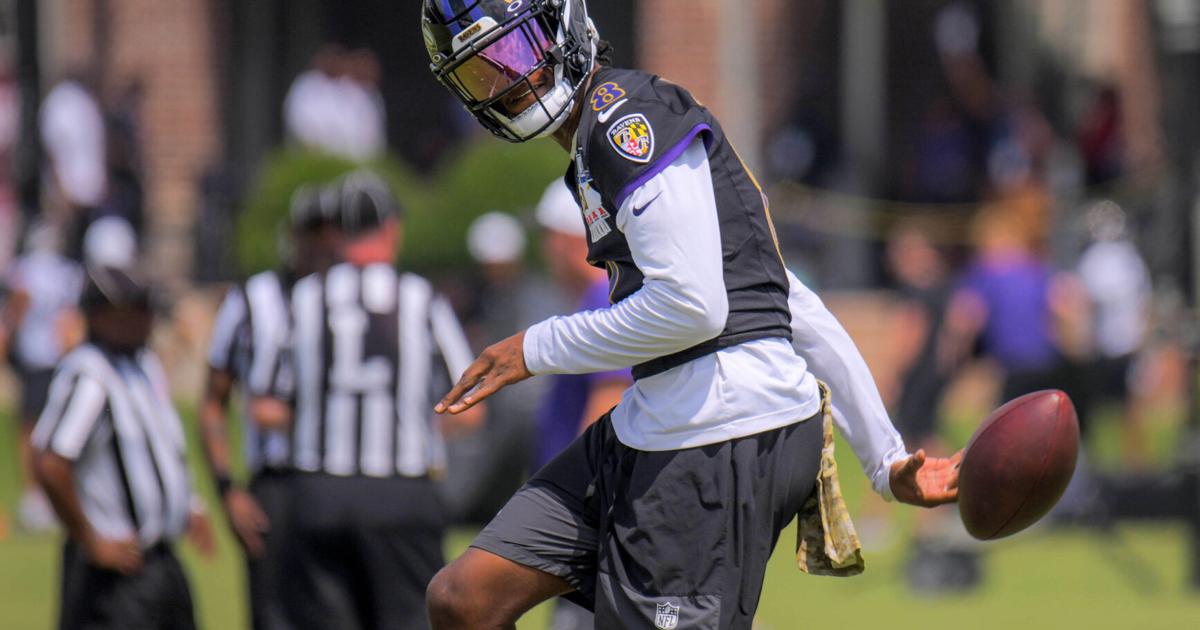
BALTIMORE – While celebrating their 30th year in the NFL, the Baltimore Ravens have assembled their most complete and balanced roster yet. But with football’s return come lofty expectations.
It’s Super Bowl or bust. There can be no other outcome.
Over the past two seasons, the Ravens had one of the best rosters in the league but came up short both times, losing 17-10 to the Kansas City Chiefs in the AFC championship game in Baltimore two years ago, and falling 27-25 to the host Buffalo Bills in the divisional round in January.
But this year’s version is the best since Baltimore’s return to the NFL in 1996. The franchise has won two Super Bowl titles – remarkable, considering 12 teams haven’t won any.
Those championship teams were built around strong defenses featuring Hall of Famers such as Ray Lewis, Rod Woodson and Ed Reed, with Terrell Suggs likely to join them. In retrospect, those offenses just had to avoid imploding.
The 2025 Ravens are different – not perfect, but different. They still need to upgrade special teams, especially at kicker and punt returner, and it’s unclear whether the secondary can improve despite several offseason additions.
But the offense? It’s nearly flawless.
The Ravens have a two-time Most Valuable Player in quarterback Lamar Jackson, who threw for 4,172 yards and 41 touchdowns last season and added 915 rushing yards with four more scores. They also have one of the best big, multi-purpose backs in NFL history in Derrick Henry, who ran for 1,921 yards last year, second only to the Eagles’ Saquon Barkley.
Even the receivers are strong, despite the team’s past struggles in drafting the position. The Ravens feature “super vet” DeAndre Hopkins, along with Rashod Bateman and Zay Flowers. Tight ends Mark Andrews, Isaiah Likely and Charlie Kolar round out the group.
Whom does Jackson throw to?
Anybody he wants. The only real challenge for offensive coordinator Todd Monken is finding enough touches for all the playmakers.
The offensive line isn’t elite – few are in the NFL – and this one struggles in pass protection. But Jackson’s scrambling adds an unpredictable element. The backfield is deep, too, with change-of-pace runner Keaton Mitchell and third-down specialist Justice Hill.
The situation on the other side of the ball is less certain, but the upside is high.
The secondary should be better than last year, when it ranked 31st out of 32 teams. The group improved in the second half but faced subpar quarterbacks, including Pittsburgh’s Russell Wilson (twice), the Giants’ Tommy DeVito and the Browns’ Bailey Zappe.
To boost talent, the Ravens drafted Georgia safety Malaki Starks in the first round and signed free-agent cornerback Jaire Alexander in June. Alexander made the Pro Bowl in 2020 and 2022 with the Packers but has missed 20 games over the past two seasons due to injuries.
If Alexander returns to form, defensive coordinator Zach Orr has options. Safety Kyle Hamilton can play near the line of scrimmage. Rising corner Nate Wiggins could start outside opposite Chidobe Awuzie or Alexander, with veteran Marlon Humphrey in the slot.
With Chuck Pagano helping coach the secondary, this unit should better complement a run defense that ranked No. 1 last season. Nose tackle Michael Pierce retired, but the Ravens still have size up front with linemen John Jenkins, Nnamdi Madubuike, Broderick Washington, Travis Jones and rookie Aeneas Peebles.
What’s missing?
They lack a proven kicker. Justin Tucker – perhaps the best in league history – was released in early May and later suspended for 10 games for violating the league’s personal conduct policy. More than a dozen female massage therapists accused him of inappropriate behavior at Baltimore-area spas and wellness centers. Sixth-round pick Tyler Loop and undrafted rookie John Hoyland are now competing for the job.
Tucker and Matt Stover were crucial in both of Baltimore’s Super Bowl runs. Tucker hit 30 of 33 field goals in 2012. Stover went 35 of 39 in 2000, when the Ravens went five games without scoring an offensive touchdown.
Another gap is in the return game. In 2000, Jermaine Lewis averaged 16.1 yards per punt return and ran back an 84-yard kickoff for a touchdown in the Ravens’ 34-7 Super Bowl win over the Giants. In 2012, Jacoby Jones led the league with 1,167 kickoff return yards and scored twice.
There are other intangibles, too.
In 2000, quarterback Trent Dilfer was a conservative but effective game manager. In 2012, Joe Flacco had one of the greatest postseasons ever, tying Joe Montana’s record with 11 touchdown passes and no interceptions.
The Ravens need that kind of heat again. In 2000, coach Brian Billick leaned on Jamal Lewis down the stretch. Lewis rushed for 1,364 yards to support a record-setting defense. Flacco was exceptional in 2012.
Jackson needs to catch fire in the postseason. He’s 3-5 in eight career playoff games with 1,753 passing yards, 10 touchdowns, seven interceptions and three lost fumbles.
There’s also the Ray Lewis factor.
He wasn’t just the NFL’s best player in 2000 – his presence also inspired the 2012 team. Without him, the Ravens don’t win either title.
His absence has never been filled. After 2012, coach John Harbaugh moved on from the alpha males: Lewis, Reed, safety Bernard Pollard and receiver Anquan Boldin. That ushered in a five-year run of mediocrity.
Those lean years also coincided with Baltimore’s early struggles in free agency. The team lacked the cash to compete on both sides of the ball until Steve Bisciotti became a minority owner in 2000.
But now, the Ravens are back on pace. Only one team has more talent: Philadelphia. The defending champion Eagles can dominate both lines but play in the NFC, leaving the AFC wide open.
The expectations in Baltimore are justified, even if they also bring pressure. But there are no more excuses. This Ravens team is too good to miss the Super Bowl.
It’s easily the most balanced squad in franchise history.
It’s time for them to reach a third Super Bowl.