
LAS VEGAS — The Big Ten and SEC set aside decades of gridiron animosity for cooperation on off-field ventures from last fall through early spring. However, it’s safe to assume the era of good feelings between college football’s super-conferences has expired.
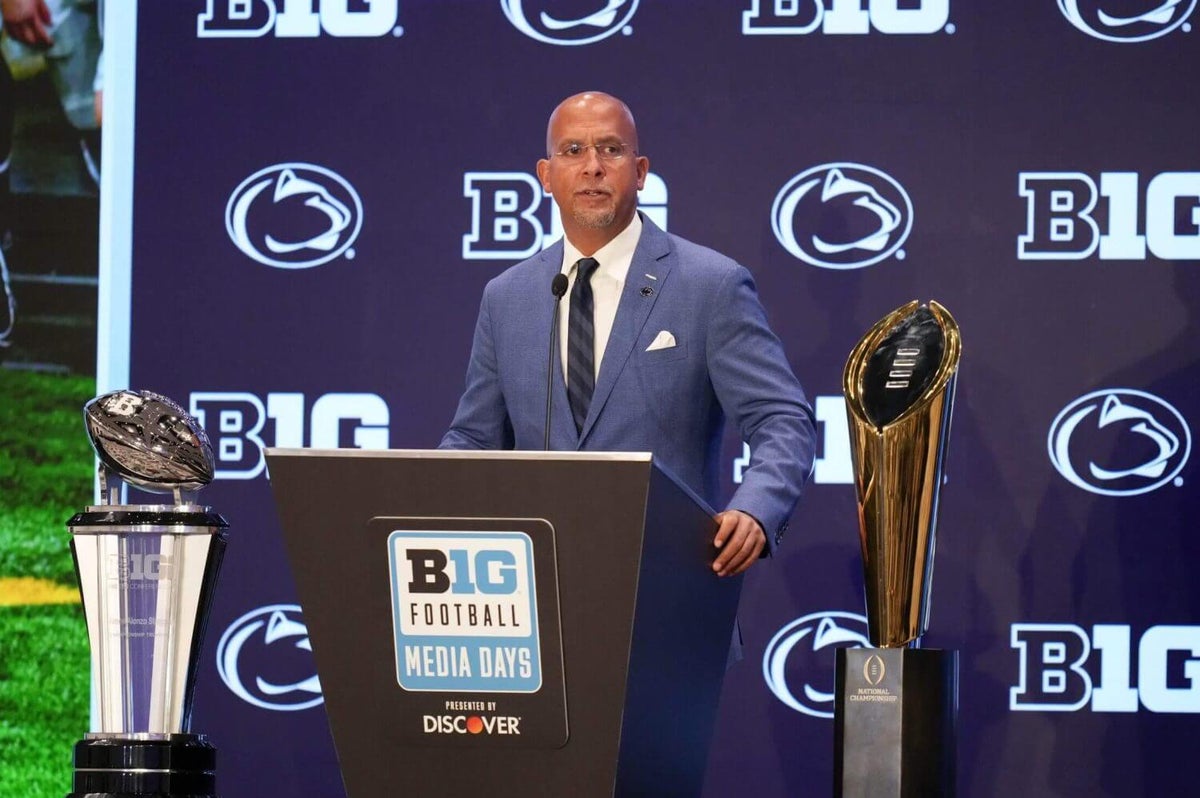
From the rhetoric during the SEC’s late-spring meetings in May to Big Ten football media days last week, the two leagues have found ways to antagonize “the other conference,” which is exactly how Penn State coach James Franklin referred to the SEC at the podium in Vegas. In response, SEC commissioner Greg Sankey posted a logo on X with the initials “TOC” inside a circle.
Greetings from That Other Conference pic.twitter.com/KFPzTRiMQY
— Greg Sankey (@GregSankey) July 25, 2025
As their commissioners try to find common footing on a new College Football Playoff structure, the leagues’ coaches used their media days to argue their conference’s righteous might. The largest point of contention is with the leagues’ uneven number of conference games, as the Big Ten plays nine and the SEC plays eight. The debate spills over to nonconference games; 13 SEC teams play only nine power-conference opponents this year, while 13 Big Ten teams play at least 10.
“You’re not comparing the same thing,” Franklin said. “When the Big Ten first went to nine games, you could make the argument maybe the worst decision Big Ten has ever made. Just mathematically, we’re going to have more losses. We’re going to beat each other up.
“There’s an easy solution. Everybody play the same number of games.”
The Big Ten’s full-court pressure on the SEC to go to a nine-game schedule will likely spark stubborn resistance. No league wants to accept dictated policy, especially from either of these two conferences. In multiple public settings, SEC coaches and officials have touted their eight-game schedule as more rigorous than any other league’s nine-game slate. That led to Big Ten coaches — for the first time — showing a similar amount of solidarity in opposition to their SEC counterparts.
Perhaps Texas legend Sam Houston described the Big Ten (err, the North) best in the 1850s when he said: “They are not a fiery, impulsive people as you are, for they live in colder climates. But when they begin to move in a given direction, they move with the steady momentum and perseverance of a mighty avalanche.”
Either way, it’s probably for the best that these two regions are back to rivalry status. They were uncomfortably chummy last fall and winter. Now, it’s on to college football.
Two different organizations (Kings of the North and Cleveland.com) conducted unofficial preseason polls because the Big Ten does not have an official one. Media members in both polls chose Penn State as the favorite, just ahead of Ohio State.
Reluctant favorite: Penn State
The league’s 2024 runners-up return impact starters at every major position group. Quarterback Drew Allar threw for 3,327 yards and 24 touchdowns last year, while running backs Nick Singleton and Kaytron Allen each ran for more than 1,000 yards. Defensive end Dani Dennis-Sutton and defensive tackle Zane Durant each posted more than eight tackles for loss.
Penn State, which advanced to the CFP semifinals, is hardly an overwhelming favorite. The perpetual losses to Ohio State (eight straight) and Franklin’s record against top-five opponents (1-15) keep the Nittany Lions from a hearty endorsement. However, no team is better on paper.
“That was bittersweet, just watching (the national title game), knowing how close we were to being in that game, it was fuel to the fire,” said Penn State safety Zakee Wheatley. “We kind of got a taste of it. So now I think we’re all hungry.”
Top challengers: Ohio State and Oregon
Considering the Buckeyes won the national title and the Ducks finished No. 3 in the final polls, it’s reasonable to expect these teams to compete for the title alongside Penn State. Ohio State brings back arguably college football’s two best players in receiver Jeremiah Smith and safety Caleb Downs, but 14 stars of the 2024 roster became NFL Draft picks, including the entire starting defensive line and quarterback Will Howard. Redshirt freshman Julian Sayin takes over at quarterback.
Oregon turns over almost its entire offense, but its impactful portal pickups, combined with a few holdovers like uber-talented sophomore quarterback Dante Moore, could keep it near the top. The defense features potential All-Americans in edge rusher Matayo Uiagalelei and linebacker Bryce Boettcher.
“Since we’re in Vegas, it seems like the right time to say it: Our theme for this team is double down,” Oregon coach Dan Lanning said. “We have done an unbelievable job of building this team over time. You look at our success season to season, and as this team has grown, the process works. We’re close.”
Next wave: It’s really deep
The Big Ten hasn’t enjoyed a collection of depth like this in years, perhaps decades. Traditional powers like Michigan and USC could vault back into CFP consideration, Iowa and Nebraska might battle for a spot on Black Friday, Illinois and Indiana face off in a critical mid-September blockbuster, Washington eyes a return to its 2022-23 form and Minnesota has high expectations.
Two factors likely will separate the teams: quarterback play and schedules. Of this group, Illinois has by far the most experienced Big Ten starter in Luke Altmyer. Michigan snagged the nation’s No. 1 recruit in true freshman Bryce Underwood, who will face a ton of pressure to make an early impact. Jayden Maiava returns as USC’s starter, but five-star true freshman Husan Longstreet will push him. Indiana and Iowa grabbed highly touted transfers Fernando Mendoza and Mark Gronowski, respectively, while Minnesota redshirt freshman Drake Lindsey beat out multiple transfers this spring. Sophomores Dylan Raiola (Nebraska) and Demond Williams (Washington) have sky-high potential.
“I thought we missed some opportunities a year ago, and I’m hopeful that this season, that if we stay healthy, we can capitalize on those same opportunities we missed,” Washington coach Jedd Fisch said. “I think that we’re just in a different place.”
Of the teams in this tier, the Wolverines have the easiest road, with their conference opponents finishing 27-54 in Big Ten play last year. Illinois (33-48) is next, followed by Nebraska, Minnesota and USC (all 37-44). Of that group, Iowa has the most difficult schedule (47-34); its home opponents finished a combined 33-12 in conference play last year.
On the come-up
Michigan State and UCLA are in the next tier after losing seasons last fall, but their dynamic young quarterbacks could point them upward. Aidan Chiles flashed potential with bouts of inconsistency in his first season with the Spartans after following coach Jonathan Smith from Oregon State. Despite the chaotic nature of his departure from Tennessee, UCLA’s Nico Iamaleava had a productive first season as a college starter. Rutgers returns quarterback Athan Kaliakmanis and its offensive line from a seven-win season.
“It’s a great challenge,” Iamaleava said. “Everybody in the locker room has a chip on their shoulder, and our coaches have a great expectation for us to meet. We’re gonna go out there and prove ourselves right.”
Maryland, Northwestern and Purdue all face different challenges. If any of the three reach a bowl, it’s a good year. After losing 97 players in the transfer portal the last two seasons combined (including 65 this offseason), the Boilermakers made a smart hire with Barry Odom. They’ll need a steady hand during a massive rebuild.
Wisconsin’s tall task
Pollsters slotted the Badgers at No. 12, but they boast the nation’s most difficult schedule. Wisconsin caps nonconference play at Alabama, then faces Michigan (road), Iowa (home), Ohio State (home) and Oregon (road) consecutively in October. November isn’t much easier, with Washington (home), Indiana (road), Illinois (home) and Minnesota (road). Only Wisconsin’s league opener against Maryland features a non-bowl qualifier among its power-conference opponents.
“Thank you, Captain Obvious,” Wisconsin coach Luke Fickell deadpanned about the schedule. “As I said to our guys in the past, this isn’t the Big Ten West anymore.”
The old Big Ten West competition didn’t provide Wisconsin with a reprieve in 2024. The Badgers (5-7) finished 2-3 against their former divisional foes, with wins against Purdue (52-6) and Northwestern (23-3) and losses to Iowa (42-10), Nebraska (44-25) and Minnesota (24-7).
About that CFP proposal
Big Ten commissioner Tony Petitti used last week’s podium time and individual interviews to sell his CFP plan, which would give four guaranteed spots each to the Big Ten and SEC, two for both the ACC and Big 12 and one for the highest-ranked champion outside the power conferences. However, Petitti was even more enthusiastic about the Big Ten’s three-game play-in weekend consisting of a championship and matchups between No. 3 and No. 6 and No. 4 against No. 5.
“There’s no league in any area that doesn’t want as many teams in contention as late as possible,” Petitti said.
If Petitti’s CFP plan doesn’t pass, the Big Ten would need to push for NCAA rule changes to play an extra two games. Or, as Iowa’s Kirk Ferentz brought up, there’s the crossover challenge the Big Ten attempted during the 2020 pandemic. In what was labeled as “Champions Week,” the Big Ten tried to pit the No. 2 West Division team vs. the No. 2 East team and so on down the standings, and the regular-season matchups were set up the previous week. Only two true “champions” games took place (Nebraska-Rutgers and Illinois-Penn State). That weekend also included cancellations (Iowa-Michigan, second tries at staging Maryland-Michigan State and Indiana-Purdue) and a rescheduled rivalry (Wisconsin-Minnesota).
It’s possible that without play-in games, the Big Ten could bring back its “Champions Week” with a championship game between No. 1 and No. 2 and eight other matchups between teams that didn’t play during the season. Last year, for instance, the games could have been as follows: Oregon-Penn State, Ohio State-Minnesota, Indiana-Illinois, Iowa-Michigan, Washington-Nebraska, Michigan State-USC, UCLA-Wisconsin, Rutgers-Northwestern and Purdue-Maryland.
(Photo of Penn State coach James Franklin: Lucas Peltier / Imagn Images)