
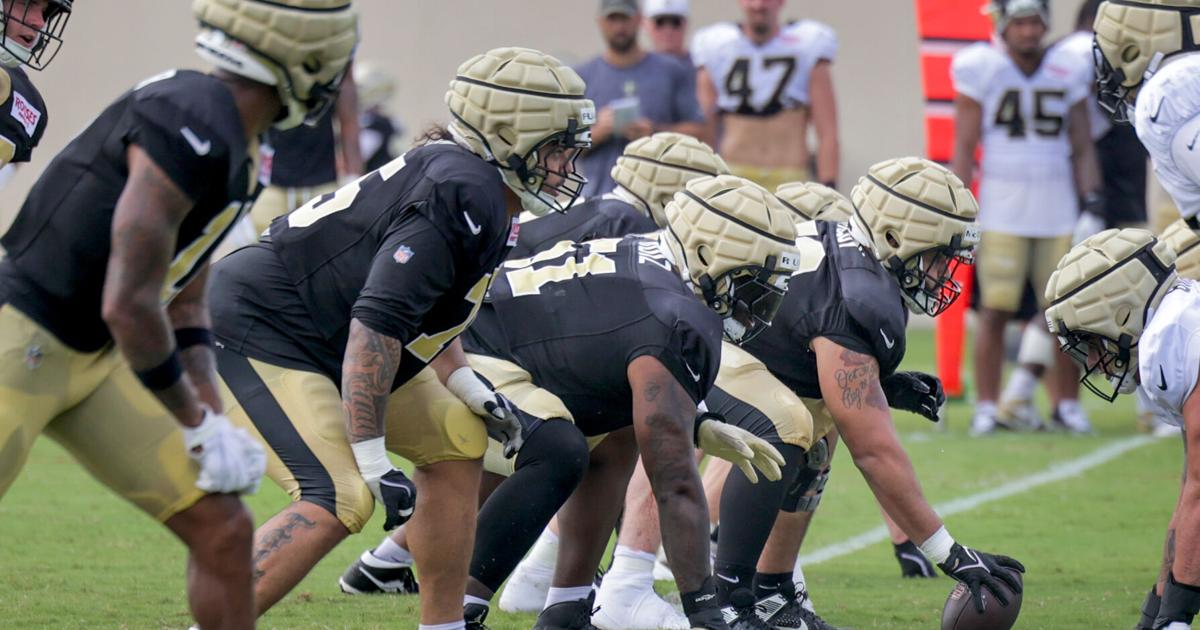
Erik McCoy is surrounded by first rounders.
On his left, there’s Kelvin Banks and Trevor Penning — the New Orleans Saints’ first-round picks from 2025 and 2022. Then, to his right, there’s Cesar Ruiz and Taliese Fuaga — from the 2020 and 2024 classes.
Not many centers — let alone teams — can say the same.
The Saints are just one of two teams projected to have four starting offensive linemen who were taken in the first round. The Los Angeles Chargers are the only other team that meets this criterion, but in that case, one of the four players wasn’t homegrown. Mekhi Becton, picked 11th overall in 2020 by the Jets, joined Los Angeles in March after a successful year with the Philadelphia Eagles.
Does it matter?
Since arriving to coach the Saints, Kellen Moore has consistently vowed to build his team through the trenches. But he isn’t alone in that train of thought — coaches across the NFL love to tout the importance of offensive (and defensive) line play. And New Orleans is coming off a season in which its line play was relatively poor, despite having three first-rounders.
The difference, it seems, might be the distinction between general platitudes and whether a team actually continues to make an investment in the position year after year. And to start the Moore era, the Saints drafted tackle Kelvin Banks ninth overall, switched Taliese Fuaga back to right tackle and moved Trevor Penning inside to play left guard.
The Saints are banking on their changes up front suddenly turning one of their biggest weaknesses into one of their biggest strengths.
“You can have that status and you can have all that, but you’ve got to go out there and play football at the same time,” Banks said. “The guys on our line, we were picked in the first round. They believed in us for a reason and obviously, we have talent. And they believe we have the talent to go out there and do it.
“Now we’ve got to put it all together.”
Draft status, as Banks said, isn’t everything. It could be said the reason the Saints have taken so many offensive linemen over the past few years is because that their hit rate hasn’t been ideal. Penning was taken to be a star left tackle, but the 26-year-old has had a tumultuous pro journey that has included several benchings, a move to right tackle and now a kick to inside. As well as Fuaga played at times last year, his struggles in pass protection — his pass block win rate of 84% ranked 57th out of 66 qualifying tackles, according to ESPN — perhaps explain why the Saints’ new coaching staff wanted to move him back to the position he played in college.
But the Saints’ tendency to build their line through the draft is also a philosophy — a throughline that has existed over general manager Mickey Loomis’ 23-year tenure. Loomis strongly believes in homegrown talent, and indeed, the Saints are one of seven teams projected to have a starting offensive line that does not include a player who has played elsewhere in the NFL.
The other six? Atlanta, Baltimore, Indianapolis, Dallas, Detroit and Seattle.
Because the Saints have invested so many draft picks in the line of late, the unit isn’t that expensive for 2025. McCoy and guard Cesar Ruiz are the team’s only starting linemen who are on their second contracts, and according to Over The Cap, the Saints have the eighth-fewest amount of cap dollars allocated toward the offensive line this season. Consider this: Ryan Ramczyk — who retired in June and hasn’t played since 2023 — has a higher cap number this coming season than any other lineman on the roster.
Still, plenty of concerns exist.
Take a glance at any annual offensive line ranking, and the Saints tend to fall in the No. 22-25 range. Offensive line expert Brandon Thorn, one of those rankers who had the Saints ranked 22nd for Establish The Run, said that while there’s promise at all five spots along the line, he thinks that New Orleans’ line is better suited for run blocking than pass protection.
He said he thought Fuaga was “pretty shaky” in the pass game as a rookie, but believes the switch to right tackle will help raise the 23-year-old’s floor. Thorn was also “a little bit skeptical” on the Banks’ selection — not because he disliked him as a player, but because he’s concerned about the rookie’s play strength and whether he can sustain blocks. And then there’s Penning — who Thorn called one of the sport’s five best run blockers before citing the “very stark” disparity in pass protection. Thorn said he’s “cautiously optimistic” on Penning’s move to guard.
“If all three hit, then yeah, I mean maybe the Saints could be top 10,” Thorn said, later adding, “For me, it was easier to poke holes and ask questions than actually have solid answers. That’s why I’m going into the year with them as a below-average unit.”
Health, of course, will also be an important factor. Last year’s line was decimated by injuries, none more impactful than McCoy’s groin and elbow injuries that caused him to miss nine games. The Saints’ depth up front appears to remain a huge problem, and training camp hasn’t eased those concerns. Both backup centers, Will Clapp and Kyle Hergel, have had consistent snapping issues, while guard Nick Saldiveri, a 2023 fourth rounder, was already lost for the season with a knee injury.
But as much as the Saints were hurt last year, New Orleans hasn’t deviated from the Banks-Penning-McCoy-Ruiz-Fuaga lineup in camp — at least in a practice setting. The Saints’ goal, for now, is to establish as much continuity as possible.
Consider the plan another way Moore is trying to invest in the unit.
“It’s about building inside out ultimately,” Moore said.