
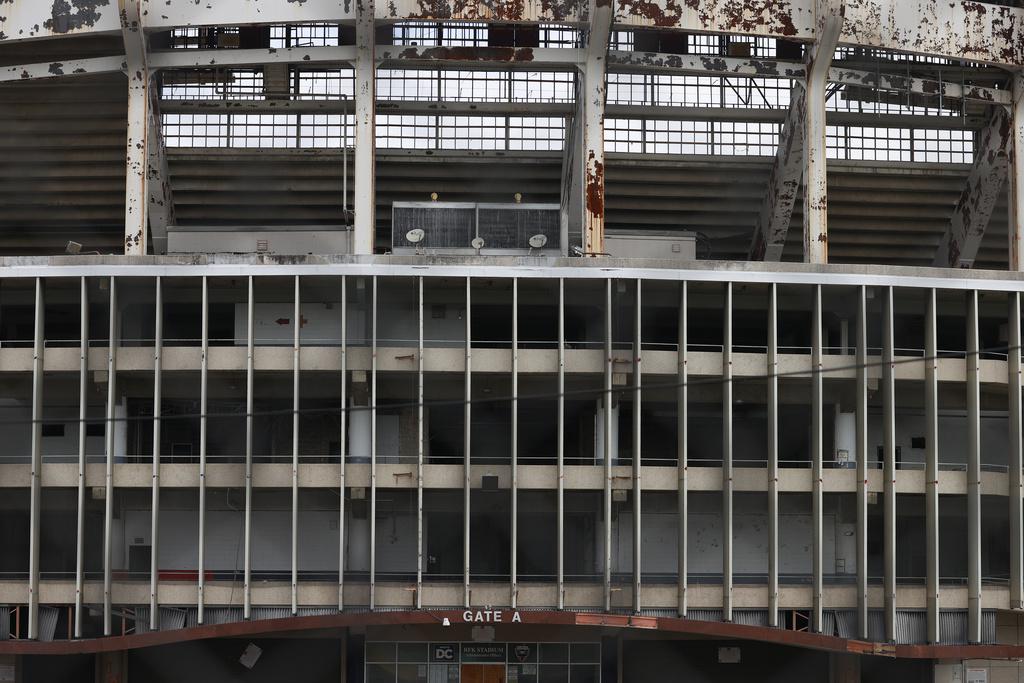
Washington Mayor Muriel Bowser lobbied for a quick city council sign-off on the first of two votes on the construction of the Washington Commanders stadium and entertainment district. Last Friday, she got her wish. The Council of the District of Columbia voted 9-3 to build the new facility, at a $1.1 billion upfront cost to the city, while the team pays practically no rent for the first 30 years. While the mayor emerged victorious, the vote doesn’t show how the city council actually saved Bowser from the breakdown lane she had careened into.
The mayor has visions of a sports and entertainment mecca as one component of rebuilding the economy of a city undone by the politics that used to keep it going—and the destruction of federal departments and the dispersal of the federal workers that survived DOGE cuts made Bowser’s campaign to secure the council’s nod that much more urgent.
But in her mission to bring a professional football team “back home,” Bowser signed such a lopsided agreement that one resident complained during last week’s public hearings that “it was either stunningly inept or blatantly corrupt.”
The mayor had inverted the regular process of municipal governing, working backwards from a poorly negotiated agreement rather than coming into the talks with a well-conceived proposal. The initial term sheet she signed was a massive giveaway that persuaded Council Chairman Phil Mendelson to vet the pact more closely. But the modified agreement still falls short of what the city needs or could have demanded, underscoring how weak Bowser’s initial deal was.
The council clawed back sales tax revenues on food, beverages, and merchandise and managed to keep parking revenues for “non-stadium events”—that is, ones that would likely be imposed on local drivers. Then, Commanders officials delivered a “commitment letter” to the council late last Tuesday night outlining fresh concessions. If the team can’t deliver on the housing that is part of the overall development deal within specified timelines, it would have to pay market-rate rents to the District instead of the $1 annual rents on parcels. The team also agreed to cover cost overruns and to dedicate revenues from sales of food, beverages, and merchandise to an RFK Campus Reinvestment Fund.
But the aggressive construction schedule that the team has agreed to—which would have the stadium become operational by 2030—complicates all of these factors. It wouldn’t take more than a natural or fiscal disaster to throw the whole project out of whack.
The hearings showcased the city’s political fractures and the deep flaws of expediting a mega-project under questionable “deadlines.” Council members worried about being on the hook for maintenance costs, cost overruns, and construction delays. The project still lacks a transportation vision and defaults to three parking garages with 8,000 spaces in a city with impressive mass transit. The local Metro stop isn’t up to the demands of stadium crowds, and a new stop is just a talking point in the mix along with nebulous congestion mitigation strategies.
The council’s own Office of the Budget Director published this provocative finding: Though the stadium delivers revenues faster over 30 years, a mixed-use development minus a stadium generates more total revenue. But the speed-of-light pace demanded by the political powers that be, manipulating a city’s attachment to a game and its players, negated a critical revelation that should have taken center stage in the discussions.
Related: Is the Price Too Steep for D.C. to Bring Back the Commanders?
Separately, a development report commissioned by the council concluded that the project presented “notable risks” whose remedies are still being debated. And the city’s Office of the Chief Financial Officer pointed out that it was “unable to determine the amount of tax exemption necessary to prevent the [Commanders] from exploring a relocation agreement elsewhere.” (Translation: Who knows what it would cost to get the team to stick to Washington?)
Building a stadium and entertainment district on the stadium campus will have the greatest impact on the adjacent Kingman Park neighborhood. Councilmember Robert White, a once and likely future candidate for mayor, tried to entice Bowser, during one hearing, with the idea of a housing preservation fund to stave off the displacement of low-income and elderly people in the neighborhood. He described a meeting with the Commanders where he asked how they could work together to prevent residents from being pushed out. The response, he said, was, “That’s your problem.” Bowser said that mechanisms already exist to help residents stay in their homes and that any refinements would have to be citywide.
The council has scheduled a final vote on the deal for mid-September and could consider amendments in the meantime.
Displacement, and its evil twin gentrification, are not far below the surface in conversations with Black Washingtonians, who view the mega-project as a beacon for new jobs, viable opportunities for small businesses, robust recreational programs for youth, and fresh beginnings for returning citizens. And African Americans also understand that when community benefits are unleashed, they must be doubly assertive about getting ahead to stay ahead.
As is typical in stadium deals nationwide, the deal was solidified with the public with a healthy dollop of nostalgia. Obie English of Northeast Washington, a longtime fan decked in Commanders gear for his virtual hearing appearance, said that the “eyesore of a stadium,” which he can see from his home, represents “what once was,” an intangible that escapes people who have recently moved to the District. “This is the opportunity to restore that hometown pride in bringing the team back to the city, and also a sense of belonging and fellowship that we’re missing as native Washingtonians,” he said. “We’re starting to get pushed out of the city, and we’re now residing outside the District limits. This is something that makes us feel united, and united all together.”
George D. Robertson, 73, came downtown to listen to the public testimony. He called Bowser the city’s “biggest visionary,” pointing to her work on the Wharf and the Navy Yard (site of the Washington Nationals baseball stadium), two recently constructed residential entertainment mixed-use development projects. “She rolls up her sleeves,” he said.
Robertson is a stadium supporter who moved to the city 55 years ago from southwestern Virginia. One of the first pieces of advice he got in Washington was “to make friends, talk about the football team.” The Commanders, he said, connects him with “the spirit of the city.”
Bowser has emerged as the big winner in round one of the bringing-the-team-home sweepstakes. But her victory lap ignores her role in steering Washington toward this unfair deal in the first place. White, a potential challenger as she contemplates a fourth term, pointed out that the city has a $1 billion deficit over the next three years, and plans to support a nearly $4 billion project with mammoth public subsidies. The council member pointed out that many, many economists, including the city’s own, have found that the numbers for professional sports stadiums don’t add up.
“How can we say we don’t have enough for our residents on Monday and then turn around and say we found a billion dollars for a billionaire franchise on Friday?” White said last week. “Make it make sense.”