
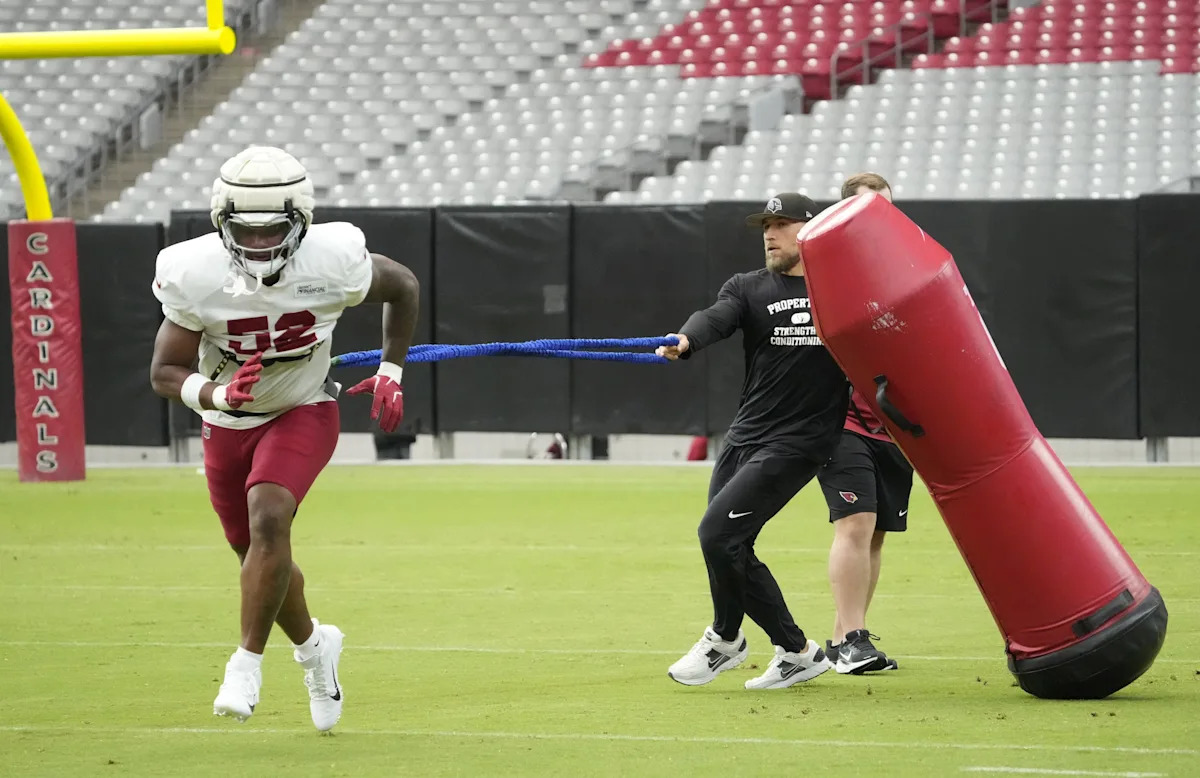
On the second night of the NFL draft this past spring, Arizona Cardinals general manager Monti Ossenfort sat at a podium and kept landing on the same word to describe his third-round draft pick.
Jordan Burch, he explained, is a “unique guy” with “some unique athleticism” who “brings a unique skill set.”
Advertisement
This is what drew the Cardinals to Burch during the draft process. It’s also what has, in the months since, occupied the attention of their coaching staff.
At 6 feet, 4 inches, 280 pounds, Burch is monstrous for a defensive end. He would even be big for a defensive end. Heck, Aaron Donald spent his career playing at 280 pounds, and he’s arguably the greatest defensive tackle of all time.
When you combine that size with Burch’s athleticism, Ossenfort’s description makes sense. Burch ran a 4.67-second 40-yard dash, an excellent number for anyone on the defensive line. In high school, he was used as a short-yardage running back, a red zone wide receiver and occasionally even as a quarterback.
In college, he made highlight shows when he juked multiple defenders on a 36-yard rush off a fake punt.
He still moves like the kid who was reared on basketball, who played point guard even as he blossomed into his near-300-pound frame. As a sophomore in high school, he transferred from his small hometown of Florence, S.C., to a powerhouse in the state capital of Columbia — a move designed to increase his recruiting profile in both sports. The interest was real in basketball, too, with South Carolina head coach Frank Martin particularly enamored.
Advertisement
His size, though, quickly ensured that football would be his future.
“You take one look at his build,” said Erik Kimrey, his high school football coach, “and I looked at our basketball coach and I go, ‘Hey buddy, sorry. That’s not a basketball player, that’s an NFL football player.’”
Put it all together and it’s a package that few players can offer.
Now, for the flip side. In college, Burch could use his size and speed to rack up sacks. He finished his final season at Oregon with 8.5 sacks in 10 games. Most of them featured him running through the face of opposing left tackles, because few college linemen could handle his natural traits. In the NFL, that won’t work as consistently.
Advertisement
“They move a lot faster and they have better hands,” Burch acknowledged recently. Even in practice, he says, Cardinals left tackle Paris Johnson Jr. has shown him the chasm between college and the NFL.
So beginning in the spring, the Cardinals coaching staff set out to work with Burch on his first-step explosiveness.
“I really wanted to stress him just getting off the ball and accelerating,” defensive coordinator Nick Rallis said. “I want to see that burst.”
At the NFL level, this is key. If Burch can explode off the line of scrimmage, he’ll be able to access the rest of his skill set. If he can’t, he’ll constantly be a step behind the opposing tackle.
Advertisement
Cards push Burch on early explosiveness
It also comes less naturally for Burch. In the 40-yard dash, his time ranked in the 85th percentile among defensive ends and edge rushers. But his 10-yard split — the first 10 yards of his dash — was slightly below average. It takes a beat to get his 280-pound body going at full speed.
Addressing that first step has been a multi-part equation.
The Cardinals focused on resistance training with Burch, a recent team-wide emphasis. They cleaned up his footwork. They instilled the importance of eye discipline — football-speak for not being distracted and keeping a focus on the opposing tackle. They’re also having him work more as a stand-up rusher, rather than with his hand in the ground, so that he can get into his first step quicker. That has required training his balance.
Advertisement
“It’s a little bit different for me,” Burch said. “But I’ve been just working it, trying to help my mobility out so I can bend the edge.”
It’s a lot to put on the plate of a rookie, all while he’s learning a new defensive system.
But Burch’s development is crucial for the Cardinals — and not just because of their third-round investment. On the opposite side of the defensive line from Josh Sweat, the Cardinals are still searching for another edge rusher who can consistently get to the quarterback.
Baron Browning has shined since coming over from Denver at the trade deadline last year, but he’s never topped five sacks in a season. Zaven Collins is more valuable for his versatility than his work as a pure pass rusher. B.J. Ojulari is still recovering from a torn ACL.
Advertisement
So while Browning and Collins remain clearly ahead of him on the depth chart, Burch has the potential to fill a valuable void.
It’s in that context that his preseason debut against the Kansas City Chiefs was so encouraging.
“He was impactful,” head coach Jonathan Gannon said. “I thought he affected the quarterback.”
It wasn’t just that Burch affected the quarterback but how he did it. Twice, he generated near-instant pressure by coming off the edge and bending around the Chiefs right tackle — the exact type of pass rush on which he has trained his focus this summer.
All the typical preseason caveats are worth noting here. Those two plays came against a career backup and a camp body. But given everything that Burch has put into the past four months, it felt like it represented more than that.
Advertisement
“It felt good,” Burch said. “Coach was like, ‘Just let it fly, don’t do too much thinking.’ And that’s what I tried to do.”
This article originally appeared on Arizona Republic: Jordan Burch makes encouraging preseason debut for Arizona Cardinals