

Who shined, struggled for Arizona Cardinals at scrimmage with Denver Broncos
Trey McBride, Darius Robinson had good days for the Cardinals while others are still looking for preseason spark.
One month after it began, the highlights of Arizona Cardinals training camp have carried a common theme: They center around Marvin Harrison Jr. making plays he didn’t make a year ago.
There was the one-handed catch early in training camp, when he spun backward to bring in an acrobatic pass along the sideline. There were a pair of go routes, working against Garrett Williams and Jalen Thompson, that displayed an explosive element he lacked as a rookie. In last week’s joint practice against the Denver Broncos, he beat cornerback Riley Moss deep on one big completion, then came back two snaps later with a leaping catch on a corner route against reigning Defensive Player of the Year Patrick Surtain.
It’s those moments that have spurred so much of the optimism surrounding Harrison’s second season. It’s also those moments that have hidden some noteworthy inconsistencies.
With the Cardinals’ starters unlikely to play in the final preseason game, we probably won’t see Harrison and Kyler Murray until the regular season opener (the Cardinals’ remaining practices are not open to reporting). Essentially, we’ve learned all we’re going to learn about that connection until Sept. 7 in New Orleans.
Since training camp began, the Cardinals’ starters have had seven high-speed practices against themselves, one joint practice with the Broncos and one preseason game. In those nine sessions of 11-on-11 football, one stat stands out.
When targeting Trey McBride, Murray’s completion percentage has been 84%. When targeting Harrison, his completion percentage has been 56%.
All the typical preseason caveats apply, but those numbers are jarring for their similarities to last season. In the 2024 regular season, Murray completed 76% of his passes to McBride and 53% of his passes to Harrison.
The numbers also align with the eye test. Consider the joint practice in Denver — the same practice when Harrison impressed with his catches against Moss and Surtain.
Murray’s first three pass attempts to Harrison all fell incomplete. Two of them came when Harrison was tightly covered on end zone fades, and Murray threw the ball away, over his head. One was a jump ball that Harrison lost against Ja’Quan McMillian. The final one came with Harrison open on a go route, only for Murray to overthrow him.
That is the smallest of possible sample sizes, but it bore a striking resemblance to the results of Harrison’s rookie season. Among 51 receivers with at least 80 targets, his catch rate ranked 49th.
In a press conference this week, Harrison brushed aside that concern.
“No, I like the connection we’ve had throughout camp,” Harrison said. “I think we’ve done a great job of continuing to talk off the field and in between meetings or in between plays, what we’re both seeing out there. I definitely like where we’re at. We’ve just gotta go out there and put it on the field now.”
His coaches have echoed that refrain. Both head coach Jonathan Gannon and offensive coordinator Drew Petzing believe that Murray and Harrison’s connection has developed since last season.
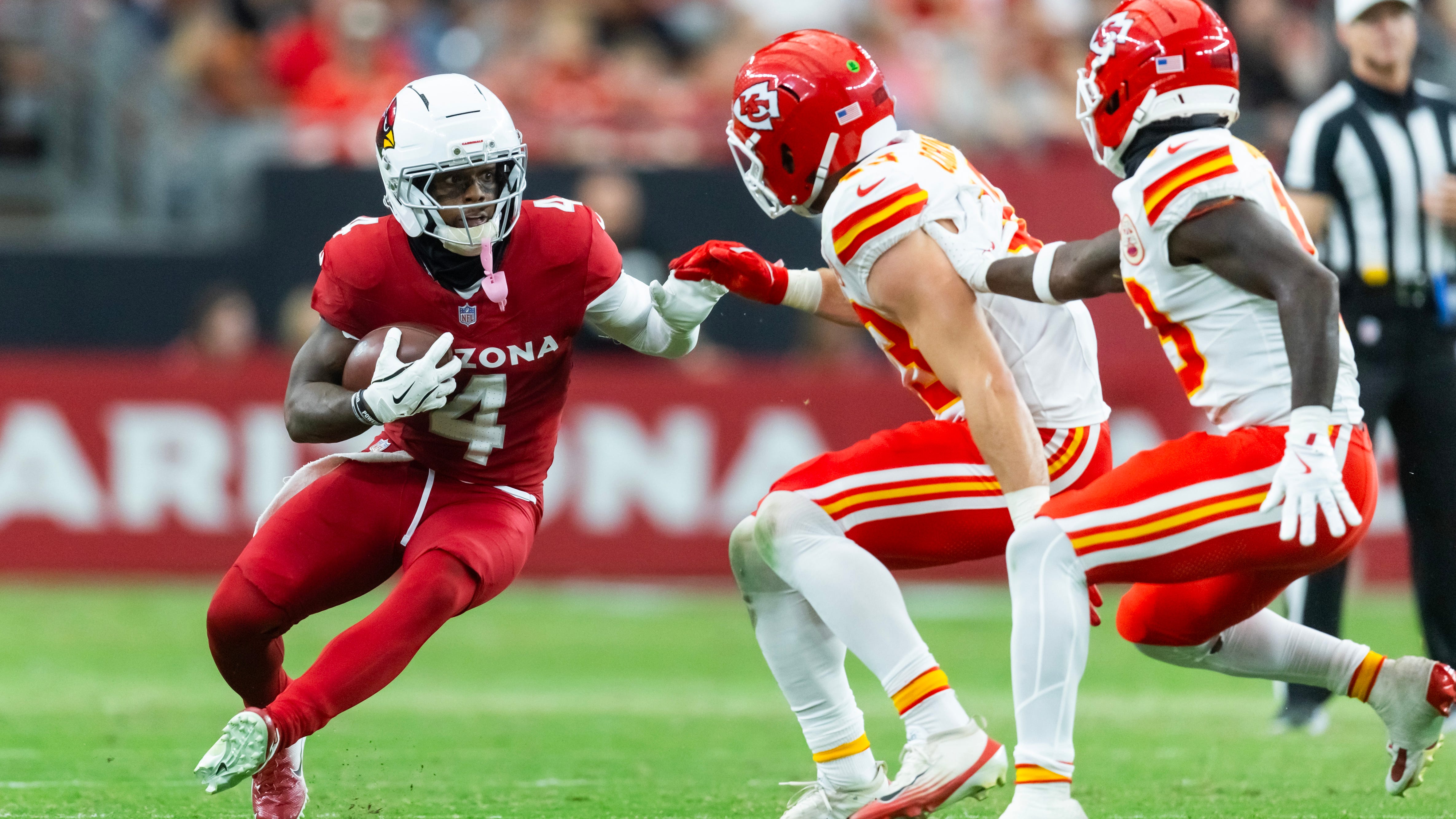
Breaking down the Arizona Cardinals’ preseason win over the Chiefs
The Arizona Republic’s Theo Mackie breaks down the Arizona Cardinals’ first preseason win in two years.
Gannon sees an increased understanding from each player of how the other operates. Petzing sees both displaying more confidence in their connection.
“I think it’s further along right now than what OTAs looked like,” Gannon said. “Even the first part of camp. I like where that’s trending and I’m excited about it.”
Then, Gannon turned toward the future.
“We’ll get some good work here this week on it,” he said.
Maybe the Cardinals are knocking on the door of a consistent solution. There are tangible reasons, after all, to believe that Harrison could take a significant second-year step forward.
He’s added 11 pounds of muscle, which should help him on contested catches and with yards after the catch. He also, at times, looks to be playing faster within the offense. A 15-yard catch in the preseason opener was just one play, but it showed an encouraging trust between quarterback and receiver, as Murray led Harrison into open space with an anticipatory throw.
“I know what we’re trying to do as an offense,” Harrison said. “Moving around the formations a lot. Playing different spots. I definitely feel a lot more comfortable in the system.”
It’s a crucial question for the Cardinals to solve. Their coaching staff is the same as it was a year ago. Their offensive personnel is the same as it was a year ago, meaning Harrison and McBride are the only two high-usage receiving weapons.
The clearest path for significant offensive improvement, then, is to get more production out of the player they drafted fourth overall to be a difference-maker.
Last season, the Cardinals had an excellent passing attack when the run game was a viable threat. But when that threat disappeared, so did their offensive effectiveness.
Take third downs, for example. On 3rd-and-5 or shorter, they ranked fifth in yards per pass attempt. On 3rd-and-6 or longer, they ranked dead last in yards per pass attempt. They turned just 21% of those throws into first downs.
In order to succeed in those situations — when the defense knows a pass is coming — playmakers need to show up.
That’s an area in which Murray and the Cardinals once excelled. In 2021, when they last reached the playoffs, they ranked seventh in pass plays of at least 20 yards, with 62. Last year, they ranked 24th, with 43.
“If you look at the majority of scoring drives in the NFL, a good portion of them contain some version of an explosive play,” Petzing said. “Not all of them but a lot of them. So it’s a measure that we look at because it affects that and it’s something we always want to make sure is at the forefront of our mind.”
To be clear, Petzing doesn’t care whether those explosives come on the ground or through the air. But the Cardinals run game has limited room for improvement. They were already elite in every meaningful metric.
The passing game was not. That’s where Murray and Harrison hold the keys to the Cardinals’ future.