
Let’s start here. If you’re a fantasy football veteran and your biggest struggle is remembering which sleeper picks are on which of your multiple rosters, this article is not for you. Please see yourself out. Go read some 10,000 IQ strategies from The Athletic’s senior fantasy writer, Jake Ciely. Watch an episode of “The League.” Join our Discord. Touch grass. There’s nothing for you to see here. Move along.
If, however, you are new to fantasy football and finally caved to the constant stream of solicitations from your family, friends and/or coworkers to join their fantasy football league because they “just need one more team,” then you’re in the right place. Now let’s make sure you don’t spend the season like a sucker handing over your hard-earned money, because candidly, that’s probably why they invited you.
These tips may not turn a fantasy square into a sharp, but they will set some guardrails so your team doesn’t careen toward disaster before the season even begins. Once you memorize these essentials, you can proceed to our more in-depth advice and make your leaguemates regret they invited you to the league in the first place.
1. Read NFL news
Staying on top of the latest player news and team trends can be a superpower when it comes to fantasy football. Read a story about a starting wide receiver working through a pulled hamstring during training camp? Avoid him on draft day. Is a late-round rookie running back suddenly getting more carries than the veteran in front of him? Snatch them up before another team gets the chance.
Given the firehose-like torrent of NFL news each week, you’ll be pleased to know you don’t have to pore over reams of reports (though we certainly wouldn’t discourage it). Each Friday this season, esteemed fantasy football analyst Andy Behrens will round up the choicest news nuggets from around the league and provide his perspective as it relates to fantasy managers. Saturdays, Jacob Robinson will comb through stats and seek insights from The Athletic’s armada of NFL beat writers to spot trends before they become nationally known. Check out those two articles each week, and you’ll get a leg up on your competition. (And do yourself a favor and sign up for the Scoop City newsletter while you’re at it, anchored by Robinson and NFL news-breaker Dianna Russini.)
2. Know your league settings
This is a warning for people like me who unbox their Ikea furniture and attack it with the included hexagonal wrench only to discover from the stick figure with no opposable thumbs that you’ve been building your Ivar storage shelving all wrong. Draft format (snake draft or auction?), scoring system (point-per-reception (PPR) or non-PPR?) and overall format (redraft, keeper or dynasty?) all have a significant impact on how you craft your roster. Here’s a simple draft tip for each of the aforementioned settings:
Snake draft: The most common draft type, each round alternates going from pick No. 1 to the last draft slot (most leagues are between 10-14 players, so let’s use 12 for this example) and then back from 12-1 — the slithering down-and-back path giving rise to the term “snake draft.” That means the managers at the beginning and end of each round will have consecutive picks — it also means many players will be coming off the board before your next two selections. If you want to fill a position with a specific player, you may need to select them higher than their average draft position (ADP). You might not get the best value, but that’s OK. Get the players you want! It will make your season more enjoyable.
Auction: In auction formats, every manager will have a budget (usually $200) and a shot to land any player by having the highest bid. It’s smart to employ a high-low strategy here, budgeting most of your money to land two or three stars (top 5) at critical positions like running back and wide receiver. Then save some money for low-cost or $1 players to fill out your roster, particularly at positions like kicker and defense/special teams (D/ST), where scoring fluctuates weekly and players/teams are separated by fewer fantasy points over the full season.
PPR/Non-PPR: In PPR leagues, prioritize running backs that catch a lot of passes out of the backfield, as well as the wide receivers or tight ends that work as their quarterback’s favorite targets. Even if they gain zero yards on the reception, they’ll still get you a point, and those can add up quickly. In non-PPR leagues, prioritize running backs that score a lot of touchdowns. You should also take aim at one of the elite running quarterbacks — Josh Allen, Lamar Jackson, Jalen Hurts, Jayden Daniels — who can provide a larger advantage in this format compared to PPR leagues, where their point production is muted relative to WRs and RBs.
Redraft/Keeper/Dynasty: In redraft leagues, all that matters is the season ahead, so age is less of a limiting factor than in keeper or dynasty leagues. In those latter formats, you’ll be better off keying in on younger players who can provide you with multiple years of solid scoring. Dynasty leagues persist forever, so you’ll only draft rookies each season after your initial dynasty start-up draft. Finding a franchise QB can be super valuable for Dynasty leagues, but the 2024 NFL Draft featured a lot of talented running backs. If you can somehow get Raiders RB Ashton Jeanty, you’ll be sitting pretty, but Omarion Hampton (Chargers), TreVeyon Henderson (Patriots), Kaleb Johnson (Steelers), RJ Harvey (Broncos) and even seventh-rounder Jacory Croskey-Merritt (Commanders) are good names to know.
3. QBs might not be as valuable as you think
While a franchise quarterback is essential for NFL success, in most fantasy formats, the first players off the draft board are almost always wide receivers and running backs. The reason? Most lineups require managers to start at least two WRs and RBs, often in addition to a Flex position, which can be filled by a WR, RB or tight end. Thus, talent at those positions becomes scarcer more quickly in the draft.
If you really want to land one of the top five quarterbacks, you’ll likely need to spend a pick in the first three to four rounds. After they’re gone, though, you’re likely better off waiting until later in the draft because there is less scoring differentiation. This can be seen visually in our “Draft Chasms of Doom” series, which depicts where the point production drops off significantly at each position.
The exception to waiting to draft a QB is in leagues requiring teams to start multiple quarterbacks (2QB leagues) or those incentivizing playing multiple QBs (Superflex leagues, which allow you to start either a WR/RB/TE or QB in that slot). In those instances, QBs almost always comprise half or more of the first-round selections.
4. Separate fantasy from reality
Super Bowl trophies do not matter for fantasy; our game is about statistical production in categories that produce fantasy points. That’s why savvy managers love players like former Jacksonville Jaguars QB Blake Bortles, the patron saint of garbage time stats. Yes, the Jags lost a lot of games with Bortles in 2015, but all those dinks and dunks and meaningless (in reality), late-game TDs allowed him to rack up the fourth-most fantasy points among quarterbacks that season. That 5-11 record for Jacksonville in 2015? Not your problem! So don’t get blinded by Patrick Mahomes and his Super Bowl rings. The past few seasons, he has not been a good quarterback for fantasy purposes.
5. Manage your risk
There has been no shortage of fantasy rosters that get destroyed when an early-round pick fails to match their hype or, worse, is lost for the season due to injury. The latter is tougher to predict (the best, but hardly fool-proof predictor for future injuries is past injuries), but you’d do well to avoid putting players atop your draft list if they lack a track record of success.
Despite his rookie status, Arizona Cardinals wide receiver Marvin Harrison Jr. enticed a lot of fantasy managers into an early-round selection last season, only to finish far down the scoring leaderboard. Teams that drafted him lost a boatload of points relative to their competitors’ early selections, and many fantasy teams with Harrison sank into the abyss. Make sure there is some statistical substance behind the hype. (For example, though aforementioned Las Vegas Raiders running back Ashton Jeanty has never played a regular-season game, there’s actually a good track record of rookie running backs providing strong fantasy value.)
You shouldn’t be risk-averse for your entire draft, however. Once your starters are stable, take aim at the ceiling with your later picks … or as Michael Salfino writes, shoot for the stars. Find players in positions where they could greatly outperform their draft position — a phenomenon that turns certain players into so-called league winners — and pay no mind to the risk in the late rounds. Miss out on a first-rounder? Yikes! Whiff on an 11th-rounder? Drop them back into the waiver pool and pick another name.
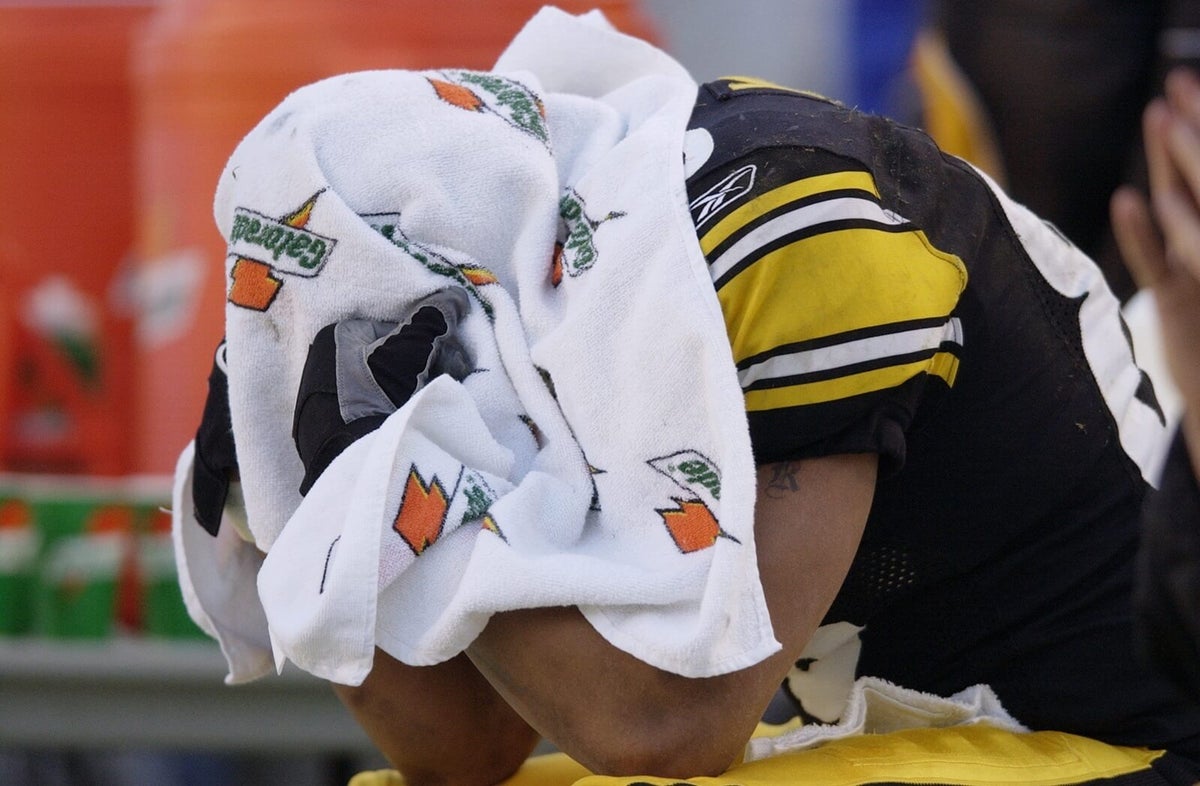
(Photo of Hines Ward: Ezra Shaw / Getty Images)