
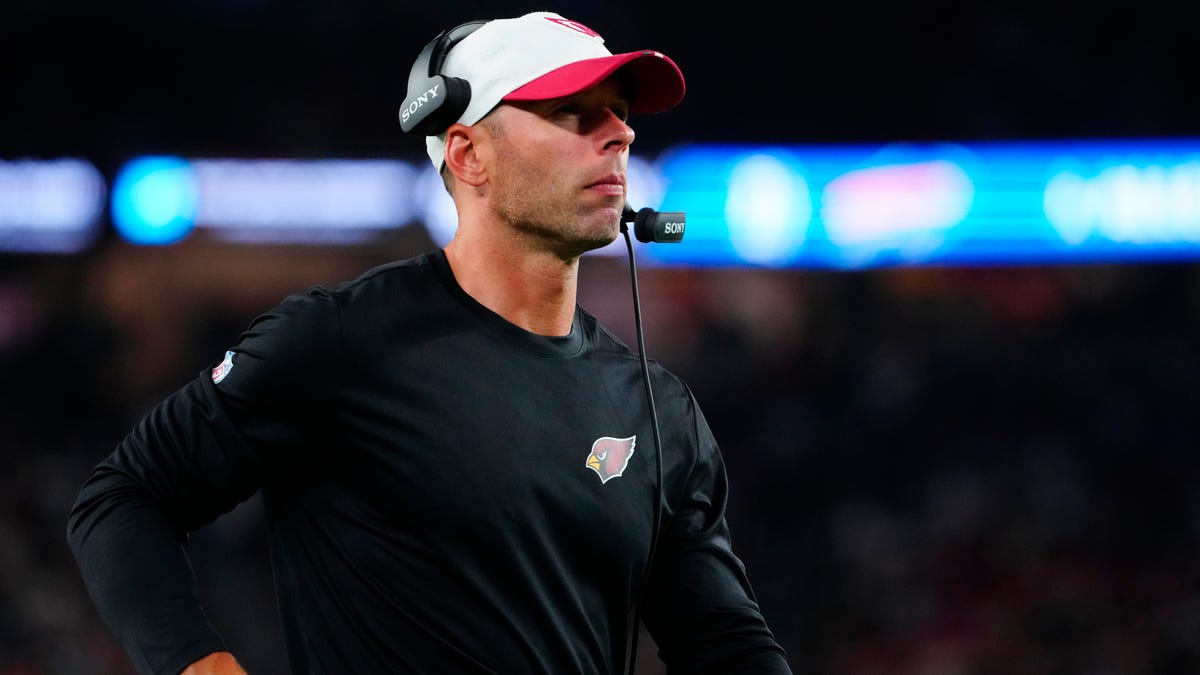


A look at what’s important from the Cardinals’ preseason win over the Raiders
The Arizona Republic’s Theo Mackie breaks down the Arizona Cardinals’ win over the Las Vegas Raiders in their preseason finale.
The Arizona Cardinals invested heavily in their defensive line during the offseason, signaling a push for playoff contention.The team’s roster is now largely comprised of players chosen by the current management, reflecting their strategic vision.
As this summer unfolded, Jonathan Gannon and Monti Ossenfort resisted the pull of labeling the Arizona Cardinals expectations.
No matter how many times they were asked, the response was the same. Some combination of words strung together without much meaning. There’s little point in publicly announcing that you fancy yourself a playoff contender.
The Cardinals’ actions, though, have made that statement for them. This offseason, they went out and spent $110.9 million to rebuild their biggest weakness, the defensive line. They made win-now additions in the draft, most notably selecting Will Johnson amid concerns over his long-term health.
Those are moves that teams make when they believe they’re ready to contend.
Even the typically taciturn Ossenfort acknowledged that the situation is different now as the Cardinals enter their third season with him and Gannon at the helm.
“When we’ve gone through three cycles, three drafts, three free agents, I do feel that we’ve got guys that understand what we’re looking to do,” Ossenfort said.
That much has been clear over the past two offseasons. Not only have the Cardinals significantly increased their overall talent level since Ossenfort inherited a threadbare roster from Steve Keim in 2023, but they’ve done so in a way that maximizes the philosophies of their coaching staff.
The undersized speedsters who fit Kliff Kingsbury’s offense have been replaced by bruisers. Marvin Harrison Jr. and Michael Wilson, their top two receivers, are both pushing 220 pounds. Tip Reiman is a physical menace of a tight end whose job is to dominate as a blocker, not catch passes. James Conner and Trey McBride were re-signed from the old regime in large part because they win with physicality.
On defense, versatility has been the key trait. In Garrett Williams, Darius Robinson, Mack Wilson and Baron Browning, the Cardinals have identified players who can fill multiple roles, playing into the creativity of defensive coordinator Nick Rallis.
“With the acquisition periods of three draft classes (and) three free agency classes,” Gannon said, “… I feel like the roster is in really good shape right now.”
Cardinals aim to hit a much higher bar
That means just one thing: In 2025, the expectations are real. Whether Gannon and Ossenfort will acknowledge them is immaterial.
In each of this staff’s first two seasons, the Cardinals exceeded expectations — despite not making the playoffs. That’s a rare luxury in the NFL. Thanks to the mess they inherited, there was a built-in landing pad.
Four wins were OK in 2023 because at least it was stable and uncontroversial. Eight wins were encouraging in 2024, because the roster was still being turned over. Even in a league designed to maximize parity, it’s difficult to engineer an immediate turnaround without suddenly striking gold on a new quarterback.
All of that is different now. Of the 53 players on their initial roster, just nine were inherited from the previous regime. Of those nine, only Kyler Murray and Jalen Thompson were under contract for 2025 when Gannon and Ossenfort arrived.
The other 51 players on the roster are all here because the Cardinals’ current brass made decisions to include them in their plans. This team is their team. The caveats no longer apply.
“One thing that we set out to do from the start is we needed to create a core of players,” Ossenfort said. “And we needed to create a core of players that understood what exactly we wanted to be as a team.”
Cardinals, by comparison
That core is here. To understand what that means, consider the recent trajectories of two other NFC franchises.
In 2021, the Detroit Lions and Atlanta Falcons started from scratch, hiring a new general manager and a new head coach. In those regimes’ first two seasons, they won 12 games and 14 games, respectively, while building out their rosters.
Entering the third year, the Lions were projected for 9.5 wins while the Falcons were projected for 8.5.
This season, the Cardinals fall in that same range, generally pegged at 8.5.
Detroit, under Dan Campbell, became the darling of the NFL. They went 12-5, reached the NFC championship game and entrenched themselves as a Super Bowl contender.
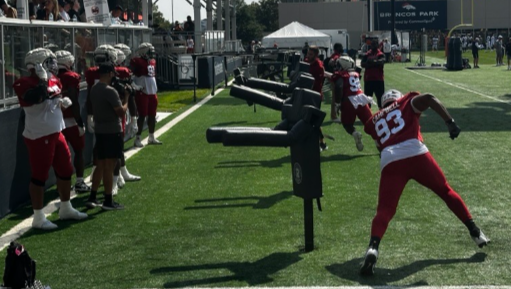
Who shined, struggled for Arizona Cardinals at scrimmage with Denver Broncos
Trey McBride, Darius Robinson had good days for the Cardinals while others are still looking for preseason spark.
Atlanta sputtered to an uninspired 7-10 finish. Head coach Arthur Smith lost his job. Terry Fontenot was retained as general manager, but his seat remains hot two years later.
That’s life in the NFL. This isn’t baseball. Rebuilds aren’t allowed to take half a decade.
The Cardinals’ rare stability is proof. Typically, teams are either good enough to get their talent poached or bad enough for heads to roll. The Cardinals are one of just four organizations to have had the same general manager, head coach, offensive coordinator and defensive coordinator since 2023.
The three others are Kansas City, Tampa Bay and Denver: playoff team, playoff team, playoff team.
Whether they’ll label it or not, the Cardinals know that is now the expectation.
“We haven’t accomplished anything yet,” assistant general manager Dave Sears said. “We feel good about the roster. I think on paper, it looks better. But you can throw that out as soon as the first game goes.”