
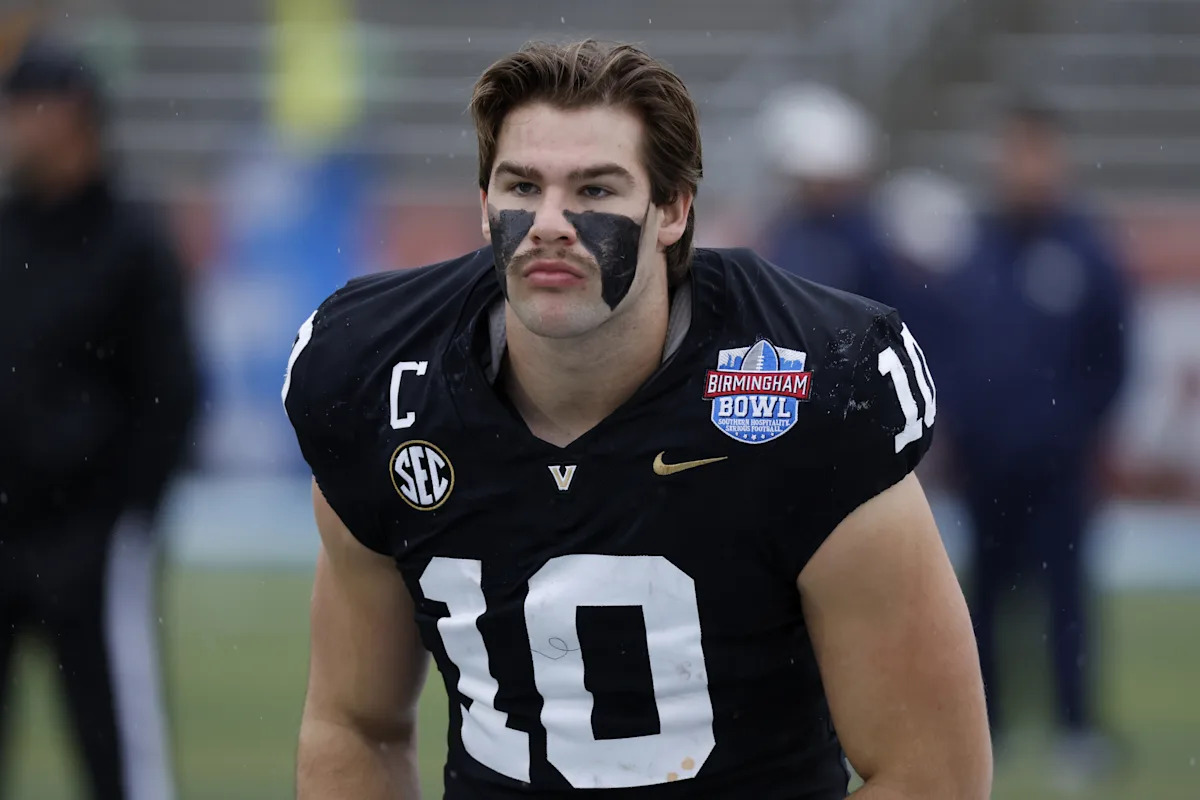
Current Vanderbilt football players Langston Patterson and Yilanan Outtara, and former players CJ Taylor and Quincy Skinner, are among a group of current and former NCAA athletes suing the NCAA in a class-action suit over the NCAA’s eligibility clock, and specifically over the application of the redshirt rule.
They’re represented by alum Ryan Downton, who if you’re paying attention also represented Diego Pavia in his lawsuit against the NCAA for an additional year of eligibility. From reading the complaint, filed in federal court in Nashville this afternoon, the basis for the lawsuit has to do with the NCAA’s redshirt rule — and more specifically, the arbitrary application of the rule, which allows exceptions for some instances but not others.
Advertisement
A consistent theme emerges across the named plaintiffs that distinguishes this from Zakai Zeigler’s lawsuit against the NCAA that ultimately got denied. The four Vanderbilt players (current and former) all played too many games as freshmen to qualify for a four-game redshirt (Taylor, who played six, played the fewest), but none of them were playing a lot of meaningful snaps in their freshman season. Patterson, according to VU’s website, got on the field for 215 snaps over 12 games as a true freshman — but 195 of those were on special teams. Notably, he played fewer snaps than quite a few guys who did get four-game redshirts — a quarterback who came on to start the final four games of the season (after being deliberately held out for eight games to preserve a year of eligibility) almost certainly played more than 215 snaps.
The non-Vanderbilt plaintiffs hammer home this theme even more: there are three baseball players from Santa Clara, one of whom burned a year of eligibility to pitch three innings. There’s former Hawaii quarterback Brayden Schager, who started three games as a freshman — and got into garbage time for three more, one of which he didn’t attempt a pass. While it’s not explicitly spelled out, I am betting that the four-game redshirt rule will figure prominently in the plaintiffs’ arguments, because it really is an arbitrary exception to the rule, and one that doesn’t have an equivalent for other sports.