
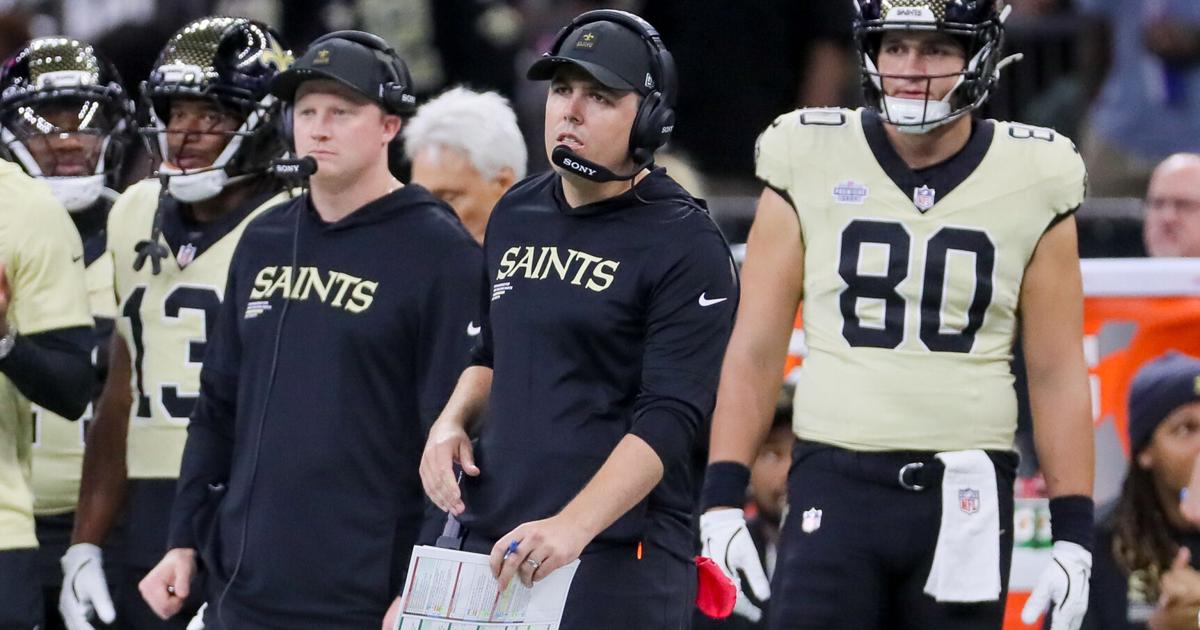
At halftime of his first game as coach of the New Orleans Saints, Kellen Moore gave an answer that left him open to ridicule.
The Saints had curiously not used any of their timeouts before the break. And by failing to do so, New Orleans was left with just 28 seconds on the clock after the Arizona Cardinals’ four-and-a-half-minute touchdown drive. It was an eyebrow-raising decision, one that was immediately questioned.
Moore’s initial answer didn’t smooth over matters, either.
“We were just trying to save our timeouts as much as we could,” Moore told CBS. “They did a good job of bleeding the clock and putting (themselves) in a favorable position. We didn’t get enough yards to play it out right there at the end of the half.”
Save our timeouts? For what?
It was a comment that perhaps Moore wanted back, because when he met with reporters after the game, the first-year coach avoided using the phrase altogether when asked about the matter again.
Moore, the second time around, said he and his staff discussed the possibility but were content to let the situation “play out” because the Cardinals also had their timeouts, and the Saints were set to receive the ball again to start the second half.
Moore may have better laid out his thought process, but the choice itself still left a lot to be desired in what ultimately turned out to be a one-score game.
Sunday’s 20-13 loss to the Cardinals came down to a wild, last-second sequence that saw the Saints’ potential game-tying rally come just short of the end zone.
It was easy to imagine a scenario in which the dramatics weren’t needed if the Saints, for instance, had better clock management in the first half. Or, if New Orleans had cut down on the glaring 13 penalties that were almost a franchise record for a season opener.
Those reasons alone aren’t why the Saints lost Moore’s debut. But the margins matter in the NFL, and Moore demonstrated noticeable growing pains in his first outing as a head coach.
“We’re going to trust what Kellen does,” quarterback Spencer Rattler said, adding, “There’s risk and reward to that (scenario). We trust in what Kellen is going to do. We knew we had the ball coming out (of halftime). … We trust in what coach is calling.”
Moore shook his head when asked if having a young quarterback like Rattler factored into his decision to play it conservatively near the end of the first half. Instead, the coach said he was “really close” to calling a timeout and would have also called one if Alvin Kamara’s run had gained more yards before the half. Rattler said Kamara would have likely needed 25-30 yards to trigger a timeout. The running back gained 6, and the Saints let the clock expire, down 17-10.
On the broadcast, CBS’ broadcast crew started to openly question Moore’s choice once running back James Conner gained a first down with 1:52 left. If the next two plays — a 4-yard gain and a 4-yard touchdown — unfolded exactly the same, the Saints could have gotten the ball with roughly 1:30 left and a timeout still available to try and drive down the field if Moore had called timeouts.
“We can play the rewind game a lot; I get that aspect of it,” Moore said. “… We had plenty of football ahead.”
Moore seemed to be much more bothered by the Saints’ 13 penalties — their most in an opener since 1983. He called them a discipline issue, one that started with him. Of the 13 flags, seven were against the offense. Six of the seven were procedural penalties, such as an illegal shift or a false start.
Kamara said he thought the tempo the Saints stressed contributed to the problem. Moore’s offense pushes the pace, but in hurrying up, Kamara said the urgency requires a certain amount of focus.
Three of the Saints’ penalties came in no-huddle situations.
“I’ll admit: Some of those times, I wanted to get in the huddle because I was like, ‘Man I don’t feel like we’re going to be able to get set correctly or get lined up correctly,’” Kamara said. “There were a couple times where we’re going tempo and guys are running from left to right, trying to figure out where to line up.
“And you know, to get where you want to go, we’ve got to be precise on every single play, every single snap.”
Moore’s emphasis on tempo, however, can also be seen as a bright spot for the coach’s debut. The style fueled New Orleans’ near-comeback at the end of the game, and the offense’s best moments Sunday came when it put the Cardinals on their heels. Rattler went 13 of 16 for 115 yards when using tempo.
In some ways, Moore’s first season will be about establishing an identity for the Saints. And on that front, it was encouraging Sunday that his team played with a distinct style and fought to the end.
But as a first-time head coach, Moore surely understands that every choice — every non-choice — is picked apart. He was also questioned, for instance, on why he kicked a field goal on fourth-and-goal from 2:46 left when trailing 20-10.
There, Moore said he would have felt more comfortable going for it if the Saints were at the 2- or 3-yard line instead of the 5. Instead, he chose to cut it to a one-score game.
The decision was up for debate: ESPN’s analytical model recommended it as a “go” situation, finding a touchdown would have boosted the Saints’ win probability to 6% instead of 4.3% with a field goal try.
“The story for us is you can’t beat yourself,” Moore said.
The story’s ending might depend on how well Moore learns on the job.