
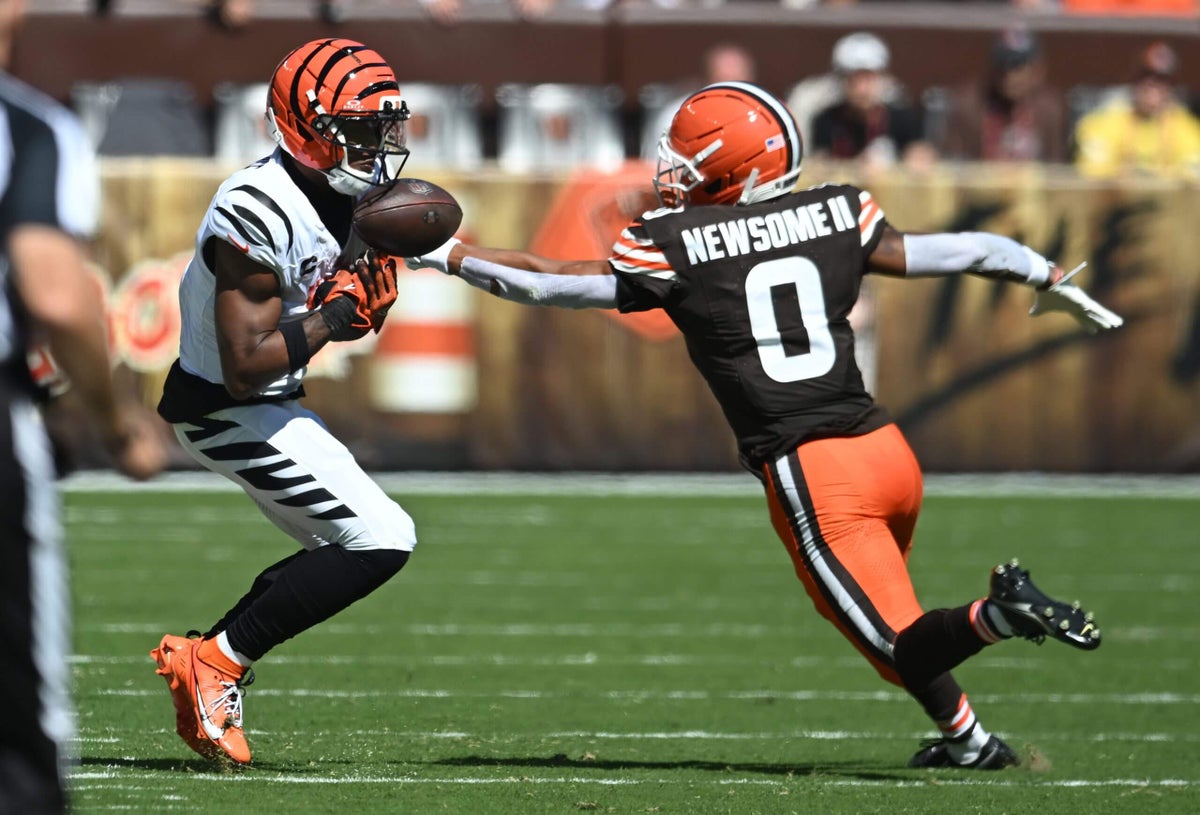
Ja’Marr Chase has led many fantasy managers to championships over the past few years. In 2024, he topped all wide receivers in fantasy scoring and was second only to Lamar Jackson in PPR scoring.
His history is why Chase was the consensus No. 1 overall pick in all scoring types this draft season (per Fantasy Pros). His track record is also why Chase’s fantasy managers are exceptionally worried following a disastrous Week 1. Chase posted only 4.6 PPR points against the Browns, a total that tied for the second-lowest single-game mark of his career.
Chase wasn’t the only major disappointment for the Bengals. Tee Higgins managed just 6.3 PPR points (his second-lowest mark since the 2023 season), and Joe Burrow tallied a mere 8.8 points, the eighth-lowest total of his career.
Following this debacle, the big question for fantasy managers is whether these depressed scoring performances will continue. Are Chase, Higgins and Burrow likely to be fantasy disappointments this season?
Unfortunately for their managers, the answer to that question leans heavily in the affirmative. Head coach Zac Taylor heeded a historical lesson from the best offenses in NFL history: It is challenging to consistently win scoreboard shootouts.
To illustrate this, let’s look at the teams that have scored 500 or more regular-season points, giving us 33 of the best offenses in league history.
Note: The following tables include postseason totals.
Year
Team
PPG
Wins
Losses
Ties
Win %
1961
Houston
34.9
11
3
1
82.1%
1983
Washington
32.9
16
3
0
84.2%
1984
Miami
31.8
16
3
0
84.2%
1994
San Francisco
33.5
16
3
0
84.2%
1998
Denver
31.4
17
2
0
89.5%
1998
Minnesota
34.7
16
2
0
88.9%
1999
St. Louis
32.1
16
3
0
84.2%
2000
St. Louis
33.4
10
7
0
58.8%
2001
St. Louis
31.3
16
3
0
84.2%
2004
Indianapolis
31.9
13
5
0
72.2%
2007
New England
34.5
18
1
0
94.7%
2009
New Orleans
32.5
16
3
0
84.2%
2010
New England
31.7
14
3
0
82.4%
2011
New England
31.5
15
4
0
78.9%
2011
Green Bay
34.1
15
2
0
88.2%
2011
New Orleans
34.7
14
4
0
77.8%
2012
New England
33.9
13
5
0
72.2%
2013
Denver
34.9
15
4
0
78.9%
2015
Carolina
29.5
17
3
0
85.0%
2016
Atlanta
40.5
11
5
0
68.8%
2018
Kansas City
34.8
13
5
0
72.2%
2018
New Orleans
30.4
14
4
0
77.8%
2018
LA Rams
30.8
15
4
0
78.9%
2019
Baltimore
31.9
14
3
0
82.4%
2020
Green Bay
31.5
14
4
0
77.8%
2020
Buffalo
29.9
15
4
0
78.9%
2021
Dallas
30.4
12
6
0
66.7%
2021
Tampa Bay
29.9
14
5
0
73.7%
2023
Dallas
30.1
12
6
0
66.7%
2024
Detroit
33.1
15
3
0
83.3%
2024
Buffalo
30.6
15
5
0
75.0%
2024
Baltimore
30.1
13
6
0
68.4%
2024
Tampa Bay
29.0
10
8
0
55.6%
Total
32.3
471
131
1
78.2%
These offenses averaged 32.3 fantasy points in regular and postseason play and posted a 78.2% win rate.
As great as those offenses were, those clubs still didn’t fare well when their opponents scored 24+ points.
Year
Team
Opp 24+ pts
W
L
T
Win %
1961
Houston
3
0
2
1
16.7%
1983
Washington
6
3
3
0
50.0%
1984
Miami
6
3
3
0
50.0%
1994
San Francisco
5
3
2
0
60.0%
1998
Denver
4
3
1
0
75.0%
1998
Minnesota
8
6
2
0
75.0%
1999
St. Louis
4
1
3
0
25.0%
2000
St. Louis
14
8
6
0
57.1%
2001
St. Louis
5
3
2
0
60.0%
2004
Indianapolis
9
5
4
0
55.6%
2007
New England
5
5
0
0
100.0%
2009
New Orleans
7
6
1
0
85.7%
2010
New England
9
6
3
0
66.7%
2011
New England
7
4
3
0
57.1%
2011
Green Bay
7
6
1
0
85.7%
2011
New Orleans
8
4
4
0
50.0%
2012
New England
9
5
4
0
55.6%
2013
Denver
8
4
4
0
50.0%
2015
Carolina
6
5
1
0
83.3%
2016
Atlanta
11
6
5
0
54.5%
2018
Kansas City
10
5
5
0
50.0%
2018
New Orleans
6
3
3
0
50.0%
2018
LA Rams
8
6
2
0
75.0%
2019
Baltimore
3
0
3
0
0.0%
2020
Green Bay
8
4
4
0
50.0%
2020
Buffalo
10
6
4
0
60.0%
2021
Dallas
7
3
3
0
50.0%
2021
Tampa Bay
9
5
4
0
55.6%
2023
Dallas
6
1
5
0
16.7%
2024
Detroit
6
4
2
0
66.7%
2024
Buffalo
7
4
3
0
57.1%
2024
Baltimore
9
4
5
0
44.4%
2024
Tampa Bay
7
1
6
0
14.3%
Total
237
132
103
1
55.9%
Their win rate drops to 55.9, or pretty much a toss-up proposition.
The good news is these teams did have a better win rate in scoreboard shootout games, which are defined as games in which each team scores 24 or more points.
Year
Team
# of shootouts
W
L
T
Win %
1961
Houston
2
0
1
1
25.0%
1983
Washington
5
3
2
0
60.0%
1984
Miami
5
3
2
0
60.0%
1994
San Francisco
3
3
0
0
100.0%
1998
Denver
3
3
0
0
100.0%
1998
Minnesota
8
6
2
0
75.0%
1999
St. Louis
3
1
2
0
33.3%
2000
St. Louis
13
8
5
0
61.5%
2001
St. Louis
4
3
1
0
75.0%
2004
Indianapolis
8
5
3
0
62.5%
2007
New England
5
5
0
0
100.0%
2009
New Orleans
6
6
0
0
100.0%
2010
New England
6
6
0
0
100.0%
2011
New England
5
4
1
0
80.0%
2011
Green Bay
6
6
0
0
100.0%
2011
New Orleans
6
4
2
0
66.7%
2012
New England
7
5
2
0
71.4%
2013
Denver
6
4
2
0
66.7%
2015
Carolina
5
5
0
0
100.0%
2016
Atlanta
10
6
4
0
60.0%
2018
Kansas City
10
5
5
0
50.0%
2018
New Orleans
4
3
1
0
75.0%
2018
LA Rams
7
6
1
0
85.7%
2019
Baltimore
2
0
2
0
0.0%
2020
Green Bay
6
4
2
0
66.7%
2020
Buffalo
8
6
2
0
75.0%
2021
Dallas
5
3
2
0
60.0%
2021
Tampa Bay
8
5
3
0
62.5%
2023
Dallas
2
1
1
0
50.0%
2024
Detroit
6
4
2
0
66.7%
2024
Buffalo
6
4
2
0
66.7%
2024
Baltimore
6
4
2
0
66.7%
2024
Tampa Bay
6
1
5
0
16.7%
192
132
59
1
69.0%
Those squads won 69% of their shootouts.
The trouble for modern elite offenses is that winning shootout games has become much more difficult.
ShootoutsWLTWin %
Since 2011
121
80
41
0
66.1%
Since 2020
53
32
21
0
60.4%
The shootout win rate dropped from 66.1% (2011-present) to 60.4% in the 2020-24 seasons. Only one team in the past five years has posted a shootout win rate higher than 66.7%, the 2020 Bills (6-2 in scoreboard shootouts).
Cincinnati didn’t quite make the 500+ point list last year, finishing with 472 points, but their 2024 track record is still illustrative of their difficulties in high-scoring games.
Per TruMedia, last year the Bengals got into a league-leading 10 shootouts. Only two other teams had as many as six scoreboard shootouts, and no other team had more than seven.
Cincinnati’s big issue is that they went 4-6 in those high-scoring games. The four victories were tied for the most shootout wins, but the six losses were the most in that category.
Joe Burrow made it clear he wanted Chase and Higgins back on the roster, so Cincinnati’s front office re-signed the wide receiver duo to huge contracts in March.
This decision left Taylor with two choices: hope for wins in shootouts or avoid them. He had the firepower in the Burrow/Chase/Higgins trio to get this offense into the 500-point category, but it might portend another double-digit scoreboard shootout total — an unacceptable road for a team that has Super Bowl aspirations as long as Burrow’s under center.
Taylor instead started this season with a run-heavy approach that saw Chase Brown run the ball 21 times. Had the Bengals lost against an overmatched Browns team, Taylor might have been leery about going this route in the future. However, Cincy won, albeit with a very close 17-16 triumph, so Taylor may be motivated to continue with a more conservative approach.
While this isn’t the best news for those with shares of Burrow, Chase, or Higgins, the Bengals have unfavorable rush defense matchups in Weeks 3-4, which may push Taylor to the pass in those games. But, as things stand now, there isn’t another unfavorable rush defense matchup on the Bengals’ schedule until Week 13. Unless that changes, Cincinnati may be much more run-heavy than fantasy managers anticipated during draft season.
So, what should fantasy managers do? The suggestion is to strongly consider trading high on Chase, Higgins or Burrow. They will still post some strong point totals this year and thus still have elite trade value. However, their values could decline if Cincinnati has another game or two that go the way of Week 1, so get out while the getting is good.
(Photo of Ja’Marr Chase: Ken Blaze / Imagn Images)