

There is an exclusive group of football fans called the Ninety-Two Club, whose members have watched a competitive first-team match at every one of the current 92 Premier League and EFL (English Football League) home stadiums.
In 2022, Richard Sutcliffe finally realised a 40-year ambition by ticking off his few remaining grounds in a five-part series for The Athletic. Now, he’s back on the road again…
OK, you’ve achieved the Holy Grail, what next?
Not necessarily a question that overly troubled King Arthur’s Knights once their search was over. But, for football fans who have completed the set of 92 Premier League and EFL grounds, things are not so simple.
Is achieving the considerable feat of ticking off every current home stadium in the top four divisions enough? Or, do you keep going, knowing full well that the task of maintaining this accomplishment is subject to change on an annual basis due to either clubs moving home or new teams being promoted from non-League?
I chose the latter. Having achieved the football fans’ equivalent of scaling Everest by ticking off the 92nd and final ground on my list as Cheltenham Town beat Morecambe 1-0 in October 2022, I wanted more.
Hence why, as the season at Premier League and Championship level takes its first breather via the September international break, I’m in north London. The Hive, to be exact, as Barnet host Shrewsbury Town in League Two.
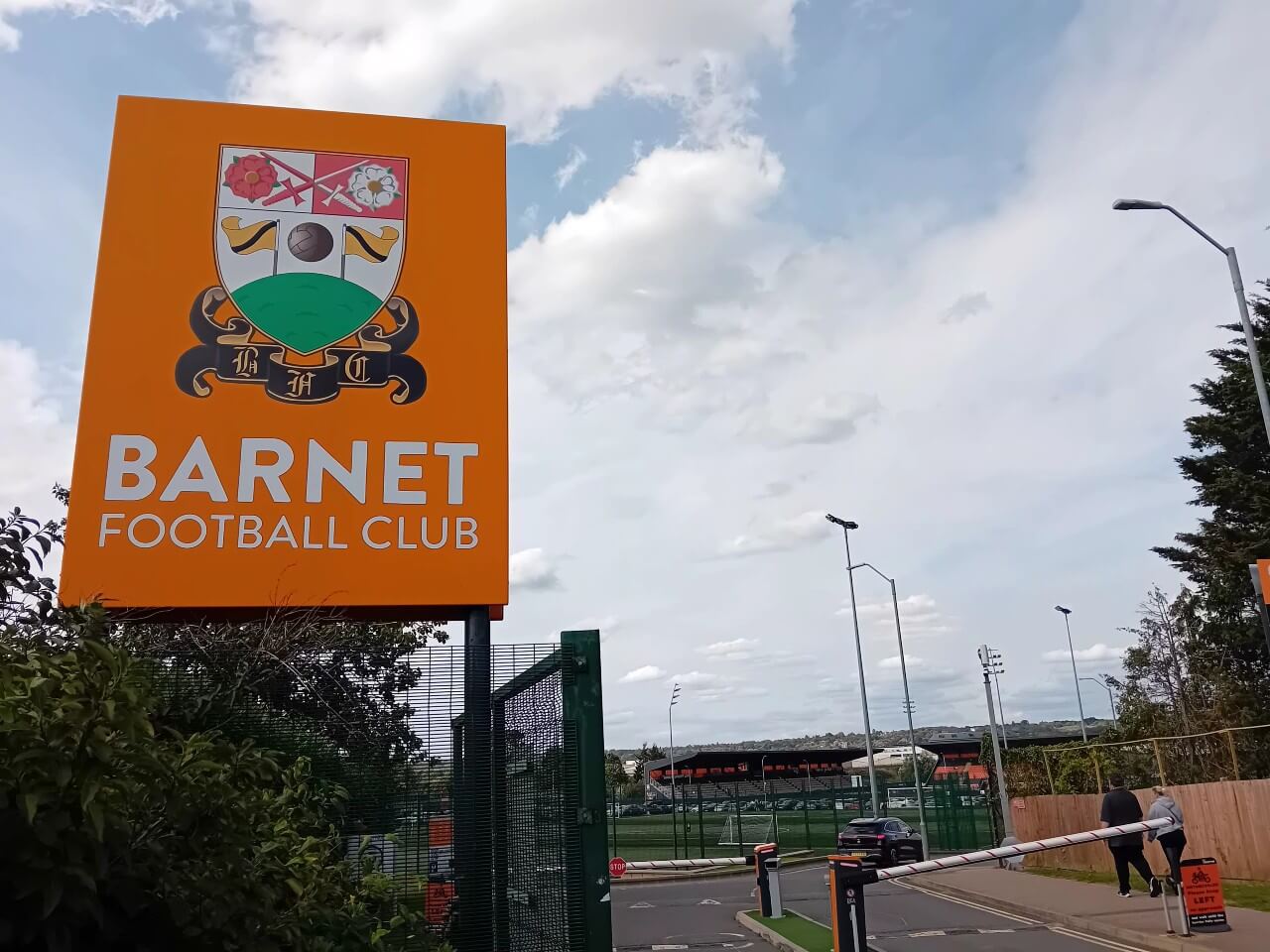
The author got back on the road again. This stop: The Hive (Richard Sutcliffe/The Athletic)
Ten days earlier, I’d visited Everton’s impressive new £750million ($1bn) home on the Merseyside waterfront — and the contrast between the two couldn’t have been greater. That, though, is the beauty of ground-hopping in the top four divisions.
This has always been the case, with early members of the Ninety-Two Club — founded in 1978 by Bristol Rovers supporter Gordon Pearce to bring together those with a similar passion — potentially able to savour Maine Road or Highbury one week and then either Feethams or Bootham Crescent the next. All four grounds are long gone, sacrificed amid the building boom sparked by the Hillsborough disaster that would eventually see 28 Premier League/Football League clubs move home in the two decades to 2013.
As if to further underline the size of the task facing those determined to keep the ‘92′ up to date, neither Darlington nor York City’s current homes count due to both clubs having dropped out of the EFL years ago.
Again, this churn is nothing new, with even the 39 founding members who answered Pearce’s initial appeal losing one ground immediately in 1978, when Southport failed in their attempts to be re-elected to the old Fourth Division (direct promotion and relegation for that tier only started in 1986-87).
Haig Avenue’s replacement was Wigan Athletic’s Springfield Park, itself replaced on the roster when the Lancashire club moved to what is now the Brick Community Stadium in 1999. No wonder some long-standing Ninety-Two Club members have 160 or even 170 League grounds to their name.
My own tally stood at 138 as this season kicked off. Preston North End’s Deepdale had started the ball rolling in the late 1970s, followed not long afterwards by a trip to Anfield to watch my first football hero, Kenny Dalglish, score twice as Liverpool beat Wolverhampton Wanderers 3-0.
But it wasn’t until reading The Football Grounds of England and Wales by Simon Inglis a few years later that I first learned about this elite group of fans who had attended a first-team match at every ground in what was then the Football League. Suddenly, my 10-year-old self had a goal: I had to join the Ninety-Two Club. Imagine the joy then when it was ‘mission finally accomplished’ in 2022.
That feeling at Cheltenham is unlikely to ever be matched. Nevertheless, here I am, on a rare weekend off, almost 200 miles from home and about to watch two teams sitting 15th and 23rd in the fourth tier of English football do battle. (Oh, and I’ve actually watched Barnet play at The Hive before but we’ll come to that.) Welcome to the world of the football ground obsessive.
Let’s dispel a few myths early on. I don’t own an anorak. Nor do I scribble train numbers down in a notebook when criss-crossing the country or even collect matchday programmes. But I do love visiting a football ground. Even on holiday, when there isn’t a game on.
During the summer, I spent a few days in Vilnius, Lithuania. It’s a lovely city with so much to do, and yet a couple of hours one afternoon were spent searching for the capital’s main stadium. Once there, I couldn’t resist sneaking through a gate wedged partially open and taking a few photos of the LFF Stadium, home to FK Zalgiris.
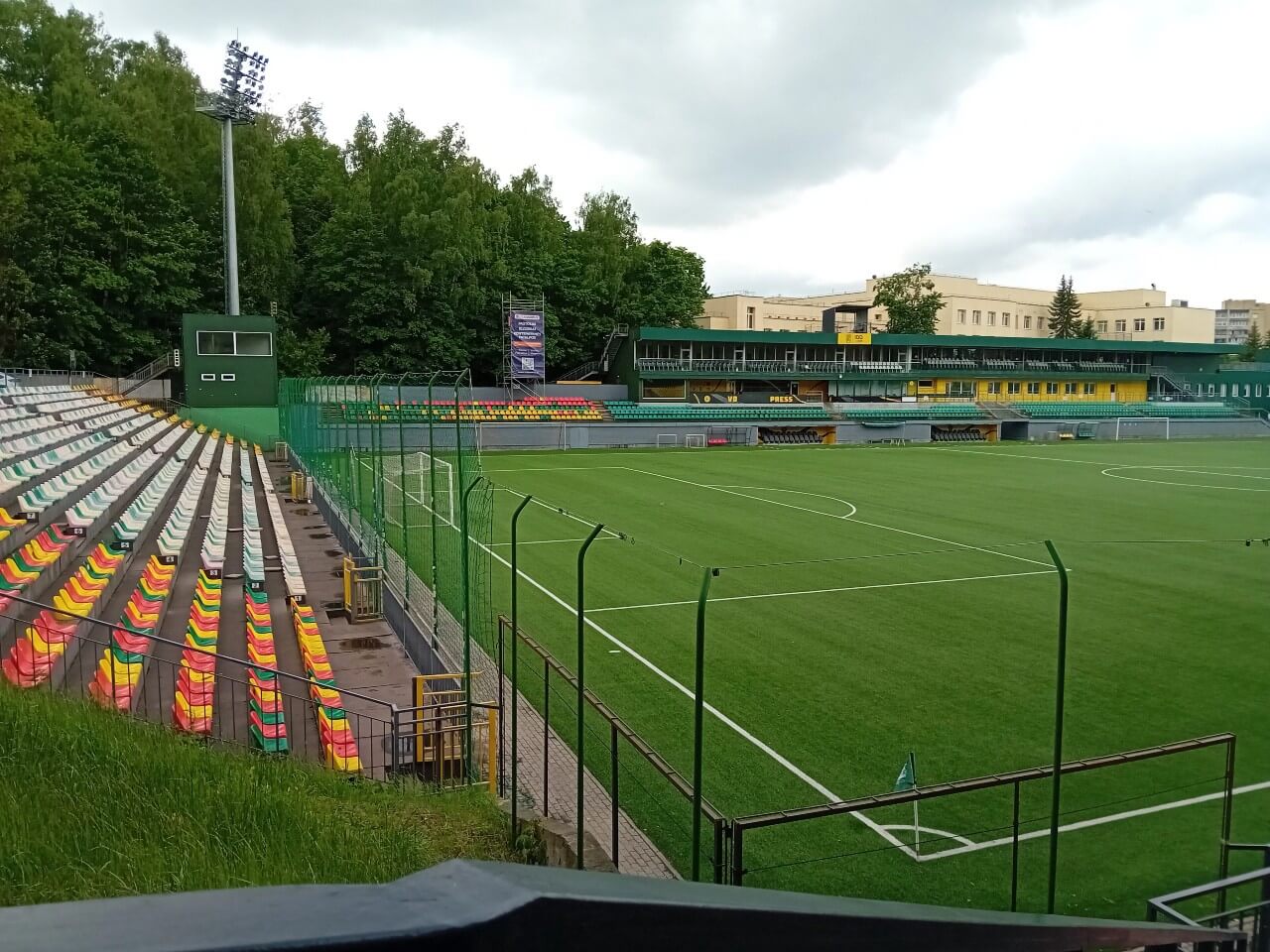
A trip to Lithuania isn’t complete without a stadium visit (Richard Sutcliffe/The Athletic)
I’d done similar during a week spent in Germany during Euro 2024.
A particular highlight — or low point, you choose — coming when, on discovering the gates to Lokomotive Leipzig’s Bruno-Plache-Stadion were locked, I found a small vantage point to peer in behind one goal that could only be reached by balancing on one leg over a water trough.

Flexibility and dexterity were needed to capture this image of Bruno-Plache-Stadion (Richard Sutcliffe/The Athletic)
Thankfully, there was no need for such acrobatics to catch a first glimpse of the Premier League’s newest venue. But an element of planning had been required, considering how Everton’s Hill Dickinson Stadium is likely to be sold out all season long.
Ninety-Two Club members faced a similar problem when Brentford moved into the Gtech Community Stadium in 2022. With only Bournemouth having a smaller capacity in the top flight, tickets were always likely to be scarce, even for fans of the visiting clubs.
A possible solution came via the cups, and particularly the early rounds of the Carabao Cup, where attendances are invariably lower. Sure enough, Brentford drew Gillingham and the slightly below-capacity crowd in November 2022 was boosted by the people there to tick off the stadium.
Everton hosting Mansfield Town in last month’s second round was an opportunity I couldn’t pass up to visit what is a welcome addition to the 92 in not only design but also location. Liverpool’s growth and prosperity were built on the success of its docks. To have the city’s oldest football club lead the regeneration of an area blighted by the decline of those same docks feels right.
Dan Meis, the American architect behind Everton’s new home, deserves huge credit for creating a venue where fans feel so close to the action. This is particularly the case at the South Stand, where the rake is set at 34.99 degrees — the legal limit is 35 degrees.

Everton’s new stadium is at the forefront of architectural design (Richard Sutcliffe/The Athletic)
Judging by the sticker ‘Make Everton Great Again’ on a wall opposite the new stadium, Evertonians hope the move can be as transformational for their club as it is likely to be the end of the waterfront. Even so, I’ll miss Goodison Park.
Unashamedly old-school, the passion and noise generated from within helped keep Everton in the Premier League when perhaps performances warranted otherwise. As other great old football theatres such as Roker Park and Upton Park were reduced to dust, Goodison stood firm as a link to more innocent, if less lucrative, times for top-flight football.
Sadness over Everton’s departure last May was at least tempered by confirmation that Goodison’s future lay as a home for the women’s team, echoing what often happens in Germany, a country that seems to value football heritage.
Here, old grounds usually disappear quickly under a housing estate or supermarket with barely a nod to the past. Barnet fans know all about that. Their club’s old Underhill home, where the pitch famously sloped 11 feet from one end to the other, is now occupied by a secondary school, Ark Pioneer Academy.
The narrow pathway that once led to the East Terrace is still there. But instead of the faded black corrugated iron that used to welcome both home and away supporters, there’s now a fence to keep pupils in and the public out. Also absent is any indication that Barnet played here for 106 years, including two spells as a League club.
Barnet want to return — not to the original site but to a 7,000-capacity stadium on part of the adjoining playing fields. The move, though, was blocked in July by the local council due to the land sitting on green belt land, where building is restricted. The fight will continue.
For now, anyone wanting to watch the club with a record four promotions to the EFL, the most recent coming in May, must head not to the borough of Barnet but neighbouring Harrow.
I knew this before Saturday’s visit to re-complete the 92 because I’d been there before. A little over two years ago, in fact, to watch Wrexham draw 0-0 on a warm afternoon not too dissimilar to this return visit.
The problem with that goalless stalemate is that it came in the National League, and the fifth tier doesn’t count under Ninety-Two Club rules. I’d discovered this much when Bromley, another club I’d visited in non-League, won promotion to the EFL last year.

The Hive is located in the London Borough of Harrow (Richard Sutcliffe/The Athletic)
“Any recognised competition normally entered by English Football League or Premier League clubs at first-team level may be included,” read the relevant section of the Ninety-Two Club’s 10 qualifying commandments, which is how I ended up attending Bromley’s maiden EFL win over AFC Wimbledon in August 2024.
Now, I’ve heard all the arguments. If you’ve watched a match at a ground, surely it counts towards the 92 regardless of competition. Or, how friendlies — another no-no, under Ninety-Two Club rules — should also count.
Some mates go the other way, insisting only those grounds visited supporting your own team should count. Leaving aside how only maybe Luton Town fans would have a chance of qualifying thanks to their team’s meteoric rise and subsequent fall in recent years, I simply reply, “Them’s the Club rules.”
The Hive has changed little since my visit in April 2023, other than the addition of some EFL branding. The London Underground trains, for instance, continue to trundle along the Jubilee line that runs behind the stand housing the majority of the home fans, while one end remains nothing more than a grass banking.
It’s a pleasant setting and the 3,009 crowd is treated to an entertaining contest, mainly thanks to some slapstick defending by both teams. Shrewsbury deservedly triumph 3-1, meaning their noisy band of 490 fans head home happy.

London Underground’s Jubilee line runs close behind The Hive (Richard Sutcliffe/The Athletic)
I do the same. Members of the Ninety-Two Club — there are around 1,400 in total, including 500 or so who remain active in maintaining the 92 — have two years to tick off any new grounds. But, having previously taken almost four decades chasing this footballing Holy Grail, a month into the new season felt plenty long enough to re-complete the set.
Just as Cheltenham or Bromley wasn’t the end, neither is Barnet. Manchester United, Newcastle United and Luton may all be on the move in the future, while just last month Oxford United received planning approval for a new 16,000-capacity stadium. Further hurdles lie ahead for Oxford’s application — including a review from the secretary of state due to the plans being on green belt land — but if they get the go-ahead, this will be their third home I’ll have ticked off after earlier visits to the rickety Manor Ground and the unloved, three-sided Kassam Stadium.
Not quite on a par with the six different venues where I’ve seen the two incarnations of Wimbledon and their shunned offspring MK Dons play. But still, an illustration of the shifting sands that can mean there are plenty more miles to go yet for the Ninety-Two Club.
If you want to read more about Richard’s Ninety-Two Club adventures, here’s part one, part two (Oxford/Wimbledon), part three (Brentford/Forest Green/Crawley Town), part four (Salford City/Sutton United), part five (Cheltenham Town) and part six (Bromley).
(Top image: Sam Richardson for The Athletic)