


Lions WR Jameson Williams shares how he reacted to his new contract
Lions WR Jameson Williams said he hasn’t yet gotten the opportunity to celebrate his new contract extension.
On the second play from scrimmage during the Detroit Lions game against the Green Bay Packers at Lambeau Field on Sunday, Sept. 7, Packers quarterback Jordan Love found receiver Romeo Doubs for a 20-yard completion, the first of many big plays for Green Bay in their 27-13 win over the Lions.
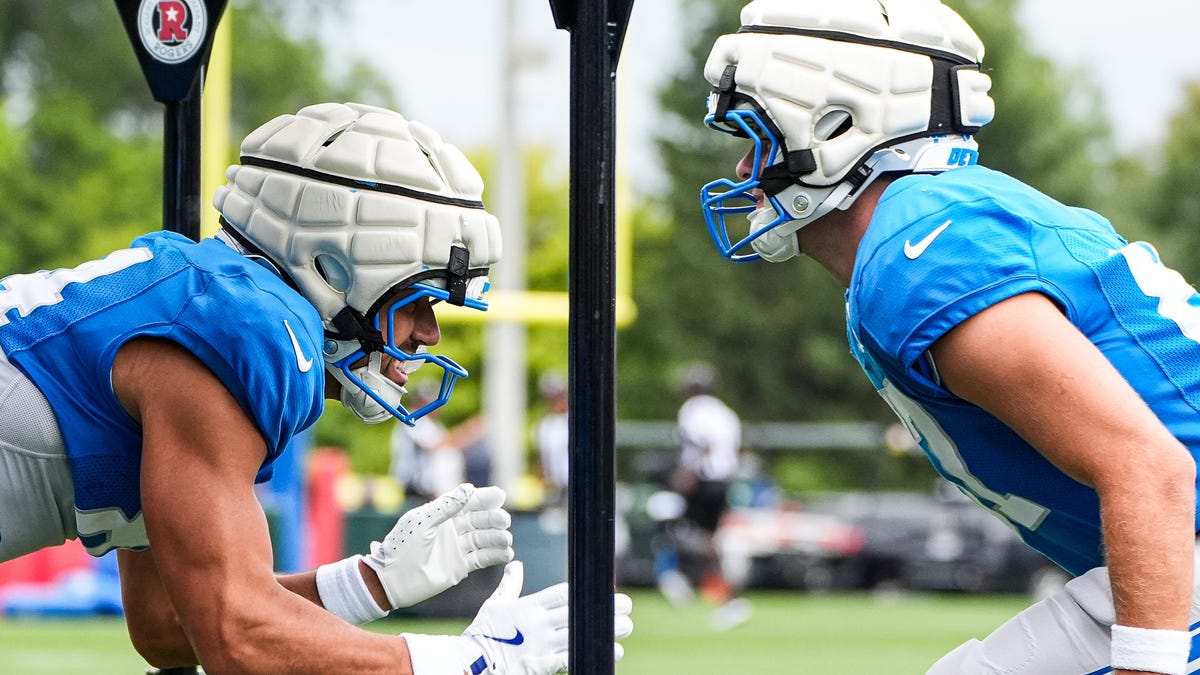
The throw itself wasn’t particularly noteworthy, but the receiver was, with Doubs being the only player on the field wearing a Guardian Cap.
This wasn’t Doubs’s first game wearing the protective head cover, as he has been wearing one in-game since his team’s win over the Seattle Seahawks on Dec. 15, 2024, three weeks after he suffered a concussion in a game against the San Francisco 49ers.
He’s also not the only player to wear one during a game, as a few players started doing so once the league made it an option ahead of the 2024 season. But most players, including every Lions’ regular so far in 2025, have chosen not to wear it during games.
In fact, only two Lions players were even seen wearing Guardian Caps during practice on Thursday, Sept. 11 (outside of the training-camp window the NFL mandates Guardian Caps to be worn): offensive linemen Michael Niese and Mason Miller, who are both on the practice squad.
“I wear it in practice basically to reduce the amount of impact I get in a week,” Niese said after practice on Thursday. “I think, honestly, a lot of people don’t wear it during games because it looks ridiculous. But it can be helpful, so I wear it.”
Guardian Caps, already a training-camp staple, are slowly becoming more visible on practice fields and in stadiums during the regular season. But could NFL fans start seeing them on more than just the occasional player on Sundays?
How the Guardian Cap was invented
Whatever the reason for the slow adoption, Erin and Lee Hanson hope players start wearing them more often.
The married couple runs a chemical manufacturing company called The Hanson Group, which around 2010 started to work on ways to prevent brain injuries in football. That’s when interest surrounding preventing concussions in football started to grow, but Erin Hanson said the family had a bigger reason to work on a safer helmet alternative.
“Our son wanted to play football,” she said in an interview with the Free Press. “And we were like: ‘You know what? It’s not okay. Someone’s going to have to do something, and it looks like that someone’s going to have to be us.’”
Lee Hanson, a chemical engineer, came up with the idea for a loose, soft-shell helmet covering that would eventually become the Guardian Cap and applied for the patent in 2011. The company’s first big sale went to the University of South Carolina’s football program in 2012, and the patent for the cap got cleared in 2014.
NFL teams started purchasing the caps for the 2020 season, and in 2023 the league mandated their use during training camp for most players. Starting in the 2024 season, the NFL allowed its players to wear them in-game, albeit with a second covering over the cap that displays a team logo.
Football fans can now see Guardian Caps everywhere, from NFL practice fields to college programs to high school games all across the United States. Their widespread adoption is a big reason why the Hansons were named the 2025 Inventors of the Year by the Intellectual Property Owners Education Foundation.
Here’s how they work: Because the Guardian Cap is a loose covering and not a fixed pad, it is designed to redirect the force of a head-on collision, especially if the collision comes helmet-to-helmet with another Guardian Cap.
“Nobody’s ever thought about redirecting the forces around the outside of the helmet. Everybody’s always looked at, ‘hey, what do we do with the padding on the inside of the helmet?’” said Lee Hanson.
So, are they effective in reducing concussions?
The results aren’t very clear at the moment.
The science behind the Guardian Cap
The NFL’s chief medical officer Dr. Allen Sills claimed in 2023 that position groups on NFL teams who wore Guardian Caps saw a 52% reduction in concussions compared to those which didn’t in previous years. Guardian Sports also cites a 2024 Virginia Tech study that claims the Guardian Cap can reduce concussion risk in football players by as much as 34% on average.
However, a 2025 University of Wisconsin study measured concussions in high school players across Wisconsin and found no significant decrease in concussions between players who wore Guardian Caps during practice and those who didn’t.
According to Dr. Chandramouli Krishnan, a University of Michigan Professor of Physical Medicine & Rehabilitation and director of the U-M Neuromuscular & Rehabilitation Robotics Laboratory (NeuRRo Lab), one reason why the results are so mixed is because the studies use lab research and retrospective data. He says these are useful but not ideal ways to measure how well Guardian Caps work on the field.
“Getting all the controls that we need is not easy, but without those it’s very hard to say how effective they are in reducing concussion risk,” he said.
Krishnan would rather see a randomized control trial to measure the effectiveness of the caps, but that there are ethical dilemmas, like choosing which subjects wear Guardian Caps and which don’t, that make running a randomized control trial like this very difficult.
Going off the data that is currently available, Krishnan says that Guardian Caps may have a measurable effect on lower-velocity impacts like head-to-knee or head-to-ground collisions, but might have little impact on higher-velocity impacts like head-to-head collisions.
And since there are a lot of head-to-head collisions in football, that might make the biggest impacts difficult to mitigate.
Trying to make football safer
Lee Hanson says that the company’s goal is to protect as many athletes as it can. But with head-to-head collisions such an inherent part of football, the Guardian Cap has not shown to be 100% effective at preventing serious brain injuries.
Guardian Sports’ website acknowledges the cap’s limitations, saying: “No helmet, practice apparatus, or helmet pad can prevent or eliminate the risk of concussions or other serious head injuries while playing sports.”
Erin Hanson says that as part of the company’s mission, Guardian Sports doesn’t market its product to youth football players, saying she would rather young players start out in flag football to learn the game before taking hits.
“I’d rather they wait a little longer to play. If they’re going to play, I’d rather them wear a Guardian Cap,” she said.
Though Krishnan is still open to the idea that products like the Guardian Cap can eventually be shown to significantly reduce concussion risk, he has a slightly different opinion about how safe football can be.
“Truthfully, the human body is not made to play that game,” he said.
You can reach Christian at cromo@freepress.com.